
One of the most rewarding parts of this month for me has been our team Bible study. The seven of us men have been studying the book of Romans this month, chapter by chapter. One chapter, a few days ago, Romans 7, prompted a particularly lively discussion, as Paul described the all-out war that was being waged inside of his (and our) body.
This was one of those parts of the Bible that made us feel as if the Bible was reading us more than we were reading it. “I know exactly what he’s talking about, and it pisses me off,” more than a few of us commented—in more colorful wording—“It’s agonizing.” "For I do not do the good that I want to do, but I practice the evil that I do not want to do,” Paul comments in Romans 7:19. After we get saved, we are engaged in—willingly or not—a very real war between our flesh and our minds. We want to do good, but all too often, we do not and at least feel as if we cannot.
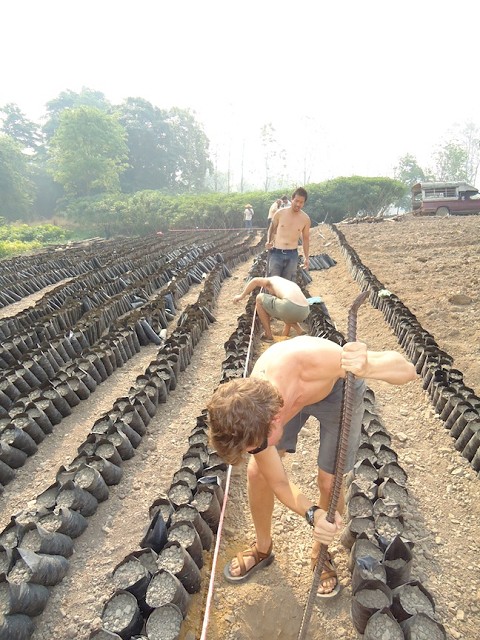
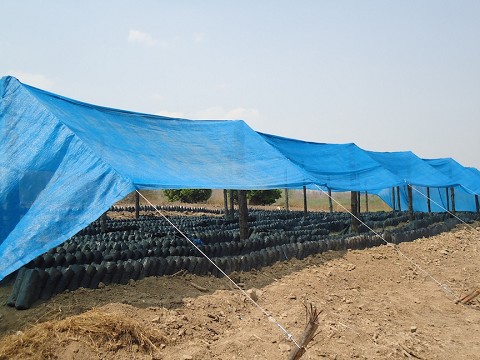
It doesn’t take any more than a cursory review of my day’s events to find this to be true. Because ministry has continued to consist entirely of manual labor for YWAM Thailand this month, there hasn’t been too much of an external spiritual battle to realize or engage in—no lies or half-truths to be combatted, no sick or lame to be prayed for, and with very few actual neighbors, not even much of a Gospel to be preached. The war is far from dormant, however, as God, in his relentless pursuit of my growth and dogged determination to see me hammered and chiseled into a vessel that will lovingly display his glory on this temporary earth, has used this lack of an external spiritual battle to turn my thoughts to the battle that is being waged within me.

My salvation was a free gift (Ephesians 2:8-9), but my sanctification is a battle—a battle between pride and humility, lust and purity, love and hate, faith and doubt. Overall, the battle is indeed tiring. It’s no wonder that the very next chapter of Romans, Romans 8, expresses this sense of fatigue—a fatigue that yearns for what is next:
"For I consider that the sufferings of this present time are not worth comparing with the glory that is going to be revealed to us. For creation eagerly waits with anticipation for God's sons to be revealed…For we know that the whole creation has been groaning together with labor pains until now. But not only that, but we ourselves who have the spirit as firstfruits—we also groan within ourselves, eagerly waiting for adoption, the redemption of our bodies.(Romans 8:18-19; 22-23).
I certainly wait for the time when this battle will be no more. This, too, was the sentiment of my team. There is, however, another side of the story. In some small, maybe strange, temporary sort of way, I like the battle. The battle is what keeps me fresh. The battle is fuel—pure diesel—for my soul.
There were times in the Old Testament (think about the conquest of Canaan in Joshua or David’s battles in 2 Samuel) when God used the Israelites as human instruments to carry out divine justice (Deuteronomy 9:4) when it was needed. Even then, those wars were responses to less than ideal situations—blatant idolatry, usually. That season is now over, however, and because, temporarily, “(God) causes His sun to rise on evil and good, and sends rain on the righteous and unrighteous”(Matthew 5:45), and because judgment is now reserved for God alone, after death, we now say that “The peacemakers are blessed” (Mathew 5:9)—rather than the earthly warriors.
I think it would be a mistake, however, to confuse the idea of war or—and I define war, here, as an intense fight against an enemy, with some sort of stakes—with violent, earthly war. God purposefully gives us the ability to make war, in the internal spiritual realms, so that we may glorify his name in the way we triumph over sin by counting as worthless (Philippians 3:8) the things of this world and choosing to find our pleasure in God (Psalm 37:4). In this sense, war (as I defined it above, again to avoid confusion) is not all that different from the many other things that God created as good, but that our sinfulness and the brokenness of this world have turned bad. Sex is good, but we’ve turned it into rape and adultery. Wine is good, but we’ve turned it into drunkenness. Food is good, but we’ve turned it into gluttony. War is good, but we’ve turned it into the ending of human lives.
I think that we see these truths ring loud and clear in our day-to-day lives. Despite the absolute horrors of earthly war, we still have no problem reading newspaper headlines such as, “Eagles Beat Giants in a War in the Meadowlands”. Nobody would call that headline distasteful, simply because they understand war, in that sense, to mean something different than earthly war. You will never see, however, the headline: “Eagles Rape Giants in the Meadowlands”, simply because that new world cannot be used for quite a wide array of meanings without being incredibly offensive. It has already been obscured by sin.
All disclaimers now aside, I can say that I truly believe we—or, at the very least, I—will go stale without a battle to fight. I think back to all of my long high school summers of cross-country training. There was always the understanding that the two-a-day runs were not in vain. Yes, we were sharpening our cardiovascular weapons, so to speak, but there was always the understanding that they were being sharpened so that they may be used in the fall—in battle. When the first autumn leaf fell from the summer tree, it was time for the runners to throw down. Summer training without autumn racing would be—well, pointless.
Why do we have high school and college “argumentation and debate” classes? For all practical purposes, “debates” are much less fruitful than discussions, and the average person (myself included) tries to avoid arguments at all costs! We were made to spar, though! Again, it is only because of our sinful nature that this sparring results in pride or shame.
Why do we play organized sports? I believe it is for reasons over and above character building alone. Even if we are less competitive in the “traditional sense”, I would argue that there is still a drive—perhaps dormant or latent in some of us—to overcome. I have often been most motivated to do something when people tell me that I cannot do it. This isn’t shocking to us, simply because many of us feel the same way, but at a logical level, isn’t it a bit counter-intuitive?
At the simplest level, I would even ask you why we do Sudoku puzzles! I have never once seen a person flip to the back of a Sudoku book (where the answers can found), and proceed to fill in all of the blank squares with the answers in hand. In one send, isn’t that the point—to fill in all of the blank squares, in the fastest time possible? In another sense, however, it’s not. People do Sudoku to challenge their mental capacities—to keep their brains from going stale. In fact, things like Sudoku and Crossword puzzles are recommend by doctors as ways of keeping the brain fresh in old age. Simply completing the puzzle, however, isn’t what keeps the brain fresh—and it certainly isn’t what provides the satisfaction!
In some funny way, however, life is very similar. Merely completing life isn’t satisfying. Completing life doesn’t keep the heart, soul, and brain from going stale.
If the blog ended here, it would be ridiculous. What am I suggesting we do? Join an organized sport to combat staleness? Market crossword puzzle-books? Pen a written pep-rally for the over-competitive? Not at all. There is a final, important, qualification to be added.
To me, it seems as if the battle is rewarding to the degree that it actually matters. And the battle combats staleness to the degree that the battle actually matters. In that sense, the “battle against illiteracy” will be much more rewarding, in the long run, than the battle we fight in Call of Duty or World of Warcraft. The “war on poverty” will be much more rewarding than the “war for the division title”. If the battle is only partially relevant, it will only be partially rewarding—at least in the long run, as winning the state title may feel like conquering the world at first, but will eventually become no more than a faded memory and a dusty trophy. A battle need not have name recognition—think illiteracy, poverty, or AIDS—for it to have significance. Raising a child with special needs—with unconditional, Christ-like love, is very much a relevant, and thus rewarding battle.
This is the part of the blog, though, where I want to sell out so badly. I want to proofread this thing, sprinkle in some pictures of cute kids, post it on Facebook (at a good time—to get the most views, of course!), and lather in the mostly positive feedback via blog comments. My flesh wants the gap between the secular world and the Kingdom of God to be minimal. Oh, that I could write about a topic—any topic—in such a way that would make it applicable to the Christ-follower and the secular world alike! That would surely win me a few Facebook friends, some “likes”, and a whole bunch of consensus. Ironically, though, to do that would be at the deepest level, to retreat from the battle—to give up my long-term reward and sell my soul into the slavery of staleness.
As a Christian writer, I feel that my job is to use the written word to combat worldly lies with Godly truth. It is a lie that the spiritual battle we fight, both externally and internally, is interchangeable with secular battles—one of many battles to choose from, all of them equally relevant. Secular battles can, of course, be valid means of fighting our spiritual battles, in that they often exhibit the Corinthians 13-type of love we are called to show to the world, for the ultimate glory of God’s name—if that is our aim. Sadly, though—or luckily, depending on how we look at it—when seen from a heavenly perspective, the only battle that holds any real relevance is the battle for the glory of the creator God verses the hijacked glory of his creation.
Fighting illiteracy for illiteracy’s sake alone is worthless. There will be no reading in hell and no need to read in heaven. Battling AIDS for health’s sake alone is also worthless—completely worthless. Our bodies will rot in hell or be eternally healthy and without blemish in heaven (1 Corinthians 15:40-49).
So, what seemed to be a tiring battle in Romans 7 preserves me in the end. It is precisely this spiritual battle alone—both internal and external—that fulfills me and keeps my soul from going stale—lukewarm (Revelation 3)—in this life, and it is precisely this battle alone that is creating the “labor pains” which will eventually give birth to an “incomparable weight of glory” (2 Corinthians 4:17) in the next.
“Fight the good fight for the faith.” (1 Timothy 6:12).







