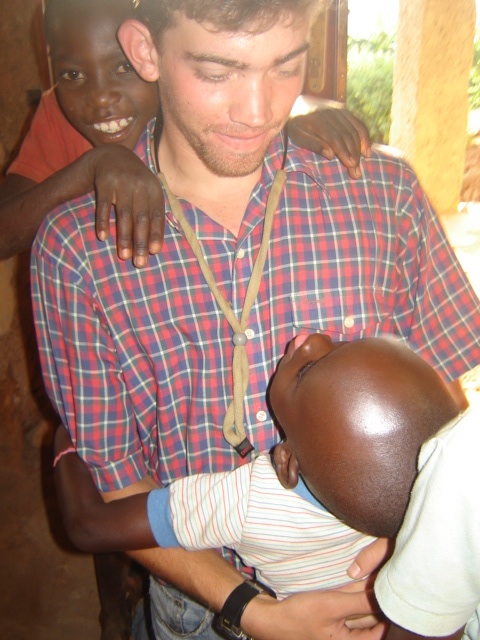
This afternoon, God really glorified his name. I know that I just blogged recently, but seeing as Internet is rare in Rwanda and God is good in Rwanda, I figured an update would be in order. I will not have Internet access until after Christmas, so I want to wish a Merry Christmas to all my supporters and followers!
As a missionary, I often find myself in an awkward place between two cultures—home and overseas—where I don’t really fit into one or the other. I am never in a place long enough to be considered a local (this take years) and, as much as I’d like to let myself believe that life stops in Moorestown, New Jersey and Tuscaloosa, Alabama when Ben Friedman leaves, I know that this is not the case as life hums on with methodical indifference to my presence or lack thereof. All of this goes to say that your e-mails, blog comments, and Facebook messages are much more than passing encouragements—they are my largest source of emotional fuel.
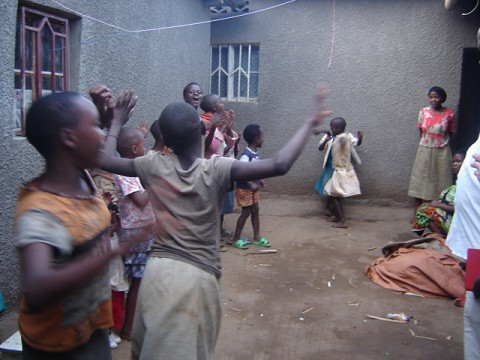
But, in keeping with the theme of my last blog (Honey, I Shrunk The Ben!)—more of God and less of me. These past few days, our team has been doing rural evangelism. Evangelism is probably the activity—or even the word—that turns non-Christians off the most to Christianity. It even turns some Christians off as well. There is nothing undesirable about building wells or distributing food to orphans, but the word evangelism often leaves a sour taste in our mouths. It’s a completely loaded word—understandably so—and almost impossible to ponder without letting imagery swallow up objectivity.
The word evangelism brings to mind images of bothersome Jehovah’s Witnesses and angry street preachers, helplessly unaware of their audience’s reactions, preaching eternal damnation as if it was the sole motive for which we should accept Christ. Self-righteous “Christians” who refuse to submit to the Holy Spirit—the same spirit that would undoubtedly convict them of their delivery—have played a large part in giving the word evangelism a negative connotation.
If we can look past the word’s connotation, however, and treat the word with the same objectivity with which its detractors typically champion, I legitimately believe that we would find it less sour than our emotionally-driven minds make it out to be. I would argue that when we evangelize—preach the Gospel—what bothers people most is not the act of preaching the Gospel itself—as many opponents of evangelism would claim—but the message of the Gospel. For example, if my team were to go from house to house in rural Rwanda and tell people nothing more than “You are beautiful and we thank you for welcoming us into your country”, I’m not so sure that that would bother those who typically disagree with the act of evangelism. Deep down, though, it must be something about the message, rather than the act, which bothers people.
Anyone who legitimately believes that Christ has risen and that heaven and hell are on the line will be driven to evangelize. The degree to which one feels the call to evangelize is directly proportional to the degree to which he or she believes in the glories of heaven and the horrors of hell. There is no exception. Though I generally try to avoid making sweeping “there-is-no-exception-esque” statements in fear of ruining my witness by casting myself as an intolerant and narrow-minded, I will risk my own reputation by breaking my own rule-of-thumb and declaring that, as much as I search my brain, I really can see no exceptions. Saved and sanctified Christians who are submissive to the word of God and filled with the spirit of God evangelize. We could talk for days about the most effective methods—and I’d agree with you that the methods we often use are flawed and ineffective in many ways—but the principle remains the same: Evangelism is central to the Christian life.

The Bible says that Satan appears as an angel of light (2 Corinthians 11:14). More often than not, he does not tempt us with that which is overtly sinful—the X-rated movie or the white-collar crime—but with that which is morally neutral (if there is such a thing), yet dampens our affections for God and delays the mission of God. Because Satan knows that one day—without fail—he will be thrown into the lake of fire, following the second coming of Christ, it follows that because victory is impossible, his entire vocation is delay.
We are in a knockdown, drag-out war for souls and inescapable eternities are at stake. It is, of course, a war against spiritual powers, rather than against flesh and blood (Ephesians 6:12), but our realization of the realm in which this war takes place—and the word war, here, is not a metaphor—should only intensify the effort with which we fight. The obvious implications of Ephesians 6:12 are that we exchange our swords and spears for truth and love and that we don’t win the war by killing flesh, but by saving souls. I believe, however, that not only is this war not fought against flesh and blood, in the violent sense, but also that it is not fought using flesh and blood, in the peaceful sense.
Satan, appearing in his typical, angel of light form, has tried time and time again to convince me that saving souls would have to be done through the power of my own flesh and blood. Though in my mind, I know this is not true, the majority of my actions during evangelism—and actions expose what I truly believe—are centered around the well-intentioned, but false belief that my own flesh and blood can save souls.
My flesh tries to win debates and my flesh wants to move quickly from house to house, but none of these things save souls. Even for my ministry back home, my flesh wants to send encouraging Facebook messages and make emotional videos with soul-stirring background music, but again, this is, was, and never will be God’s appointed way to save souls. I am completely well intentioned, as I legitimately do want to see people come to know Jesus Christ, but good intentions are no substitute for the supernatural saving grace of God.


This is where Satan has convinced me to show up to the wrong battlefield, and it is only by the grace of God that I even realized this. Satan says “amen” to my warrior spirit and “amen” to my intentions, only to direct me straight past the real battlefield, replace my real sword with a plastic one, pat me on the butt, and with the wink of an eye, watch me shadow-box. There is no better way to neutralize a warrior than have him fight with impotent weapons on the wrong battlefield.
The fine-sounding apologetics arguments of the tongue, the complicated Gospel “sales-pitches”, and even the writing of these very blogs, though well intentioned, are not the right weapons, and the realm of interpersonal relations is not the right battlefield. These are all good things, but the fruit these weapons bear over the battlefield of interpersonal relations is merely a manifestation of how the true battle in the true realm with the true weapons is faring.
The true battle that I speak of is being waged in the heavenlies. The true weapons are prayer and the overwhelming power of God and his Holy Spirit. Another human being and his or her logic are not what need to be blasted to smithereens. My own flesh that wants to deliver arguments in a triumphalist manner (as opposed to a humble one) is what needs to be blasted to smithereens. Doubt is not what needs to be removed. Doubt is a manifestation. The hard wax casing around people’s own hearts that clogs the channels of inborn Gospel-receptiveness, applied— almost undetected—drip by drip, over the course of many years, from the tip of Satan’s slanderous eye-dropper, is what needs to be removed.
With this new revelation in mind, and the determination—placed in us by God—my team was determined to “fight the good fight” (1 Timothy 6:12) during evangelism, on the right battlefield and with the right weapons. Before we left for evangelism these past few days, we gathered in our room to worship and pray. Before the Israelites would go into battle, they would send the worshippers out ahead of the army (Joshua). Thanksgiving and praise precede victory.

As a team, we openly confessed the weaknesses and inabilities of our own flesh. We admitted our own shocking lack of anguish over souls we knew were perishing and our own shocking lack of elation over souls we had recently seen saved. We prayed for supernatural boldness like the disciples in Acts 4:29. We asked God to go ahead of us and soften hearts to create receptiveness to our message. We begged him to arrange circumstances that were beyond our control and foreknowledge to work out perfectly so that we might reach the most people possible. Most importantly, we asked God to consider and act on behalf of his own Glory—to make his name great, through us.
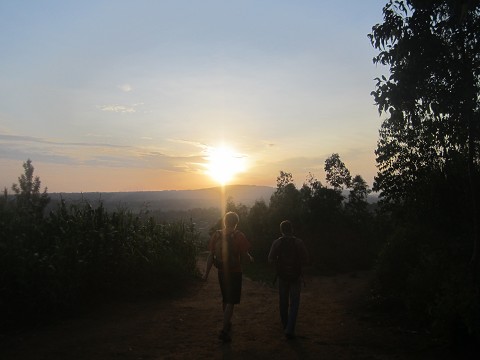
As we walked the hour-and-fifteen minute trek to our ministry site, up and down dirt hills, through cornfields, and finally under the canopy of banana trees, God gave me an intimate awareness of purpose. All the hours spent writing support-letters, riding trains, filling my mind with Biblical knowledge, and praying was for this.
We followed our Pastor, Robert, around a bend and arrived to find a group of seven or eight men building a mud house. They stopped to talk to us as we offered them water and sat down with them. Within minutes, a crowd, twenty-strong (or more) had assembled around us and were intently listening to our message and asking their own questions as well. Two men were especially engaged, as they asked questions about the path of salvation, world religions, the historicity of Christ, the birth of Jesus, the difference between salvation in the Old Testament and The New Testament, how one should pray, and the specifics of heaven and hell.
A few of the men said that they attended a local church when we asked them—as I am realizing is always customary to say when a pastor is present—but by their questions and lack of knowledge of the Gospel, it seemed that few, if any, of them actually did.
We taught them out of the Bible and used personal examples and analogies. People came and left throughout, but a core group of eager listeners remained throughout the entire hour-plus time we were there. Though my focus was on a young man that I had laid out the gospel for, my eyes kept wandering to an elderly woman sitting in the back of the group. Throughout the entire time, she never spoke a word, nor did she seem to know the rest of the men (as she came alone), but it was clear that she was pondering deeply the message that was before her.
When I asked, fairly early in the conversation, who wanted to receive Jesus Christ as Lord and Savior, nobody came forward. I had the feeling, however, that the day wasn’t over because they had seemed to almost disregard my salvation invitation in favor of more questions, as if the conversation had never stopped. As Brandon and Stephanie spoke, I prayed, “God, glorify your name, glorify your name, glorify your name…”
Finally, when we had said all that there was to say, we stood up to pray for the people, as is our custom. Exhausted from teaching, somewhat discouraged at the lack of fruit, but still pleased that we “fought the good fight”, we noticed about ten people walk to the center of the grassy patch where we were sitting. We asked them for their prayer requests, but our Pastor told us that they did not have prayer requests, but were stepping forward to become Christians and accept Christ as their savior. My heart jumped as I scanned the group and saw young women, and some, though not all, of the men we had talked to standing among that group. However, what truly made my day was what came next. I noticed that that same old woman from earlier who hadn’t said a word the entire time had stepped forward and “approached the throne of grace with confidence” (Hebrews 4). Praise be to God that salvation knows no age limit.
We gave people directions to Pastor Robert’s church (which was less than a half-mile from the mud house) and some of them told us they would be there on Sunday. Soon starts the long process of discipling, but the rest of the day was filled with rejoicing.
As we walked home, I noticed that Talitha was talking to a separate man she had met just five minutes before. I hesitated to join the conversation, tired and feeling as if I had somehow “earned” the right to be anti-social, before Talitha stopped the group. As it turned out, the man wanted a Bible and somebody to teach him how he study it. I almost laughed. The salvation was enough—now God was just flexing his muscles!
I thank God that he glorified his name and allowed our team to bear fruit. Fruit is born when the battle is fought on the right battlefield! Let us lay down our plastic weapons and take hold of the weapons Satan doesn’t want us to use and let us leave the decoy battlefield for the true battlefield. Then, Jesus Christ will come again, beginning the chain of events that ushers in the final stage of redemptive history—that time of eternal spiritual peace, where there is no battle or battlefield to be found.