
As I looked out into the distance and set my eyes upon the Manila skyline a few nights ago, perched atop a high building in our ministry complex, forty minutes from center city yet still tucked soundly into the middle of the Filipino capital, a thought ran across my mind: I love the city. The thought was the definitive culmination of what had been an increasingly noticeable affinity for urban life—I legitimately feel called to the city.
My newfound love for the city—not Manila, but cities in general–represents more to me, however, than a personal taste or a desire brought about by the Holy Spirit, but represents instead a part of God’s surprising nature. I’ve written before about how a great mentor of mine, “Coach” Gary Cramer, once told me, “God will change your visions and your plans, but he will never do so without changing your desires beforehand.” This, for me, is another classic case of that principle manifesting itself in my life.
Before the race began, I had a strong love for rural areas—and I still do. There are not many things in life among the gifts of God that are able to stir my emotions like crisp pine trees, red dirt roads, and rushing rivers. Fresh air and star-studded skies will always occupy a corner of my heart and I doubt that this will ever change. Not only was it the case that I loved rural areas, however, but I hated cities. I couldn’t stand the sound of honking car horns and traffic and the raw number of people that are often crammed into small places in urban areas made me feel claustrophobic and stressed.
Early on in the race, I heard a sermon and read a few things online about the importance of ministry in the city—the sheer number of people that can be affected and the fact that cities are beacons of cultural influence, for example—and agreed wholeheartedly. I remember telling God that day that I would gladly spend my life doing ministry in a city—if and only if he did some serious changing of my desires first.
And God has done just that. It started when we spent just twenty-four hours in Dehli, India and grew throughout the race. Now, less than a year later, I can legitimately say that I love the city. I can’t pinpoint when my desires changed, but can only say It was like growing up—your appearance doesn’t seem to change from day to day, but when you look at yourself a year later, you look totally different. Now, I love everything about the city and its urban heartbeat—the rush of people, the mixed smells of competing street vendors, and even the graffiti that adorns the side of old buildings. There is always the presence of life in the city, and where there is the presence of life, there is the possibility of the presence of God. They say that New York is the “city that never sleeps”, but honestly, I don’t think any city ever sleeps.
Cities, as centers of humanity, naturally contain and display both the best and the worst of what the human race has to offer the world. A.W. Tozer says, wisely, “Why is (life) like that? Why is there light and shadows? Why is there ugliness and beauty? Why is there so much good and so much bad? Why are there pleasant things and things that are tragic and hard to live with? It is because the earth lies halfway between heaven’s beauty and hell’s ugliness.” Cities are in the front lines of the spiritual battleground that is this earth. Positioned so perfectly in between heaven and hell, Christian love and utter brokenness live as neighbors.

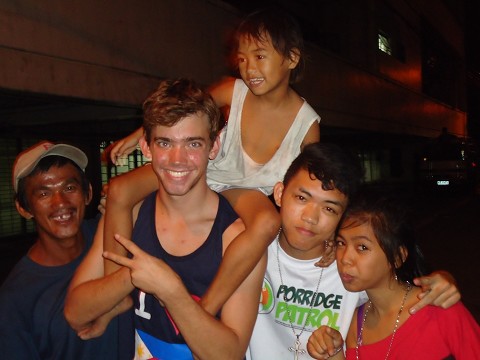
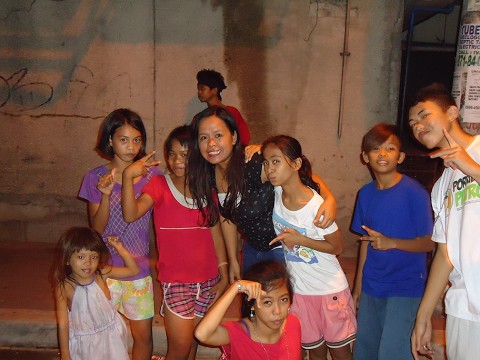
I got to see a clear picture of this last night. One of the ministries we’ve been working with this month, the Children’s Garden, is a home for former street children (all boys) and it has definitely been my favorite part of this month. Every Thursday night, the former street boys go out into the city and minister to current street children and last night, Logan and I had the opportunity of joining them.
We piled into the back of an old white truck and drove to what seemed to be a back alley near a parking lot and what seemed to be an abandoned building. As soon as we got out of the truck, little children flocked to us, asking to be held and played with. Almost all of them were barefoot, and they wore tattered clothes that reeked of urine and sweat. We played with them, prayed for them, and gave them food, water, and to some, new tee shirts. It was saddening to think that as we would go home to our comparatively comfortable ministry base to sleep in real beds, or at least mattresses, these children—due to no fault of their own—would settle their heads on concrete or cardboard, and fall asleep next to some closed shop or under a tin overhang.
Older boys huffed glue and practiced street dances, yet all of them were friendly and thirsted for love. They wanted to look at my tattoo (and feel it to see if it was fake or real), and I admired their earrings and basketball jerseys. They were thrust into adulthood prematurely, but were clearly still children at heart.
I’m sure the Children’s Garden home would have loved to have taken every one of the children in—and they already push the envelope with the way they love, serve, and risk, even beyond their means—but it simply wasn’t a possibility last night. There the beauty of Christ’s presence in the place, as a magnet for the weary and downtrodden (Matthew 11:28-30), met the harsh realities of the world, and the collision produced none other than a picture of everyday life in the fallen world.
On our way home, we dropped a family off at their old apartment—they had been evicted a week ago and had slept on the streets since—and a woman, Sharon, from Children’s Garden, put some money forward and asked the landlord to let the family back home. Luckily, God’s favor was in the place, and they were allowed back in. We snaked through tight, dark alleys, ducked clotheslines and avoided potholes to reach their small apartment. The smell of burning trash was ever present. Because they couldn’t afford electrify, they bought candles and led us up the plywood staircase to their home on the second story. “Welcome to the Philippines,” Sharon said, turning to Logan and I, after lighting her candle. Finally, after praying for them and seeing them off, they settled into bed—on ripped pieces of cardboard and a creaking plywood floor.
I myself went to sleep about an hour later, though sleep itself was hard to achieve. I lay in bed and thought about the night’s events and the heart of Manila. Despite the brokenness I saw, I am convinced that God is working in this city—and in cities around the world. I am ready to be used in a city somewhere, to experience the sometimes painstaking, sometimes beautiful juxtaposition of the best and worst that humanity has to offer, and to see God be present in all of it. I am ready to be a channel of urban grace.
There is a famous song whose lyrics say, “They paved paradise, and put up a parking lot,” and, in many ways, this is an accurate description of our fallen world. We’ve taken what was paradise—the Garden of Eden (Genesis 2)—and over thousands of years, turned it into a series of ugly parking lots. As a Christian however, I am not inclined to believe that this is where the story ends. I praise God that he, a redeemer by nature, is in the business of taking parking lots, and raising up paradise.







