
As this month nears its halfway point with startling speed, God has graciously given me exactly what I had been praying for—a focus. An all-consuming focus, or a rallying point, so to speak, was exactly what I needed to keep my head in this month and to soak up all of the beauty—sometimes hidden, sometimes overt—that Cambodia has to offer. This consuming focus has taught me two things—or, brought to light two things that I had been learning for a while, rather. Let me explain.
Every day I am swarmed by smiling children, sweat stained and unashamed of their innate joy, so wholly immersed in that precious state of life that all-too-often erodes as the “cares” of teenage and adult life fight tooth and nail to destroy it, or, at the very least, coax it into dormancy. Toothless grins and fingers too small to be human meet me in the morning and close out my evening. Despite the vibrancy these children unknowingly bring to my daily life, and despite the fact that these children give me an opportunity to practice and walk out the Biblical picture of “loving the little children”, these children are still not the focus God has given me. The focus God has given me for this month is on a class of late teenagers and early 20-year-olds called Knowing God.
Our contact, Vuthy (pronounced “woo-tee”), was a former tuk-tuk (the Southeast Asian version of a taxi) driver and a Buddhist until just four years ago. After he came to Christ in his mid 20’s, he moved out to this province, Kampot, and this village where there were literally no Christians at the time. Since his time here, he has seen both his family and thirty youth become Christians and get baptized. Because the first wave of new Christians is now growing into spiritual maturity, Vuthy’s goal is to see 150 children come to Christ in the next year. The principle agents of this mission will undoubtedly be the young adults in the Knowing God class.
With this in mind, it is such a great honor to me that Vuthy has entrusted me (and my squadmates, Kendall and Jess) to love, lead, and teach this great group of young Christians. This class does have a book, but at its core, it is essentially an open-ended class about how to live a fruitful and fulfilling Christian life.
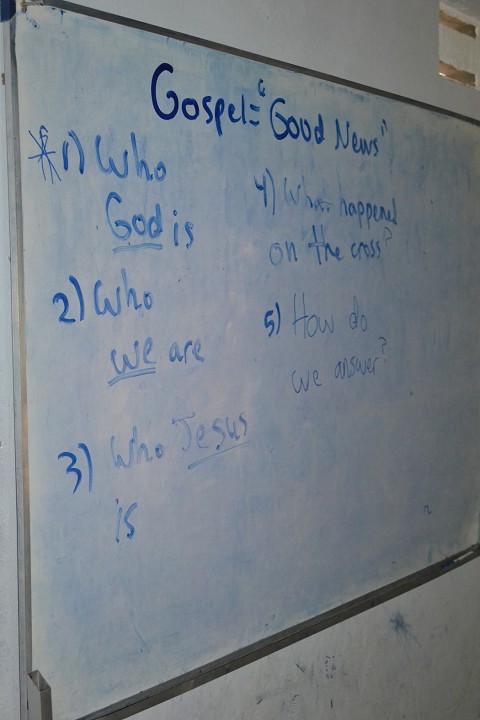
Kendall and I decided that instead of going through the book immediately (or at all), we would rather feed their senses of longing and relationship and teach them in such a way that presents them with a beautiful picture of God and his Gospel. The most effective way, we figured, for them to bear great fruit, would not be for them to remember a practical system of spiritual tips, but rather to present to them a picture of Jesus Christ high and lifted up, and then see the fruit flow out of their increasing sense of adoration.
So, for the last week, we have been teaching our hearts out about the Gospel in all its richness and all its depth and it has absolutely rocked me with joy. I am finding, however, that as much as it truly does give me joy to teach, and as much as I derive joy from the refreshing nature of what teaching Biblical truth does to me, I am finding that my greatest joy, in this exchange, is in them.
I could barely focus during dinner last night, following a Bible study of ours on Rahab (Joshua 2). The students asked amazing questions, underlined their Bibles left and right, opened us up in joyful worship, and closed us out in heartfelt prayer. My greatest joy this month is in their growth and their increasing spiritual maturity. This is perhaps the first time that scriptures like 2 Corinthians 1:14 made sense to me:
“…we are your reason for pride, as you are ours, in the day of our Lord Jesus.”
My pride and my joy are in their growth. The first thing that I learned is the fact that it truly is possible to find great joy in others’ growth and maturity. I’m sure if I was a parent, I would have learned this by now, but seeing as I’m not, this was a fairly new occurrence for me—at least on a non-superficial level. This was one of the many examples of scriptures—or even bits of spirit-directed wisdom in general, that only made sense to me through experience. That is the second thing that I’ve learned recently.
Don’t get me wrong—I believe strongly in the absolute authority of scripture—that it is not defined by, but rather defines the realm of personal experience. The most telling example I always use of this is Psalm 23:6: “Only goodness and faithful love will follow (those in a covenant relationship with God) all the days of our lives…” If we let personal experience define how we view scripture, we might say, after a few minor shake-ups, that perhaps mostly goodness and faithful love follow the Christian all the days of his or her life, or that goodness and faithful love will follow us some—not all—of the days of our lives. If we let scripture define our personal experience, however, we conclude that somehow and in some way, fully embracing our own limited wisdom and understanding (Isaiah 55:9), what seems like misfortune to us is actually a representation of God’s goodness and faithful love.
I simply mean to state that it is largely personal experience that makes scripture and spirit-led wisdom come alive. I hearken back to “training camp”, especially. For future World Racers: there are things that you will be taught and told at training camp that will only make sense to you in the context of having experienced many months on the World Race. Even some worship songs only make sense to me after I have had experiences that brought them to life.
The lyrics “you’re never giving up, you’re never giving up, you’re never giving up on me,” make sense to me, at the deepest levels, only now that I have experienced trial after trial and seen God’s faithfulness shine through. Before God gave me a context within which I could internalize that song, it represented little more to me than an over-emotionalized pump-up song. Or the Chris Tomlin lyrics, “I hear the sound of many angels sing, ‘Worthy is the Lamb’”, with all its Book-of-Revelation-laden imagery—make so much more sense to me after experiencing worship rising up from countless skin colors and languages around the globe. Or even the spirit-led advice I received a few years back from one of my friends and mentors, “Coach” Gary Cramer—namely, that “God will change your plans, but he won’t do so without changing your desires beforehand”—makes sense to me, only now that I have seen God, well, change both my plans and my desires.
The reason why this all excites me is because it means there is hope. Just because I haven’t yet experienced the full weight of a scripture or the full truthfulness of a piece of advice doesn’t mean that I the word I received was untrue or even exaggerated. I no longer have to pretend that verses like “As a deer pants for water, so my soul longs for you, God” (Psalm 42:1) apply to me fully and at the current moment. I don’t have to fake it! I can be free to admit that I want God really badly and I focus on him with a good bit of my time and energy, but that I am not quite at the level of a “deer panting for water” yet. And, lastly, I can admit this because I have confidence that “he who started a good work in me will carry it on to the day of completion” (Philippians 1:6), and will do so largely by providing a context of personal experience by which I can soak in, with true understanding, its value.







