
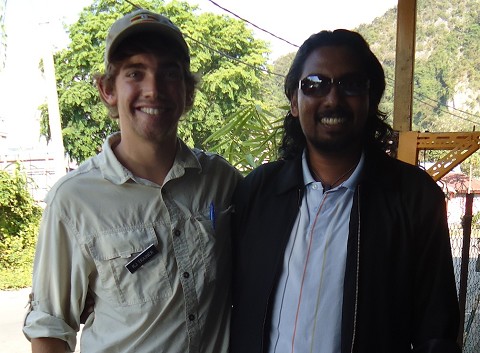
A few days ago, our team arrived in Gua Musang, Malaysia, a small town in the middle of Kelantan, Malaysia’s most fundamentally Islamic state. Since our arrival, I have found that we face two primary challenges: externally, the language and culture barrier, and internally, the deliberate building of intimacy within the new team.
Here, the Islamic government controls almost everything, and Christian influence is despised, to say the least. There is absolutely no direct sharing of the Gospel. Our team has been working with an ex-pastor, now “marketplace minister”, Pastor K. (I will call him that for the remainder of the month) at his English tutoring and character-building center. Our primary task is to teach English to children of all ages and to show them the love of Christ while doing so.

Sometimes, I think I far underestimate the fallenness (Genesis 3) of this world. The gap between the “Garden of Eden” (Genesis 1-2) and the ”end times” (Revelation) condition of this current world is much, much larger than I often imagine it to be. This doesn’t necessarily have to mean that the world is more sinister, in the traditional human sense, than I think it is—that there are more murderers, rapists, and child traffickers than my naivety would estimate—but rather that the original and final states of the world were and will be far greater than I am capable of picturing. Thus, it follows, that the large “gap”, so to speak, comes (mainly) not from my underestimation of and naivety to the sinfulness of this world, but from my gross underestimation of the height from which we fell.
I realized this principle, externally, in something as simple as teaching English this week. It was amazing—though a bit sad—how something as simple as language can be a barrier to the fellowship of two or more people. “At one time, the whole earth had the same language and vocabulary,” (Genesis 11:1). As people migrated eastward, however, we know that the prideful intents of their hearts compelled them to build an idolatrous tower, which enraged God (Genesis 11:2-9), causing him to “confuse their language, so that they (would) not understand one another’s speech (11:7). It was not supposed to be this way.

I learned this, step by step, as I tried to teach verb tenses. I told the children to add “-ed” to the end of a word to make it past tense, but as I tried to write examples of common words (eat, run, swim), on the board to illustrate my point, I found that almost none of them followed the rule! These Malaysian children would have to spend years upon years memorizing what we native English speakers already consider second nature. Likewise, we would have to do the same if we wanted to learn Malaysian.
In a dark twist of irony, I sometimes even became prideful myself, wondering why the children were picking up the material at a (slightly) slower rate than I had expected. I thought to myself, “I could have learned this faster,” or “I would have raised my hand more often if I were them.” Sadly, it was this same inner pride that caused the Lord to confuse the languages of the people in the first place. It was me who caused this problem. Thank God for grace.

Internally, I love my new team, but I am already finding that the things we want—trust, communication, intimacy—will have to be fought for. After spending more than four months with my old team, Team Deep Roots, we were at the point where everything almost felt second nature to us. Feedback was easy and painless, trust was ever-present and well cultivated, and communication was direct and supportive. As a whole, we operated as an efficient and well-oiled machine, a six-armed Gospel monster, ready and willing to tear apart any holds the enemy had in Nepal, Kenya, Rwanda, Uganda, or Thailand.
I had grown so used to the blessing of this ease—and believe me, it was a blessing—that my own memory was often blinded to the fact that we too had to work hard establish our internal culture. I will never forget the initial nights of awkward tension, almost rigid intentionality and nervous testimony-sharing in Nepal, as we tried to figure out for ourselves whether or not it was truly worth it to extend trust to people that could very well be considered strangers.
And now, the process—the beautiful process—has started again. Sometimes, I sit back and think about how ridiculous it is that something as commonplace and inherently human as communication and fellowship has to be worked for and fought for. After all, if God created us to need each other, which he did (Genesis 2:18: “It is not good for man to be alone…”), then wouldn’t our fundamental interactions be easy? God created us to need food and water, and eating and drinking is easy for me!
When I think of hard work and discipline, I think of applying those virtues to ventures like training for a marathon, perfecting a tennis serve, or learning the violin. I never think about having to work hard to simply love a group of people, live with a group of people, and have fellowship with a group of people. That should be, well—second nature!


And I legitimately do think that it should be second nature—in a perfect world—or the perfect world—that is. We live in a fallen world, however. Thus, things that legitimately should be easy, enjoyable, and second nature are, for the time being, difficult, awkward, and painstaking. Work, for example, was supposed to be easy, and was Adam’s main task—cultivating the garden (Genesis 2:15). After the fall, however, Adam (and his descendants) would have to “eat from (the ground) by means of painful labor all the days of (their lives).” (Genesis 3:17).
The hard work in purposefully establishing trust and intimacy within a new group of people is a reminder of Adam’s curse and a reminder of the fallenness of this world. The result, however—a fellowship that resembles something vaguely like, well, heaven—is a reminder of how things were and will be.
Bringing the kingdom of Heaven to earth, as we are commanded to desire to do in the Lord’s prayer (Matthew 6:10-11), is a matter of intentionally doing and saying—with great effort—what will effortlessly flow out of our being at the end of time.







