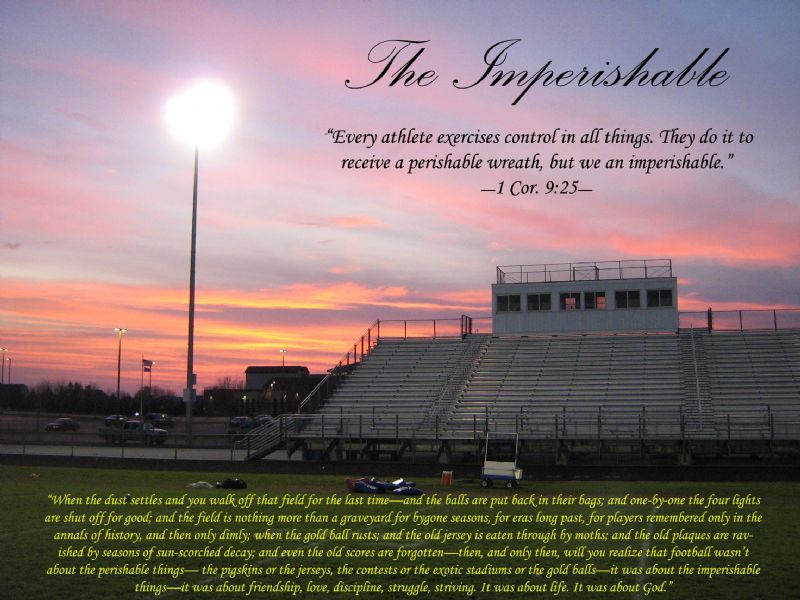
Those who know me best will tell you that almost nothing lights a fire in the kiln of my heart like Friday nights in the early fall.
For eight years now, I’ve been an assistant football coach for the Cedar Grove-Belgium Rockets, and it’s on those crisp Friday evenings that I have a priceless opportunity. For me, the lights and the luster of the game are only part of what makes coaching so thrilling. The best part is pouring into the next generation of young men. I try to love each and every player as though he were my own son, and to show him that God will meet you at the intersection of football and faith, just as He met me.
So when a former coach asked if I would write a little essay on what being a Rocket means to me, well, let’s just say I was more than happy to oblige! What follows is an essay I’ve entitled “Being a Rocket.” I hope you enjoy reading it as much as I enjoyed writing it.
——————-
There are few things quite like the sensation you feel on game day.
What begins as a flutter in the belly moves up and down the spine and then starts to consume your whole body.
The atmosphere of the locker room, the blazing look in your brother’s eye, the crispness of the autumn air, the smell of the freshly-cut grass, the thunder of the drums and the crowd…only strengthen the sensation, until, at last, it’s time: ignition, launch, kickoff.
Football has a way of awaking life—and not just on game day. It creates the kind of nostalgia that keeps the young men dreaming of days to come and the old men dreaming of days long gone.
But the game of football, great as it is in its own right, is not what being a Rocket is all about. Nor are football’s greatest lessons confined to the gridiron. If they were, I wouldn’t be writing this essay.
As I see it, being a Rocket is about far more than being a football player. There are things you learn as a Rocket that transcend the playing field and touch upon almost every area of life.
First of all, being a Rocket teaches you about interdependence. Being a Rocket, in the first instance, is not about being an individual: it’s about taking part in something bigger than yourself. You’re an indispensable part of an indivisible whole. As a Rocket you learn that there are no one-man teams. You’re not likely to hear our running backs boast to the papers about their record-breaking achievements. But you may hear them crediting their teammates. That’s because it’s oftentimes the men in the trenches—whose names you do not know, whose faces you do not recognize—whose toilsome efforts determine the outcome of the game.
Being a Rocket teaches you a second lesson about life, and it’s the counter-cultural value of delayed gratification. We live in a society of immediate indulgence: you get whatever you want, whenever you want it. You can order a hamburger in a minute, scour humanity’s collective knowledge online in the fraction of a second, and receive a text message in the blink of an eye. But as a Rocket you catch the wisdom of delayed gratification—foregoing temporary comforts for lasting satisfaction. You endure the bite of the lactic acid; you surge through the finish line; you spill your sweat and tears and if necessary your blood: you swallow down the bitter things in exchange for the taste of victory. And it is upon this foundation of delayed gratification that virtually all success in life is built.
Along similar lines, being a Rocket reminds you of the pricelessness and temporariness of life. By the time you’ve figured out how to strap on your pads, you’re already teaching your son how to do the same. One season bleeds into the next; one generation gives way to its successor; and you are made to realize that life is as short as it is precious. The present moment is a weighty thing, and a terrible thing to waste.
Being a Rocket, furthermore, teaches you something about how to build a family. In a day and age when the household is in disarray, and 40% of American boys are born without someone to whom they can point and call, “Daddy,” every young man is hungering for a father figure, for a brother on whom they can depend. When you enter into the Rocket family, your coaches become like your fathers. They remind you who you are and what you’re capable of. They chasten and rebuke you when you err. They praise you when you do well. They throw an arm around you in your day of distress. They try to love you unconditionally. And your teammates are like your brothers. It’s not about who can throw the furthest, run the fastest, or lift the heaviest. What matters is that you’re wearing black and bleeding orange.
And that brings us to another lesson. Being a Rocket instills in your heart the rhythms of brotherly love. Not a practice will pass by without you hearing a coach say something about servanthood, about selflessness, about sacrifice. Talk to the army cadet, and he will tell you that after boot camp, you become inseparable with your comrade. You would take a bullet for him, if duty called. Being a Rocket is not quite like that; but it begins to grunt in that direction. When the heat of the battle engulfs you, and the deepest reserves of energy are called for, it’s not the glitter of the gold ball that will motivate you. Nor will hatred for your opponent marshal that final flourish. No: in the bleakest and bloodiest circumstances, it is love for your brother—only love—that will prevail. And if life is about nothing else, it is about love.
Being a Rocket involves becoming a man. Almost every tribal culture has a rite of passage by which a boy comes of age and receives the mantle of manhood. He hunts down a lion, survives a nighttime raid, does things only a man can do. There is something about pressing through that final sprint, something about gritting your teeth on fourth down, something about taking a stand on your own goal line, that makes the little boy shrink away and calls out the inner man. Being a Rocket, at one point or another, will require bravery in the face of opposition—and this is part of the essence of manhood.
Being a Rocket, I suppose, will teach you about as many life lessons as you’re willing to learn. But there is still one more lesson that encompasses and eclipses them all: it’s the mystery that football, all along, was never an end in itself. Football was a microcosm of life itself. Football was a shadow, of which life was the reality. The pivotal thing you learn from football is that football is not life. But life is an awful lot like football. Being a Rocket, you begin to grasp that.
So if I may, let me close by telling you what being a Rocket means to me personally. My senior year we had a good team—I mean, a really good team. We went 8-1, and our only loss came by a slim margin to Kewaskum, who went on to the division 3 semifinals that season. I thought we finally had a chance at State. But as Providence would have it, we faced an angry St. Mary’s Springs team and bowed out of the playoffs in the first round. The loss devastated me—so much so, that as I was driving to school the next morning, for a split second I contemplated swerving my car into an oncoming truck to end my life.
For me, football was the ultimate thing. Football was life. And so when the gold ball slipped through my fingertips and shattered on the ground, I thought I had nothing else to live for.
And that is precisely when I began to seek God. Because, I reasoned, if football was the next-best-thing to God, and it could not even begin to fill the vacuous hole inside of me, then only God Himself would be big enough to satisfy.
It was when my relationship with football ended that my relationship with God began. That senior year, I gave my life to Jesus Christ; and the joy I now know in Him outstrips the pleasure I had in football as considerably as the daytime sun outshines the stars.
Being a Rocket, for me, was not the end, but only the beginning. Not unlike how a rocket sets its course upon launch, Rocket football set the trajectory for the rest of my journey in life. And as I reflect on the whole story, I think it’s no stretch to say that were it not for the playing field, I wouldn’t be on the mission field.
Being a Rocket changed my life. Being a Rocket prepared me for life. Being a Rocket pointed me to the One who gave me life. For these reasons, and still others, I am proud to be a Rocket.