
Ok, you wanna know what this Camino stuff is all about? Well check out this info I’ve put together on all things Camino. If you’re interested in learning more, follow the links and explore for yourself or leave a question in the comments. I’d be happy to answer. Enjoy!!
“KNOWN in English as The Way of St James, the Camino de Santiago is a network of routes that serve as a pilgrimage to the shrine of the apostle St James in the Santiago cathedral.
The Santiago de Compostela is in Galicia, a northwestern region of Spain where it is said the remains of the saint still lie.
What is the Camino de Santiago?
During the Middle Ages the Camino was one of the most important Christian pilgrimages, along with the ones to Rome and Jerusalem.
According to legend, the body of St James was taken by boat from Jerusalem to northern Spain, where he is buried in what became the city of Santiago de Compostela, the name deriving from the Latin Sancti Iacobi – Saint James.
There is no one precise route, but dozens. Traditionally a pilgrimage started from the person’s home and ended at the site.
But some of the routes are considered the main ones.
Since the Middle Ages the pilgrimage has declined in popularity with only a few hundred pilgrims a year registering in the 1980s.
In October 1987, the route was declared the first European Cultural Route by the Council of Europe; it was also named one of UNESCO’s World Heritage Sites.
Since the 1980s the route has attracted a growing number of modern-day international pilgrims.
Nowadays, the figure has increased to over 200,000, according to 2014 figures with people walking, using a bicycle or even on horseback or donkey.
The route does not just attract religious devotees but also people with a wide range of interests in travel, sport or simply the desire to see another country.
How long does it take to walk it?
The most common starting point on this route is Saint-Jean-Pied-de-Port, on the French side of the Pyrenees, with Roncesvalles on the Spanish side also being popular.
The distance from Roncesvalles to Santiago through León is about 800km.
Camino Primitivo, or Original Way, is the oldest route to Santiago de Compostela, first taken in the 9th century and which begins in Oviedo.
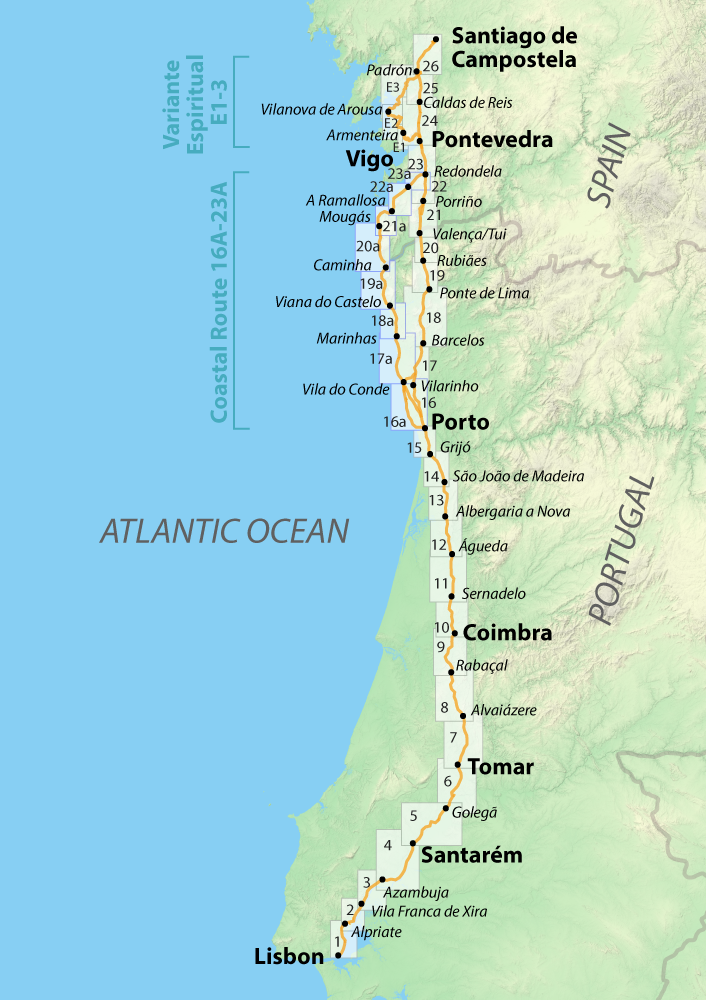
The second most popular route is Camino Portugués starting at the cathedral in Lisbon (for a total of about 610km) or at the cathedral in Porto in the north of Portugal (for a total of about 227km), crossing into Galicia at Valença.
Camino del Norte, or the Northern Way, is less travelled and starts in the Basque city of San Sebastián. The route follows the coast along the Bay of Biscay until it gets close to Santiago. It also does not hit the same number of historic cities and points of interest as the Camino Frances, but is a lot cooler in the summer and most consistently pretty. Most consider the French border as the natural starting point.
While the routes vary in length, most take around a month to complete, walking between 20-30km a day.
When is the best time to go and where do you stay?
Travellers on the pilgrimage, who hold a “Credencial” (pilgrim’s passport) can stay in accommodation called “albergue” for between 6-10 euros a night per bed and are similar to youth hostels.
Pilgrims are usually limited to one night’s accommodation and are expected to leave by eight in the morning to continue their pilgrimage.”
Excerpt from: www.thesun.co.uk
Photo from: caminoguidebook.com
How do you know the way?
“The scallop shell is one of the most iconic symbols of the Camino de Santiago and still used today to guide pilgrims on their way to Santiago de Compostela along the many different routes.
Painted or printed on walls, sidewalks, on tiles, Camino markers… the scallop shell (or ‘vieira’ in Galician and Spanish) will help you find your way.”
Excerpt from: caminoways.com







