
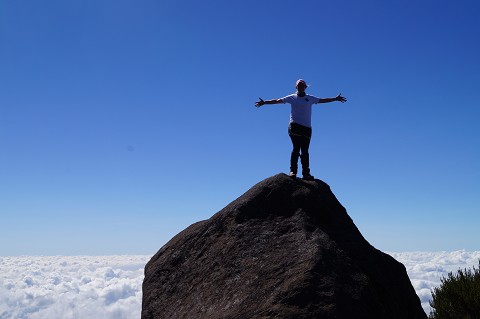
At 2:34 in the morning of summit day, I wanted to faint, vomit, and sleep all at the same time. Thanks to altitude sickness, my body attempted to do all of those at once—which left me swaying on the sandy slopes of Mt. Kilimanjaro at 18,000 feet. Luckily, my guide caught my body and plopped me down on a boulder.
“You are a strong woman. We will get you to the top.”
In those words, my guide didn’t mention the hypothermia or the exhaustion that my body was succumbing to. He didn’t remind me that the pain that I felt while climbing wouldn’t leave for days after I summited. He didn’t explain to me that these hours would be the hardest hours of my life.
He simply reminded me who I was and that he wouldn’t leave until I reached the top.
For six dark hours, we trudged upward, lifting our boots just enough for the next step. My eyes couldn’t stay focused on the next step—I kept my eyes on the peak of the mountain, which never seemed to come. When we sat down for a break, our guides made their way over to our sides, pulling out our frozen water bottles for us and, on bended knee, asking how else they could serve us.
By 4 am, I could no longer tell the guides how I felt. With each step, I struggled in the raging, never-ending darkness. All I had was a man next to me who vowed to get me to the top and the hope that, with the sunrise, heat would melt my hopelessness.
And, so, by sunrise, we reached the first of three peaks. Some turned back to head home while the rest of us pressed onward toward the top. Even with the sun, those last few hours before we summited were wretched. But, we reached the top. And, 4 minutes later, we turned around and started walking home.
Since coming off of the mountain, my teammates have asked why we bothered with the adventure. And, for starters, the 4 out of the 5 days that we were on the mountain were magical, refreshing and beautiful. But, it’s true—the day that we will all remember the most is summit day.
And, while summit day was terrible and hard, it was the collision of the journey upward and the reality of the finish.
Sometimes, our journeys seem long—so long that the end doesn’t seem as though it exists. For me, right now in Africa, this journey seems long. I wait in anticipation even though June seems incredibly far away. Each day here is a day to reassess—to shift perspective from not being home for Christmas to focusing in on what I am destined to do that day.
But, the journey does end. We summit and then come down the mountain, reveling in what the journey taught us about ourselves and about the mountain. I think that’s the part that Jesus wants us to understand: the journey will cost us everything and it will often seem as though the end will never arrive. But, it all comes to an end.
And when it does, we are left with the memory of what we did and who we were.
Climbing Mt. Kilimanjaro was the hardest thing I have ever done. But, I did it. I climbed 19,341 feet to the summit. I am wind-burned, sunburned and I can’t feel my big toe anymore.
It was worth it.
May I never be a person who forgets who I am while climbing. May I never be person who is swallowed in the darkness. And may I never be a person who forgets that the journey is just as important as the summit.







