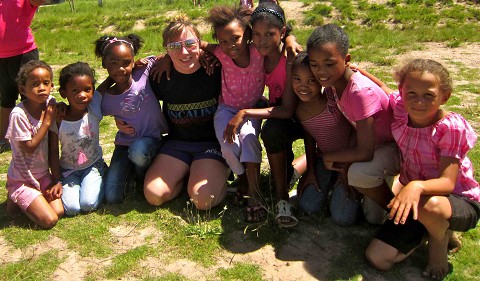
Somewhere in the middle of leading a sports camp, I found
myself in the center of an Afrikaans lesson. Afrikaans is one of the two
traditional languages spoken in South Africa, the other being English. Some
natives even speak Khoisan, the language that is
spoken with clicking sounds (which is my favorite) but I definitely cannot pick
up on that language.
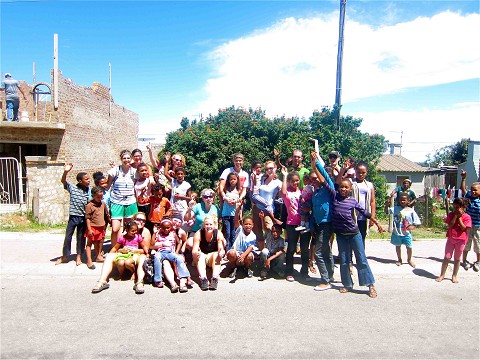
Since I am staying in Plettenburg Bay, which is a known
tourist area, English is the dominant language I hear. At first, I was just
happy to be able to understand people again. But when I heard the kids at our
soccer camp talking to each other, I really just wanted to communicate with
them in their native language.
For the boys, I found that I did not even have to learn a
language to relate to them. All I needed to do was gymnastics. In case you read
that too fast, I’ll say it again…gymnastics!
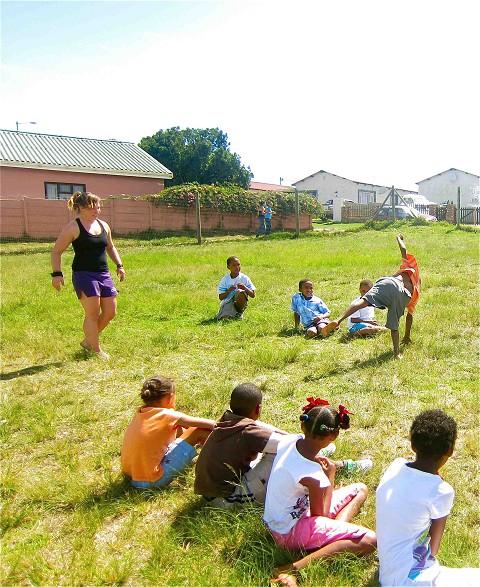
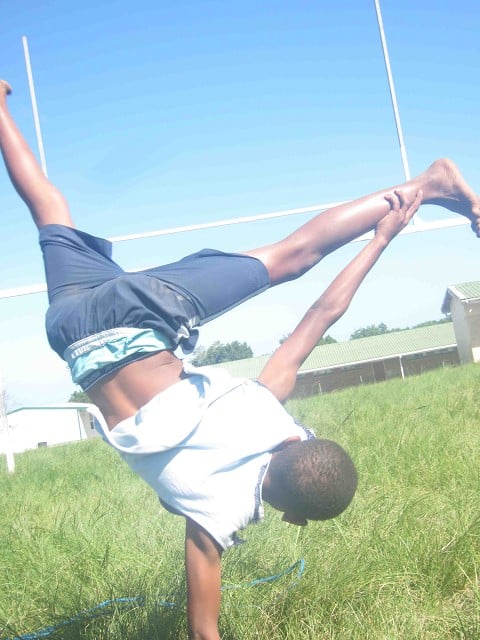
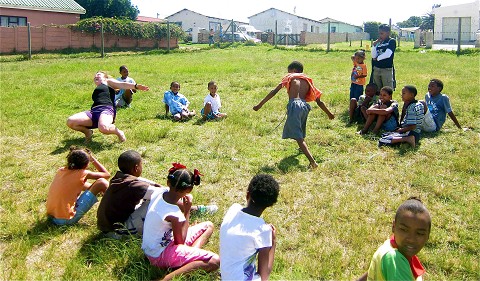
The first day I arrived at the camp, one of the younger boys came cartwheeling down the street towards me. Once he
reached me, he did a back flip and smiled at me. I knew instantly that we would
get along. By the end of the first day, I found myself caught up in a
gymnastics contest in which I was horribly losing. These boys were all younger
than 15 and could whip their bodies around so fast that even I could barely
follow the moves with my eyes. The one boy would
do so many back handsprings in a row that I stopped counting after 10. They
could all do standing back flips and could bend their bodies in ways I don’t
think I ever could. So, I did the best I could by throwing in some break
dancing moves, handstands, handsprings, cartwheels and splits. But, no matter
what I did, everyone could do it better and
faster. I loved it. I was able to connect with these boys without even speaking
at all, just moving.
For the girls, language was everything. The first day began
with a lesson in counting. I learned how to count to 10 in Afrikaans. Een,
Twee, Drie, Vier, Vyf, Ses, Sewe, Ag, Nege, Tien. (None of these are pronounced
how they are actually spelled) Then we moved on to some basic conversation
words and sayings. I learned that “Hoe gaan dit” means “what’s up?” “Tot siens”
means “good-bye.” “Do you want to play a game?” is “Wil jy n speletjie speel?”
I learned a few more “useful” words and tried to learn all their names. The
next day, I actually brought my notebook so I could write down everything they
were telling me. They were thrilled. Yesterday, Giselle asked me if she could
get the pink book out of my backpack so we could start our lesson early. She taught
me months of the year, emotions, how to ask what time it is, how to say
gymnastics (gimnastiek) and how to say “see you tomorrow.” My two favorite
sayings were “Geseende Kersfees & Voorspoedige Nuwe Jaar” which means
“Merry Christmas and a Happy New Year.”