Warning: There is graphic content and language in this blog. Take care to read at your own risk.
A few days ago we went to visit the Kigali Memorial Centre, a museum, research center, and mass grave dedicating to remembering the past and educating for the future. In other words, it was a lesson in the atrocities of the Genocide here in Rwanda, less than 20 years ago.

sculpture depicting a Tutsi chained to a tree before being killed
It caused a lot more emotions than I was prepared for. There were videos of people actually getting beaten to death by clubs and machetes- albeit the videos were taken from a distance and were shaky but there you have it. There was a mass grave outside where the bodies of over 250,000 people were buried. Inside, there was a room with femurs and skulls that had been crashed, cracked, and severed- all remains of people who had been brutally murdered. There was a room with clothing, shoes, and other personal belongings. On the second floor was a room dedicated to children that had been murdered- there were large illuminated photos of different children, ranging in age from 17 years to a few months old, and underneath were names, favorite foods and activities, and how they had been killed. One infant had been picked up by his legs and slammed against a wall. A pair of siblings, both under 4 years old had been killed when someone threw a grenade into the shower where they were hiding. One young girl had her last words recorded, “Mum, where can I run to?” before she was hacked to death by a machete.

the last photo of Ariane before she was murdered
Not only were people mercilessly slaughtered, the goal was to humiliate them and make death more painful, both physically and emotionally, than imaginable. People were forced to watch as their daughters, mothers, and grandmothers were raped and mutilated before death. Children were forced to watch their fathers being tortured as long as life could cling to their bodies, and vice versa. Imagine the woman who raised you being beaten to death slowly in front of your eyes. Hear her screams.
This is what survivors have carried with them their entire lives.

as well as scars like these, from attempted murder
[photo via: Time Lightbox]
There is even a story of thousands of people fleeing to a church where they thought the priest would care for and shelter them. That's his job, right? That's the job of a shepherd of the flock? You would think. This priest, however, signaled the militia that the cockroaches were hiding inside his church, and they quickly became target practice. Not a single soul survived.
The thing that ruined me the most was the story of a young man and woman who had been chained together and buried alive. When their bodies were exhumed later, they were still chained together. The actual chain had been kept and ultimately donated to the museum. I stood staring at it for a long, long time. Above the chain was a picture of the young man and woman, standing in a group of friends- everyone was smiling, laughing.
It’s hard to imagine how something like that could happen. Such a declaration has been so overused with all the atrocities this world has seen over its vast history, but it is nonetheless a true statement. Having never, myself, lived through such horrors, it’s difficult to put myself in a place to feel truly empathetically with the survivors.
I’ve been asking myself how could something like this happen? How could people desensitize themselves to the point that they could do something like this… that they could kill again and again and again, without mercy or remorse?? We asked these questions after The Holocaust, after the Khmer Rouge’s campaign, after the mass killings of Armenians by the Ottoman Empire after World War I. According to Wikipedia there are several stages and influences leading to genocide:
- Classification
- Symbolization
- Dehumanization
- Organization
- Polarization
- Preparation
- Extermination, and
- Denial
And while each stage is important to the flow of the hate wave, I want to focus on what I think to be the most essential stage: dehumanization.
In Rwanda, the Genocide is classified as the killing of the Tutsis by the Hutus. The Hutus were raised, taught, influenced to believe that the Tutsis (originally in the very same tribe, but characterized and divided later by European force) were less than they, were- in their words- cockroaches. Hate messages were broadcast widely via person-to-person, newspaper, and radio. The term was used so freely, commonly, and passionately that it began to numb and desensitize the Hutus to the Tutsis’ actual human heritage. Hearing these terms, listening to these messages of hate and intolerance has an actual psychological impact on a person, creating a false and calloused sense of reality and relationship with other humans.
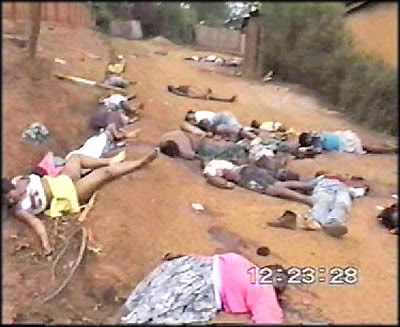
actual footage from the Rwandan massacre
[photo via: I'm Curious Too]
Do you realize that we engage in dehumanization and desensitization all the time? In fact, we even elect to partake in these things- willingly.
The teams have been listening to Andy Stanley’s Love, Sex, and Dating series, and we’ve been learning a lot about how to treat members of the opposite sex. In the second part of this series Andy says, in more or less words, this:
“Men, if you are listening to music and you hear a woman being called a ‘bitch’ or a ‘whore’ you need to delete that music immediately. Get it off your ipod TODAY. You are allowing yourself to freely listen to music where women are being treated as less-than-human. You are allowing yourself to be fed with the idea that women are a commodity, there only for your pleasure or enjoyment, and not to be treated with respect or equality.”
Do we get that? Do we get that the music, the movies, the books we partake of are subconsciously influencing and challenging the ways we perceive other human beings? If I am consistently listening to music in which women are called “bitches” or “whores” or other less-commonly-accepted terms for receptacles of man’s desires, at some point or on some level I begin to agree. I begin to accept what I am being told, via a “cool beat” or “my favorite artist.” If I am reading books that promote the romanticism of kidnapping, molestation, or rape, at some point I come into agreement with it. How many movies have been made out of a novel series promoting how romantic it can be to fall in love with a captor… or a rapist? Angelina Jolie directed a movie about rape in the midst of war in Bosnia- In the Land of Blood and Honey. It was rumored that the main story arc at was a love story about a Bosnian woman and a Serb man who raped her during the country's war. Jolie fought against these rumors, but the lines were so blurred about her intention and what was actually being portrayed that her permit to shoot the movie in that country was revoked. She eventually got it back, after conversing with wartime rape victims and a rape victim’s support group. But the damage had been done, and still continues to be done.
When you make light, or romanticize the horrors of inequality, rape, murder, or anything along this nature, you create in yourself an inability to see things as they truly are, and you begin to see things through a haze- as you teach yourself to think, or as is being taught to you via messages in the media or from someone you admire, or fear.
This can happen via your friends as well. Let's say you have a friend who drops fat jokes all the time- someone you love or care about constantly picking out larger people in a crowd and going to town at their expense. How long do you think it will take before you begin to agree, either because you want to be on your friend's "side" or because you just get used to hearing these kinds of insensitivities? How long before you stop viewing a larger person as a person, and you start seeing them only as their outward appearance? You might hear, or even say things like, it's their own fault… or they brought it on themselves… and a person begins to become less and less of a person and more and more of a problem in your eyes. Prejudice (just another word for willing dehumanization of another) comes in all forms, not just skin color or gender.

what do you see?
[photo via Confessions of a Twirly Girl]
How about we take it to the 21st Century? How many times a day do you look and laugh at memes depicting "fails" of a fat girl in a group of skinny girls, or a so-called "nerd" with a group of jocks? How often do you find your amusement at the expense of another? They're called demotivational photos for a reason.
So what do we do? What small thing can we implement to avoid these atrocities? What are some steps we can take in our day-to-day lives to ensure that we as a collective world-wide community do not succumb to any stage of genocide and, in return, to ensure that we see all people- not just those who look like our own reflections- as people?
- Stop listening to music that dehumanizes women.
- Get rid of books/movies that romanticize the use of women, children, or minorities.
- Make yourself accountable to your friends (and vice versa) to avoid jokes, slurs, or other off-hand remarks about anyone who does not share the same gender, ethnicity, religion, country of origin, belief system, level of health, or level of intelligence as you and stick to it. It may be “cool” to drop Polish jokes or fat jokes, but avoid it at all costs. The more you joke about something, the less you see that particular type of person as a person.
- Encourage others to do the same.
As I was processing these ideas out loud, my teammate-for-the-month, Marianne, a girl with the most precious and loving heart, asked, “Why can’t we all just love puppies and flowers??” to which the response came, “We do! We do all begin with loving puppies and flowers. But eventually the message comes to us slowly and quietly that puppies are just mongrel-ly flea bags meant only for man’s possession and duty, and flowers are allergy-propagating graveyard art works and eventually the hearts and confetti we felt when we thought about puppies and flowers dissolves into darkness and hatred and cruelty.”
The only thing we can do is take action. It might not be “cool” to call others out into goodness and kindness and tolerance, but it is necessary above everything. Edmund Burke (depending on who you ask) once said, “The only thing necessary for the triumph of evil is that good men do nothing.” Sometimes it’s not the saying of these things or the doing of these things that matters; it’s the seeing of and ignoring them that matter. Maybe it’s not you that needs to change a few things. Maybe it’s you that needs to start standing up for others.
We may not think these little things, like music and movies and jokes, add up but they do. They really, really do.
What are you going to do about it? How are you going to take steps in your every day life to prevent dehumanization at the basest level? Are there people in your life that you need to stick up for? Are there bullies that need to be brought to justice? How about in your own life? How are you going to begin changing even the way that you think, talk, interact? Are there words that you need to cut out of your vocabulary? Are there ways of speaking about others that you need to improve? Is there music on your ipod that you need to get rid of right now?
What are you going to do for the betterment of the world?