
Sitting on a rooftop in the outskirts of Kathmandu, I look out over the city the way I have every evening since we arrived here. It’s a sight I imagine could never grow old—a vast array of densely planted pastel-colored buildings topped with red tin roofs, worn and tired yet so beautifully united underneath a haze that never quite clears away. The city lies encapsulated by the lush walls of the Himalayan foothills. I look out to the hills—silhouettes of deep greys and blues; the sun sinking farther and farther behind, its golden beams pass through every valley and crevice, pointing my eyes ahead to the snow-capped peaks of the tallest mountain range on earth. I watch in awe as they turn from white to gold, from pink to grey, then slowly fade away with the setting of the sun.
I look across to a neighboring rooftop: a small, wobbly child attempts to dribble a soccer ball while one by one his mother rings the water from their clothes and hangs them on the line to dry. I look to another: a young couple nurtures and tends to their small rooftop garden, the green leafy vines cascading down the side of the old, brick three-story building. I look to another: a sleepy cat lies curled up on a chair, stretching and yawning and basking in what remains of the warm sunlight. With each rooftop I look to, feel as if I’m getting a small peak into the lives of the people inhabiting them.
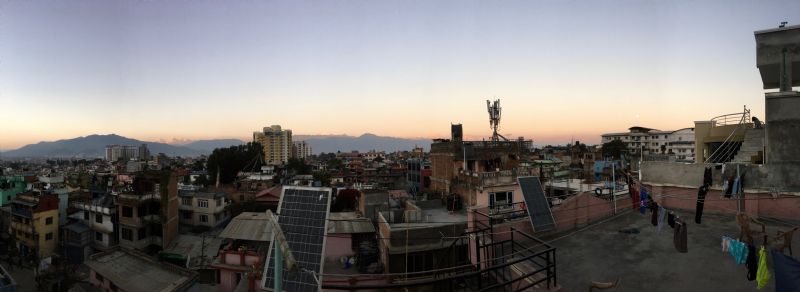
All I see is beauty.
But then I look a little deeper. The smell of incense permeates from small shrines housing man-made gods on every street corner. Strings of wilting marigolds hang from windows and door frames, remnants of the Dashain festival intended to invite in the goddess of good fortune. Small children are adorned with gold jewelry, faces painted with melted wax and tear-streamed eyeliner. Stray dogs roam the alleyways living off heaps of trash. Amidst the sea of shops and businesses lining the streets, it’s easy to miss the many dance bars and cabin restaurants scattered throughout—the ones where thousands and thousands of girls and women are exploited every single day in the city of Kathmandu alone.
Within the beauty, there’s also darkness.
Last week, two of our hosts Ruth and Rosni told us that instead of our usual afternoon slum ministry we would be spending the evening visiting cabin restaurants and ministering to the girls who work there. The two of them briefed us on what we could expect to see and all that this would entail. They told us the harsh reality that there are currently over 50,000 women being exploited in cabin restaurants in Kathmandu, of which 30,000 are minors. We were about to experience this reality firsthand. They told us that tonight, we would be acting as tourists and they would be acting as our interpreters, and we were to call them “Ruby” and “Maya” for the rest of the night. After they finished briefing us, we all prayed and put on the armor of God, and we set out on our way.
We stepped off the bus onto the side of a busy street not far from where we were staying. We split up into two groups and began walking. As we walked, we prayed fervently and allowed the Holy Spirit to lead us until finally Maya led us down a concrete staircase and through a narrow alleyway leading into an underground cabin restaurant.
It was dark and cold.
We were quickly greeted by two young nepali girls—one looked like she was about my age, and the other couldn’t have been older than 15. The restaurant was made up of several small cubicles—or “cabins”—separated by large boards of plywood that had been painted orange. Each cabin consisted of several large floor pillows and a small coffee table. The two girls led us down another narrow hallway—cabins on either side of us—to the very back of the restaurant. All seven of us crammed into our tiny room and plopped down on the floor pillows. There wasn’t even enough space for me to comfortably cross my legs. I wrapped myself in my flannel, hugged my knees to my chest, and allowed my eyes to adjust to the darkness.
The girls took our orders: five teas and two sprites–they returned with seven tall glasses of mountain dew. We thanked them and asked them to join us (we were their only customers after all). They looked at each other giggling and hesitated for a moment before finally agreeing and sitting down with us on the floor pillows. We asked them their names and introduced ourselves, then went on sharing stories and laughing together while sipping on our mountain dew—all the while praying in our hearts that the Lord would open up the door to bring Him in. (Check out my teammate, Brittany’s post to hear more about our conversation here!)
This went on for a while until finally the younger of the two girls asked us this simple question: “Are you Christians?” I immediately looked around the room to see the mutual celebration in my teammates eyes—this was the opportunity we’d been waiting for. Christianity is not illegal in Nepal, but it is illegal to convert people to Christianity, so we had to be very careful about how went about bringing Jesus into the conversation. But just like that, the door had been opened!
We took turns answering and asking questions, each of us sharing pieces of our own personal experiences and testimonies. We shared the gospel with them, and I saw hope in their eyes as we answered question after question. The older of the two girls admitted to us that she struggled with alcoholism and depression, and told us she hadn’t laughed this much or felt this much joy in a very long time. She told us that her family was Hindu, but said that maybe now that she was far away from them she could become a Christian.
About an hour had passed, and we heard a loud bang. The younger girl quickly stood up and left the room, then returned promptly and told us it was time for us to leave. We exchanged information and made plans to meet up with them again on the weekend. As we left the restaurant, our hearts were rejoicing—but we knew the battle was far from over and that we needed to continue praying for these girls with everything in us.
A few days passed, and the day that we had planned to meet up with them again had finally arrived. I made myself a bowl of cereal and went up to the roof, where I waited eagerly to hear if Rosni had gotten in touch with the girls. It wasn’t long before one of my teammates informed me that they weren’t coming. No explanation was given. We didn’t know what the circumstances were or what was holding these girls back, we just knew that they wouldn’t be there and that was that.
As disappointing as it was to see these girls come so close to accepting Christ and to turning their lives around, and then to be shot down at the last minute, I know that their story is far from over. I know that Ruth and Rosni will continue to pursue these girls long after we leave Nepal.
But even more than that, I know that the LORD will continue to pursue them. Because that’s what He does—the Lord pursues relentlessly.
I may never get the opportunity to see Part II of this story—but I’m OK with that. I trust that the Lord will finish the work He’s already started here. I know that this story has only just begun, and I know in my heart that best is yet to come.







