
Words alone cannot describe the week I spent in the villages of Xakao and Ngarange here in Botswana. So, to give you more of a visual, here’s some pictures I took from my time in the bush.
Disclaimer: I don’t want to paint a picture that portrays every African bush out there. This is just my experience with 2 specific villages, but it helps give you an idea of others.
1. THIS is the bush! Barren, dry, hot, sandy, slow-paced, yet absolutely beautiful. Living completely off the land is what they do best, outside of living in constant community. Nothing for miles, walking to friends and neighbors for meals, slaving over a hot fire to cook, taking cold bucket showers, slaughtering animals to eat, sitting under the shade of a tree to take a break from the scorching heat, enjoying small talk, and being welcomed by herds of goats, stray dogs, donkeys, cattle, and chickens on a daily basis.
2. THIS was my home for a week. Behind the unfinished cinder blocks in one of the rooms, you’ll find a small tent used to house me and my teammate. Although unfinished with no doors, no windows, and no roof, it brought shelter from the wind and blowing sand. A local pastor by the name of Pastor Zone (he asked us to call him this because Americans cannot pronounce African names lol) blessed us by letting us stay on his property. He’s in the process of making his new home to house his family. This type of home is not commonly seen in the villages we were in. You knew they were wealthy when seeing them build with cinder blocks and cement. Most houses were made of clay with straw roofs. In some of the pictures below, you’ll see what I mean.
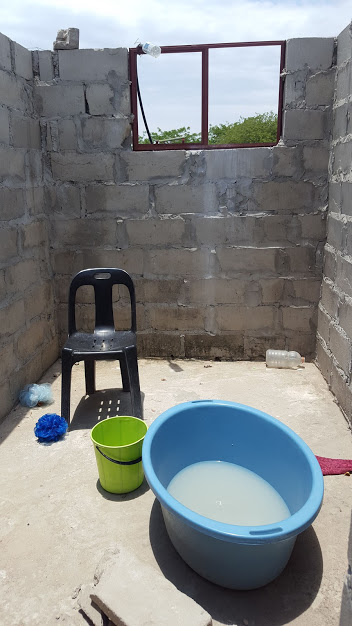
3. THIS was my shower situation. No door, no window, no roof. I filled up water from a spicket into the green bucket, stood in the large basin, and went to town. Although I had absolutely no privacy, I got clean and smelled better than before lol. I also made sure to do it at night, which was a little creepier with all the spiders, but at least people couldn’t see all of me. Also, after 4 days in the bush, we were told that there’s a hose connected to a water bottle full of holes which poses as a shower. Life changer!
4. THIS was my kitchen. Let me preface by telling you that we were told we would have access to a kitchen and be able to use their plates, bowls, and utensils. Little did we know that this is what was meant by kitchen and that everything is communal; one pot to cook, few plates, and little to no utensils. Our minds immediately went to the western world where we thought we’d have a counter top with a stove/oven and several things to cook with. Silly Americans ha! With no clean water, this meant that we needed to boil water for at least 10 minutes, after struggling to light the fire and wait for the embers to get hot enough to bring the water to a boil. Our cooked meals consisted of pasta, mashed potatoes, baked beans, canned corn, ramen, rice, and mixed veggies. Yummy!
5. THIS is community living and taking shelter from the sun. Much of our afternoons consisted of sitting in the shade, taking out our sleeping pads, and napping in the ant-infested sand. Guys, it was HOT! When I tell you that our water got to the point of being able to steep a tea bag, I’m not exaggerating. We were drained and to be honest, experienced heat exhaustion almost every day. The one perk was that it was too hot and dry for mosquitoes to stick around so at least we didn’t have to worry about those pesky things.
6. THIS is a village; specifically Ngarange, Botswana. Hut after hut surrounded by straw privacy fencing. Here, the people apply for a plot of land and depending on where the land is, it can take anywhere from 6 months to 5 years to receive ownership from the government. From there, they build their home and raise their family. From what I saw, there was one water spicket that everyone had to walk to with large buckets and bring them back to their homes to cook/clean. When we were at one of the huts evangelizing, we asked if there was a way to serve them. The woman asked if we could get her water. 4 of us willingly jumped up and fetched her some water. Man was that a long and tough journey! It definitely gave me perspective on the importance of conserving water and again humbled me that running water is so normal back home. A fun fact about villages is that there can be fewer than 50 people, yet they have their own native language.
7. THIS is what following the great commission looks like. Walking through the privacy fence saying “Coco”, greeting those who are home with big smiles and “Moro/Dumela mma’s/rra’s”, shaking their hands, sharing the love of Christ with them by letting the Holy Spirit take charge. We laughed, we cheered, we witnessed life transformation, we prayed, we served, we obeyed. The Lord not only changed the lives of those we saw, but humbled our hearts.
8. THIS is local transportation. Many times, we saw these cute donkeys lugging heavy housing equipment, food, and people. In this picture, you see them fixing a flat tire. They do have cars, but many locals cannot afford them. The condition of the roads as well, don’t always allow cars to stay healthy very long, so often the resort is to find some donkeys to help you get around.
9. THIS is local business. A man supporting his family by setting up a small shack made from wood, straw, and rope, asking 10 pula per cut (equivalent to $1). Some days, no business, others, booming. Jobs are very scarce here. You have to make a business in order to make any income. Many of the prayer requests we received were for jobs or improved business.
10. THIS is a classroom of a school and daycare center for children. ADORE Little Children was established by an Australian woman who wanted to create a safe space for children who are underprivileged and at risk. If kids aren’t in school, they are working the grounds with their family or getting into trouble. This school is a place for parents to drop off their child and know that they will be fed and loved until it’s time for them to go home.They learn english, and more importantly about the love of Jesus! It was an honor to learn about, meet and see this organization and its impact in the community.
11. THIS is an African wedding ceremony. A tent hiked up beside some houses, stray dogs everywhere, catered food, lots of dancing and singing, and very confused Americans ushers. Not pictured is a large group of people hiding under a nearby tree taking shelter. I can’t tell you how interesting of an experience this was, especially comparing it to the States. It also didn’t help that we got there at 7am after waking up at 5am to get ready to catch the ferry and not eat until 3pm and constantly sitting in the unknown laughing and shrugging our shoulders because we literally had no idea what was going on. What a day!
12. THIS is one of the many African sunsets we saw. Pictures do not do justice. Absolutely breathtaking! I took this picture on our last night as Elle and I made the decision that sleeping in the van would be better than cramming in a hot tent and also since we were leaving by 6am the next morning to head back to Maun. You make compromises when you’re a little miserable.
Well, I hope you now understand a little about the bush and the beauty it holds. Yes, it was extremely hard at times, but the Lord met me exactly where I was at and I’m walking away humbled and blessed. These pictures only scratched the surface of what I experienced in one week, but I hope to share more about that in another post.
Love you all,
~A







