
As part of my mental and spiritual preparation for the World Race, I’ve been working on reading books about missions. I wanted to post my reflections and reviews here for anyone else who is interested in this topic. I’ll be updating this blog post as I read more, so bookmark it for future reference.
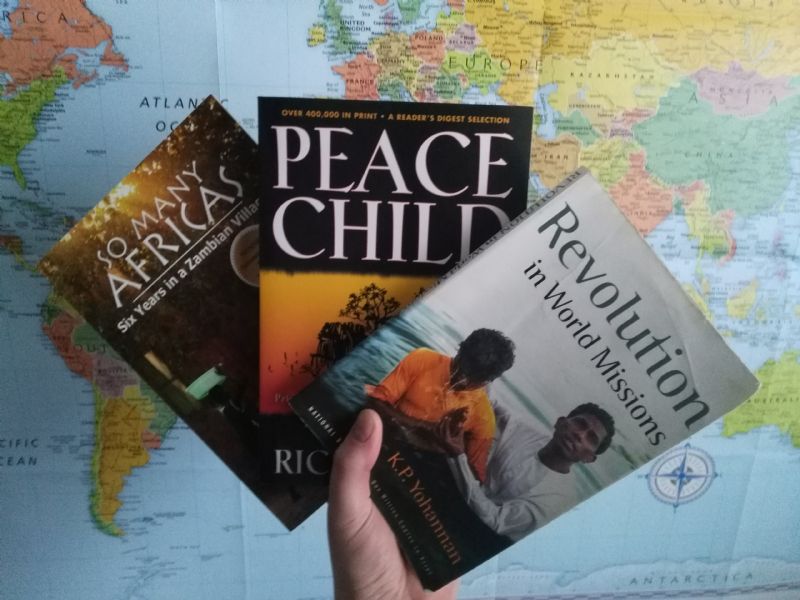
Peace Child: An Unforgettable Story of Primitive Jungle Treachery in the 20th Century by Jon Richardson
This book narrates the efforts of missionaries Jon and Carol Richardson, along with their seven-month old son Stephen, as they ministered to the headhunting and cannibalistic Sawi tribe in 20th century Papua New Guinea. Jon gives detailed background information to help the reader understand the history and traditions of the tribe, as well as the political maneuvers and missional groundwork that had been laid before they arrived. Jon and Carol sought to keep peace and provide medical relief to a people who delighted in the practices of betrayal and treachery deeply embedded in their societal structure. The Richardsons faced spiritual warfare, danger of tribal conflict, and risked their own lives as three branches of the Sawi settled in close proximity to the “Tuan,” the white man. However, it was one of the Sawi’s own traditions that opened the door to their acceptance of Christ’s sacrifice and redemptive love through Jon and Carol’s witness. Peace Child is faith-stirring, convicting, and a powerful example of the result of faith and obedience to the Lord’s calling.
Thank you to my sister Elora for this recommendation!
So Many Africas: Six Years in a Zambian Village by Jill Kandel
Although not technically a missionary story, this book is a raw and honest look at a young wife’s life in the African bush. Johan and Jill Kandel, from the Netherlands and North Dakota respectively, moved to the Western Province of Zambia as newlyweds. Johan volunteered as an agricultural expert for the Dutch embassy. Although Jill had a nursing degree from the States, she was not able to obtain permission from the Zambian government to work in their village clinic. Jill describes her life in Zambia as often tedious, discouraging, and lonely. Some of the challenges she faced in Africa included homesickness, unsanitary conditions, lack of modern conveniences, and struggling to learn new customs and languages. Even after the birth of their four children, the Kandels’ experiences with health scares, devastating loss, and guilt caused Jill’s faith to grow fragile. Her inability to communicate her discontentment with her husband only added to her burden. This book shows the strength, hope, and healing that can come after hard times when one keeps faith through the grief and the glory.
Thank you to my mom for this recommendation!
Revolution in World Missions: One Man’s Journey to Change a Generation by K.P. Yohannan
This book provides valuable historical information about Christianity in Asia, as well as powerful anecdotes of Christian missionaries and leaders who experienced both great persecution and great victory for the Kingdom. K.P. describes his inspirational experiences as a native missionary in Asia, as well as living in America and making great personal sacrifices to reach the lost in Asia. His narrative of starting the ministry Gospel in Asia is informative and convicting. However, it was hard to appreciate his extensive criticism of North American Christians. That the Western churches are flawed “beyond hope of revival or reformation” seems to be a gross overgeneralization, hardly accurate or helpful. K.P.’s views about the effectiveness of Western missionaries, that “Western mission could never get the job done,” also is difficult to stomach in the light of the Great Commission and the Holy Spirit’s prompting on individual lives. Although I agree that native missionaries have economical, cultural, political, and linguistic advantages, I don’t think that means that there shouldn’t be any Western missionaries. K.P. very much emphasizes that North American Christians should stick to giving money, that their work can never be as effective as their funds. There were a few other parts of his theology that I don’t believe are scripturally sound, e.g., that having a savings account is equivalent to “storing up your treasures on earth” and that humanitarian aid is “trading souls for bodies.” Honestly, I believe in K.P.’s message that native missionaries need to be supported and that more North American Christians should devote themselves to this cause. However, his message is lost in chapter upon chapter of disparaging Western churches and missionaries. Whether intended or not, this book is discouraging to aspiring North American missionaries.
These next three books are related, as they narrate the efforts of missionaries in the Oriente (eastern jungles) of Ecuador. I first became interested in this region and its peoples during high school when I worked on a research project about Operation Auca and the martyrdom of five American missionaries. I am blessed to be able to serve in Ecuador in 2019, and I will take with me inspiration and lessons from those who have gone before me.
Mission to the Headhunters: How God’s Forgiveness Transformed Tribal Enemies by Frank and Marie Drown
The Drowns were missionaries to the indigenous Shuar people of Ecuador for nearly forty years. This book, their memoir, chronicles their life and ministry from the first time they stepped foot in the jungle to their retirement as Midwestern Representatives for the Gospel Missionary Union in Missouri. Part of this book describes Frank’s friendship with Roger Youderian and Nate Saint, two of five missionaries in Ecuador who were martyred by the Auca (Huaorani). Frank led the search team for the men and spoke at their burial. This book was the most complete story of a missionary’s life that I have ever read. The Drowns describe the early years and struggles they faced, the ways that God proved faithful, and the fruit that came from their years of sharing God’s love, grace, and plan for salvation and eternal life with the Shuar. Ultimately, the Drowns’ vision was to raise up indigenous missionaries that would take the Gospel to their own countrymen. The Shuar have largely revoked their practices of revenge killings, head shrinking, polygamy, and witchcraft. I appreciated learning that the missionaries cared about preserving the cultural identity of the Shuar, encouraging them to apply to the government for land ownership so that they could not be driven off like other tribes. Two of the Drowns’ greatest accomplishments in furthering the Gospel in Ecuador were helping develop a written language so they could translate the Bible into Shuar and launching a radio broadcast to transmit sermons and hymns to the homes of many indigenous Ecuadorians. It was educational and inspirational to read about the Drowns’ life and work. Frank passed away in January at the age of 95; Marie is still living in Missouri.
For pictures of Frank and Marie’s ministry in Ecuador, watch this video: https://www.youtube.com/watch?v=hu-X3CxFLcw
Through Gates of Splendor by Elisabeth Elliot
Elisabeth tells the events that led Nate Saint, Roger Youderian, Pete Fleming, Ed McCully, and her husband, Jim Elliot, to move to the jungles of Ecuador to serve as missionaries. As these men, along with their wives and children, learned the languages and customs of the natives, it wasn’t long before they felt God calling them to reach the murderous Huaorani people with the message of the Gospel. Reading this book gives me goosebumps and chills, and my heart aches when the families lose radio contact with the five men. What makes this story unforgettable is the choice these missionaries made to go looking for this tribe of killers, fully knowing the risk involved, because of their anticipation of sharing the Gospel with the Huaorani; equally inspirational is the serenity of their wives after hearing of their fate. The strength of Elisabeth and the other widows’ faith is enviable. Pages of pictures included in this book add to the emotion of the narrative: pictures of the missionaries’ efforts to drop gifts for the Huaorani from their plane, pictures from the men’s own camera of the first meeting with Huaorani, and pictures of the search party and the widows receiving the tragic news. One of the most powerful parts of this story is that the women cared so deeply for the tribespeople they were ministering to that they stayed in Ecuador after their husbands were killed. For the wives to continue to serve as missionaries, even to the very people who killed their husbands, is both moving and convicting.
I highly recommend the movie adaptation of this story, End of the Spear, and the documentary Beyond the Gates of Splendor.
Jungle Pilot: The Story of Nate Saint, Martyred Missionary to Ecuador by Russell T. Hitt
This is a missionary biography of Nate Saint that I read in high school when I first learned about Operation Auca. Jungle Pilot tells of the ministry of Nate Saint and his wife Marj in Ecuador. Nate had served during World War II in the Army Air Corps. After attending Wheaton college, he became a pilot for the Mission Aviation Fellowship. Nate used his little yellow plane to transport food, medicine, and other supplies to small outposts in the eastern jungle. Marj stayed behind in Shell Mera with their children and used the radio to communicate with Nate and his destinations. Aviation literally brought life-saving changes to the jungles of Ecuador; Nate flew doctors into the jungle and critical patients out. Just like Through Gates of Splendor references Jim Elliot’s journals, Jungle Pilot does the same with Nate Saint’s. These records provide an invaluable glimpse at the men’s perspectives and thoughts. The book explains the beginnings of Operation Auca, as the missionaries felt led to make contact with and minister to the Huaorani, an unreached and murderous people group. It tells of the tragedy that led to their martyrdom and its aftermath. Elisabeth Elliot and Rachel Saint, Nate’s sister, continued the mission efforts to the Huaorani, which eventually came to fruition. Many of the Huaorani gave their lives to Christ, including those who killed Nate, Jim, Pete, Roger, and Ed.
Though cut short, the lives of these missionaries were filled with purpose, obedience, and adventure. I aspire to live up to their legacy.

Give Me This Mountain by Dr. Helen Roseveare
In her autobiography, Dr. Roseveare shares the experiences that lead her to become a medical missionary serving in Belgian Congo. Though she knew God from a young age, it wasn’t until college that Helen was convicted of her sins and surrendered her life to Christ. In Congo, she served as a doctor and trained Congolese nurses to work as midwives and run dispensaries and clinics in area villages. Helen writes openly and honestly about her weaknesses, including struggling with pride and striving fiercely for perfection. After Congo gained independence, there was a sharp increase in hostility toward Europeans living in the country. Tension and violence ensued, and eventually Helen and others were taken hostage by rebel soldiers. Several of the women missionaries, including Helen, were beaten, abused, and raped. Although they were sure death was near, mercenary soldiers rescued them and returned them home to England. At the end of the book, Helen explains her decision to return to Congo to take up once again the task that God had given her.
He Gave Us a Valley by Dr. Helen Roseveare
This book continues where Give Me This Mountain left off, and tells of Dr. Roseveare’s return to Congo/Zaire after the post-independence rebellion. Helen spent some time back in her original location to assist with rebuilding efforts. Before long, she had a vision of moving to a new location to start a medical college and hospital. This was a big step of faith, as it took years to build and gain government recognition. Meanwhile, there existed a hostile relationship between some of the students and their teachers due to continued nationalism and distrust toward Europeans. Eventually, Helen decided to resign due to a conflict with students about the use of money allocated by the government for scholarships. She felt let down by her students and some of her colleagues, which wasn’t how she wanted to end her 20 years of missionary service in Africa. As she prepared to leave, Helen asked herself if it was worth it—the pain, the frustrations, and the let down. When she reflected on the work God did through her, including the people she treated and the Congolese she trained to be evangelical nurses and doctors, she realized that it was “utterly worthwhile, with no room left for regrets or recriminations.”
Kingdom Journeys: Rediscovering the Lost Spiritual Discipline by Seth Barnes
Seth Barnes, founder of Adventures in Missions, explains in his book how kingdom journeys are a largely underutilized spiritual discipline akin to fasting, worship, and service. Each of us is on a lifelong journey of knowing, loving, and serving God. Barnes uses anecdotes and Biblical examples to show that sometimes it takes a physical journey to complete a spiritual one.
Jesus took his disciples on a physical journey. After discipling them into maturity, he sent them out on the first “short term mission trips.” They were instructed not to take food, money, or supplies and were forced to trust God completely to meet their needs. They were also given the power to drive out demons and heal in Jesus’ name. When we embark on a similar kingdom journey, we encounter challenges that enable us to discover new truths about God, the world, and ourselves. It is a chance to break free from the ordinary and to examine our identity. When we are away from distractions, we learn to focus on the present and depend on God to meet our needs. In addition, being removed from our cultural comforts helps us examine our prejudices and ignorances. In Barnes’ words, we must allow God to heal what is sick and poor inside us; then he will use us to reach the sick and poor in the world. As a result, our faith grows.
According to Barnes, there are three stages of a kingdom journey (AKA How to Change the World):
-
Abandonment: We must first leave behind home, family, friends, job, security, and comfort. We are choosing to give up control of our lives to God.
-
Brokenness: Personally seeing the needs of the world will break our hearts. We take some of the world’s pain on ourselves because we are no longer ignorant of it.
-
Dependence: As our weaknesses are revealed, we become aware of areas of our lives that we need to give over to God. Self-knowledge drives us to dependence on him. We usually return to dependence on God when we have no other choice, but what can it look like to live in a state of continual dependence and trust instead of spiritual entropy?
Barnes points out that it is important to avoid the danger of a spiritual vacation instead of a Jesus-centered kingdom journey. Different from quitting or escaping, the goal of a kingdom journey is to surrender even more completely to God’s will for our lives, seeking that he would use us to reach others. It is important to analyze why we are going, what we will be doing when we are there, and how our and others’ lives will be changed. The central focus of a kingdom journey is on expanding God’s reign in the world and in our own hearts.
Barnes has made it his life work to awaken a generation to understand that they can make a difference in the kingdom and grab hold of the abundant life Jesus offers us when we follow him wholeheartedly. He believes that kingdom journeys can show us our calling, as he has seen many World Racers go on to establish ministries, enter full-time missions, and commit their lives to making disciples.







