
What a day.
Ok, so technically our journey began at 11:30pm on March 15th when our night bus pulled away from the trash-strewn stop in Siem Reap, Cambodia. We were fortunate it was a “hotel-style” bus with beds, to sleep on, curtains for some privacy, and enough quiet for the night to pass in a prolonged blink of an eye. We arrived in Phnom Penh early in the morning, found our pickup location for our tour, and went to scout out some breakfast.
While the street-side doughnuts were delectable, we stopped off in a western cafe (the prices reflected this) that offered WiFi, AC, and some top-notch baked goods to fuel us for the day. We lounged for a bit, then made our way back to our pick-up spot for our tour.
First stop: Tuol Sleng Prison. Also known as S21, this was one of the most prominent torture facilities of the Khmer Rouge genocide in Cambodia during the 1970s. Manned by guards often younger than I am now, strewn with barbed wire (to prevent suicide), it’s difficult to process what agony many of the past inhabitants went through. Shackled to the floor or to iron frames, tortured multiple times a day to placate the paranoia of a totalitarian government, living among their own blood and excrement.
Our audio guides took us through the property, what had once been a school before the Khmer Rouge. In their pursuit of a utopia akin to Cambodia’s golden age in the 1200s, the Cambodian people were to revert to an agrarian-based society. The struggling state of the Cambodian economy was attributed to a parasitic nature of business. So, when the Khmer Rouge began, the cities were emptied and much of the intelligentsia were promptly murdered. This included lawyers, doctors, professors. Everyone else was assigned to live in various places out in the countryside in anticipation of a new agrarian lifestyle and construction of great public works. Any out-of-line behavior often earned locals a trip to their local torture camp such as S21 in Phnom Penh, where they were forced to confess to taking part in a “grand conspiracy” against the government/society. They were then taken elsewhere to be dispatched and disposed of.
Second stop: The Killing Fields at Cheong Ek. This was one of hundreds of such facilities across the country. This is where the prisoners of Tuol Sleng were sent to be executed once their confessions were extracted. The center of the grounds features a grim monument stacked with thousands of skulls of the victims. The skulls feature cracks and marks consistent with how they were killed. Bullets were expensive so the choice was between stakes, machetes, hammers, bamboo rods, whatever else struck the fancy of the Khmer Rouge soldiers. Bodies were sprinkled with DDT to combat the stench that would soon follow, and the victims were unceremoniously cast into mass-burial pits (eventually mounds). Some of them stood out. One pit was for traitorous guards who may have resisted or shown hesitation–all the corpses were beheaded, one for women and children (usually beaten to death or bashed against a nearby tree), the rest were indiscriminate.
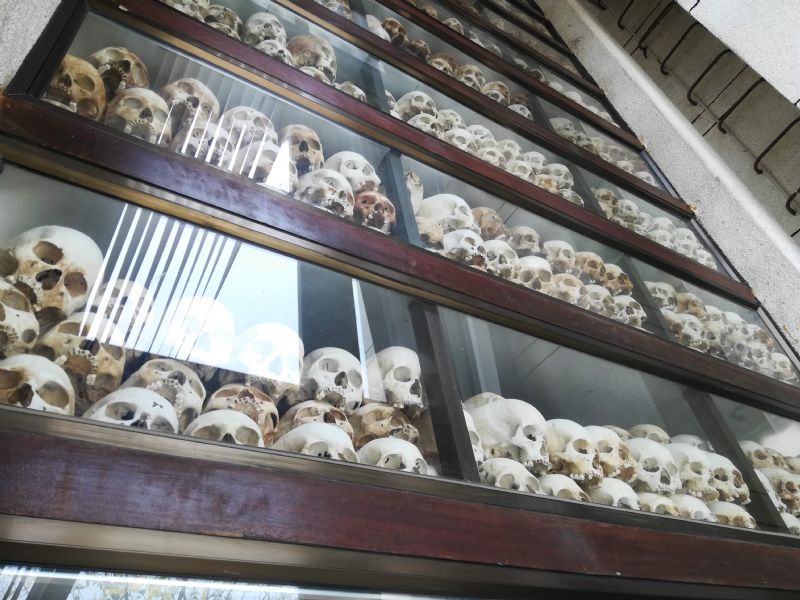
As I said, “The Killing Fields” is just one of several hundred sites scattered across the country–many are still inaccessible because of the indiscriminate land mines scattered around them. It’s difficult to process the scope of this tragedy. Even beyond the torture and execution of Cambodia people was the grinding process of starvation much of the country endured. Work was hard, people who had lived in cities had traveled long distances on foot to their new homes and were put to work with strict rations. Some simply refused to leave their homes and were executed as a result. From 1975-1979, some two million people died in Cambodia, approximately a quarter of the population.
Now let me take a quick aside:
Over the course of the World Race, I’ve been continuously aware of how incredibly fortunate I am to be an American. It’s the most opportunity-rich and free nation in the history of the world. I won’t pretend it doesn’t have areas to improve. Yet one of the most constant prayer requests I’ve encountered globally has been simple: a job. The countries I’ve been serving in have little or no industry. Where I was in Lesotho the men had 3 options: shepherd, construction, or leaving your family to be a miner in South Africa. Women kept the home, raised the children. Hopefully the father stuck around (I don’t say that lightly, family abandonment was a very real issue). The story runs true across all 3 continents I’ve been on.
Coming from an entrepreneurial climate in America where people start businesses for fun… where the poorest of the poor have greater issues with obesity than starvation… with the lowest rates of unemployment in decades (can we agree that’s good regardless of where our political differences may lie?). It’s just about the farthest thing away from what many of the people around the world experience.
So I have no trepidation in saying that many American problems are manufactured. We cast ourselves as heros in our own drama, overcoming “oppression”, or maybe just failing because of it. We don’t face starvation. We don’t fear a paranoid totalitarian government. Even coming from Seattle, a city struggling with a broken judicial branch, I still have total confidence in our judicial system. Being American is such an incredibly privilege… in the modern world its just silly, historically it’s obscene.
Aside over.
When we returned from the tour, we wandered around the waterfront of the Tonle Sap River for a time before turning back towards our hostel to find food and check-in. We had lunch, I ordered fried noodles, and a duck-broth soup (grand total $4 for 2 dishes). Then we checked into our hostel, the most hip one in Phnom Penh complete with pool, AC, and a few dozen world-traveler-type millennials.
We decided to rest and recharge for a bit. Clayton took a nap while Mike and I soaked in the pool. Though we looked on bemusedly at the secular drinking/hookup culture, it was a bit of a shock to the system. In the moment, the carefree nature of many of the guests stood in direct contrast to the solemnity we had been immersed in all morning. On the nose it was everything wrong with millennial culture. Granted, it was even greater of a shock because of the environment we have been in on the World Race generally.
The women on our squad do an incredibly job of dressing modestly. We have rules not to date, to limit our alcohol consumption. That makes for authentic relationships without any blurred lines, without occasion for temptation. Just as brotherhood nights in my fraternity (no friends, girls, significant others) were a relaxed affair where we could be ourselves, so being on the World Race is an environment free of showboating or pressure. We can all be great friends without our brains running to romantic conclusions. We are brothers and sisters in Christ.
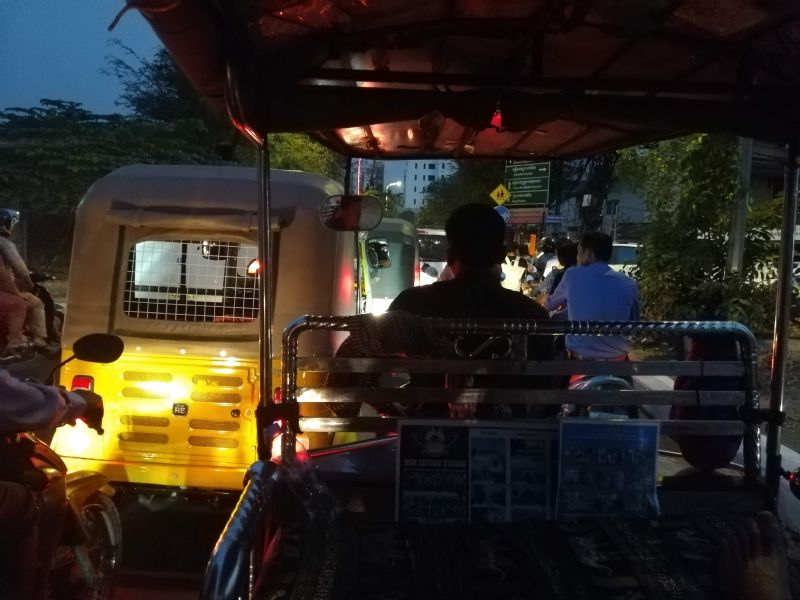
After our culture shock, Mike and I hopped in a tuk tuk to track down the only mass we would be able to make for the weekend. The catch-22 was that the service was in French! It was a first for me, but we’ve been attending mass in other languages for months now. I think I’ve attended Mass in Spanish, Chichewa, Nyanja, Besotho, and Khmer up to this point. So being able to understand some 40% of what was being said was a huge improvement from the last several months in Africa.
After mass, we went and snagged Clayton, and tracked down some dinner. This time I got fried noodles and some deep-fried frog legs. We ate heartily, and then went to explore the city at night. We made our way back to the riverfront, searching for a shake cart, but instead found ourselves in the middle of the Phnom Penh red-light district. I think Costa Rica was the last time that we had experienced commercialized prostitution (yet no surprise Cambodia and Thailand are some of the biggest human trafficking countries in the world). Certainly a sad modern twist to the tragic Cambodian tale we had been processing all day.
Once we eventually scouted out our shakes (mango-passion-lime for me) we sat and processed our day before wandering back to the hostel to turn in for the night (and to save Mike and I from ordering another round).
Our stay in Phnom Penh certainly gave us a lot to think about. Going in, I knew it would be heavy–this is a tragedy still fresh in the minds of the Cambodian people. Yet when we have been staying in touristy Siem Reap, interacting with such a joyous and hopeful group of Cambodians, this truly seems a world away. It’s incredible to imagine people being driven out of their homes, put to work, tortured, killed throughout the country. It raises so many questions. How could this have happened? What could have justified it? What was it like to recover from torture knowing more was soon to come? How stifling was the heat? How rancid were the smells? Did people not resist? How could they have held this view of a great society in the face of such pain?
At the core, Pol Pot was pursuing a system where the government promised to solve all the people’s problems. The well-being of the society overcame the rights of the individuals. In his sick mind, a price of a quarter, maybe even a half or more of his people was an acceptable price in the pursuit of utopia. They simply had to “root out” the parasites, the conspiracies, anyone who thought differently. Because only then could his experiment work.
Yet we are human, we do think differently from one another. There would have been no end. The Cambodian people were eventually subjugated by fear, resigned to their circumstances, trying to keep their heads down until it was inevitably rooted up by a paranoid government. It was only by foolishly poking the Vietnamese bear that Pol Pot incurred their invasion that unseated him. If he hadn’t would it be carrying on today? Would it be another version of North Korea? Thankfully we will never know.
To anyone who read this far, hats off to you. It’s tough but good to engage with the tragedies of humanity, to learn how and why they happened so we can be aware of how to steer away from them in the future.
Until my next blog, hopefully it’s a joyous testament to my time and ministry in some of these countries, or maybe a recap of Africa. I’ve got some good travel days coming up so I’ll try to have something else for you soon.
Prayer Requests: For our squad as we enter this final chapter. Asia is a totally different culture, and we are soon to be in Islamic countries which have severe limits on sharing our faith. I hope this can be a time of growth and clear focus as many people begin to prepare for their lives back home.







