
So, lastly is South America! While in South America, I will be going to Colombia, Ecuador, Peru, and Bolivia.
So, next up for South America is Ecuador!
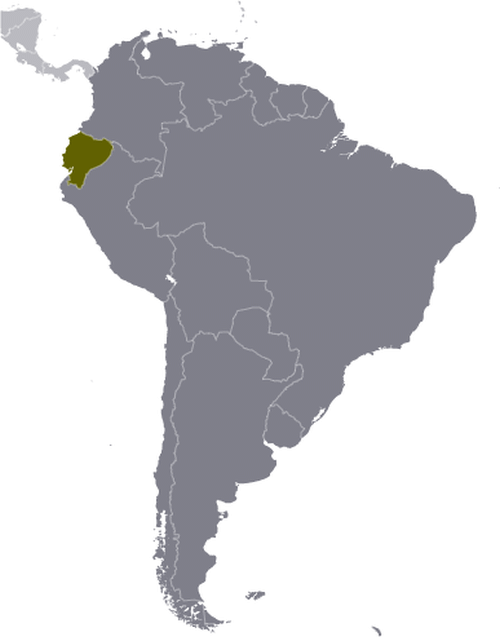
MAP OF ECUADOR IN SOUTH AMERICA
MAP OF ECUADOR
Summary
-
Named after the Spanish word for “Equator”, Ecuador is full of natural beauty. From the Amazon River to Andean glacial volcanoes, this country—and its people—are sure to enthrall you.
-
Quito, is the highest capital city in the world, at over 9,300 feet above sea level. Its views are breathtaking.
-
Although prosperous on the whole, certain regions of Ecuador continue to struggle. With more than half of the population at or below the poverty line, Ecuador is a country waiting for God’s Kingdom to come.
Area
-
283,561 sq km (Ecuador is about 2 times smaller than Texas!)
Culture
-
Members of both genders shake hands at greeting. People who know each other are likely to kiss on one cheek or embrace lightly. Indigenous people do not kiss in greeting and shake hands very gently.
-
The two major cities, Quito and Guayaquil, have distinct cultures. Quito, located in the mountains with a large indigenous community, is traditional, conservative, and mainly Catholic. The coastal city of Guayaquil, the economic hub, is less conservative.
-
It is considered rude to yawn in public, point with the index finger, or yell to get someone’s attention.
What I am going to do there?
-
I will be partnering with Inca Link Portoviejo, which is the same ministry my parents and I partnered with in Quito during PVT. In Portoviejo I will be working with the local church, kids programs, cancer hospital, garbage dump ministry, and maybe helping in the construction of new homes.
Climate
-
The climate of Ecuador varies by region, due to differences in elevation and, to a degree, in proximity to the equator. The coastal lowlands in the western part of Ecuador are typically warm with temperatures in the region of 77 °F. Coastal areas are affected by ocean currents and between January and April are hot and rainy. The weather in Quito is consistent with that of a subtropical highland climate. The city has barely any cool air since it is close to the equator. The average temperature during the day is 70 °F, which generally falls to an average of 50 °F at night. The average temperature annually is 64 °F. There are only really two seasons in the city: dry and wet. The dry season (winter) runs from June to September and the wet season (summer) is from October to May. As most of Ecuador is in the southern hemisphere, June to September is considered to be winter, and winter is generally the dry season in warm climates. Spring, summer, and fall are generally the “wet seasons” while winter is the dry (with the exception of the first month of fall being dry).
Language
-
The official language of Ecuador is Spanish.
Fun Facts
-
Guinea pig, known as ‘cuy’, is considered a delicacy in Ecuador, its consumption is seen as an ancient tradition.
-
Ecuador has the world’s first and second UNESCO World Heritage Sites. At the inaugural UNESCO World Heritage conference in 1978, 32 sites were initially designated. Every World Heritage Site has a number – site #1 is the Galápagos Islands and #2 is the city of Quito.
-
The summit of Mount Chimborazo, Ecuador’s highest mountain, is the point on Earth closest to the sun. Due to the mountain’s location along the equatorial bulge, its summit is the farthest point from the Earth’s core. This also means that Ecuador is the closest country to space.
-
The national tree of Ecuador is the cinchona tree which produces Quinine, the first drug used to prevent and treat malaria.
-
In 2008, Ecuador was the first country to officially recognize the rights of nature. Rather than treating nature as property, Ecuador recognizes that nature has constitutional rights and has the “right to exist, persist, maintain and regenerate its vital cycles.”
Is it safe?
-
Yes! Except for the occasional pickpocketers…
If you want to read other blogs in the Where in the World series, click on the country below!
As always, I invite you to make my journey, your journey. Here are three simple ways:
- The most important, PRAY.
- Subscribe. (If you want to subscribe to my blog and stay up to date on what God is doing in my life, click the orange “Subscribe for Updates” in the left-hand corner.)
- Share. (If you like what you read or feel called to, please share my blogs on any form of social media!
Also, if you are feeling called to support the World Race in a financial way, a couple of my squadmates are still in need of help. Click on their names below if you would like to know more about them!







