
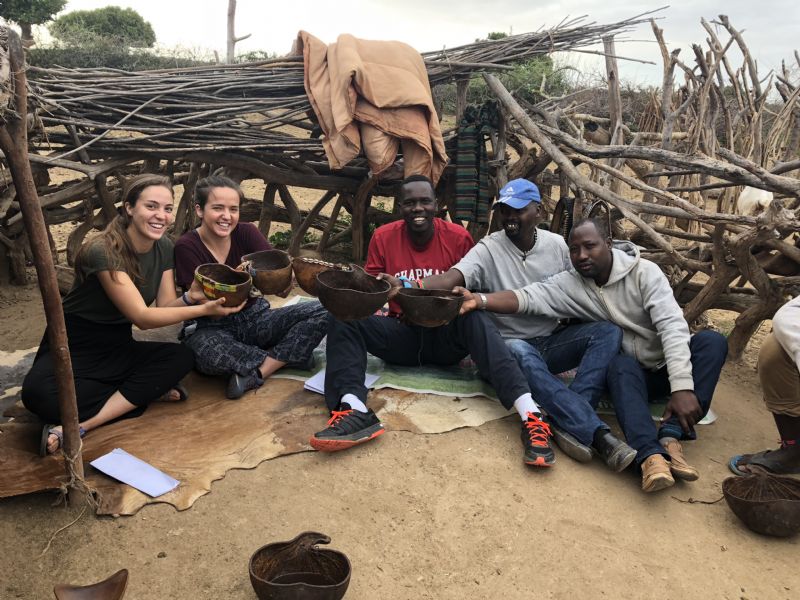
In this picture we are making a toast with our gourd coffee mugs. This is just one of the many wonderful memories I have of the trip we took to minister to the tribes in the bush of southern Ethiopia. These four days are undoubtedly the most memorable of the whole race. I’ve written about the adventures of it in my last blog but now I want to write about the greater and more beautiful side of the story. It is the testimony of the life of the man in the center.
Lale Labuko. The story of Lale’s life is a beautiful one, powerfully testifying of the grace and goodness of our wonderful Father.
Lale grew up in the heart of South Omo Valley, in Ethiopia. His people, the Kara tribe, are settled in the small village of Dus, meaning “dust”. Dus is a section of desert land on the banks of the Omo River. As pastoralists, the Kara people raise goats and cattle. In these uncivilized areas, clean water, medical care, electricity, and education are all extremely rare, and for most, non-existent.
In fact, in the Kara language there is no word for “education”. When Lale was a young boy, some missionaries started a school in Omo Valley. They tried to explain the need for education. Many of the elders didn’t understand and didn’t want to send their children, but Lale’s father, Labuko, was an exception. He was convinced that he wanted to send his son to school.
Little did Labuko realize what a beautiful gift he was giving Lale.
At nine years old, Lale started school. It was 65 miles away and Lale had to walk. It was very difficult. Several times a year he would walk back home to visit his family, then returned to school.
When Lale was 15, something happened that would mark Lale forever and would be the prompting towards the course his life was about to take. Before his eyes, a small child was gripped by strong hands and torn out of its mother’s arms. Despite the broken-hearted mother’s desperate pleas, and the child’s terrified cries, the men took the child to the river.
What Lale didn’t know in that moment was that this was only one of far too many children, including two of his own siblings, that were secretly killed in his village. They were thrown into the river, abandoned under a bush, starved, or suffocated by filling their mouths with dirt.
Lale ran to his mother and asked her about this incident. With Lale’s persistence, she reluctantly explained after making him promise to tell no one. She revealed the dark secret of the Mingi practice, a superstitious belief that a child cursed in this way must be killed to protect the tribe. Mingi happened in three ways: if the top teeth appear before the bottom teeth; if the conceived child was not blessed by the elders; and if the mother of the child is unmarried.
Many years later, in 2008, Lale decided it was time to talk to the elders. He challenged them to see Mingi as a blessing, not a curse! He told them some cultural practices are good, but killing is not acceptable.
Lale said, “Give the child to me. Let me be a river. Let me be a bush. I can take this child out of the tribe. The tribe will not be harmed.”
Lale was able to convince some of them and he rescued a few children, taking them into his own home, now in Jinka, 140 miles away. After saving six children, some of the elders wanted to stop him. “If you take more children, we will kill you,” they said.
However, Lale pressed on. By July 2012, the Kara tribe had declared the complete elimination of the Mingi killings among their people.
Now, in 2018, Lale, his wife Gido, and a large staff, are running the Omo Children’s Home, home to fifty rescued children who are growing, thriving, receiving a excellent education, and most importantly, being lavished upon with the pure love of Christ through Lale and his crew.
Lale believes these children are Ethiopia’s future leaders, inventors, presidents, doctors, and nurses.
Education is a powerful tool to change poverty, to resolve conflict, to make the impossible, possible. Lale’s life testifies of that truth, but even more, of the amazing grace of an awesome God.
Until the day I die, I want to help my people. – Lale.
And until the day I die, I will not forget the incredible experience I’ve had, walking beside this brother in Christ, and learning from him. I will tell his story and advocate for his mission and the needs of his people until the day I die…







