

A van picked us up from Cusco, Peru and took us as far as Hydroelectrica where we began footing it along the railroad tracks for the next 2 hours. Upon reaching Aguas Calientes (the valley town) we made our way to dinner and then bed.
3:30am came early on Easter morning, and by 4:30am I had hiked down to the bridge entrance at the base of Machu Picchu.
At 5am, the gates opened and the line of people I was within began crossing the river to ascend. Buses run up a hairpinned road that curves back and forth all the way to the top. I could have spent an extra $25 to ride up and back down, but I was trying to conquer this wonder of the world step by step like it’s settlers did 600 years ago.

Our foot path cut through the middle of the roads, etching a staggering 145 flights of stairs up the mountain’s side. It continued on and on and on in the darkness. Occationally, I would pass a stranger who had stepped aside to regain the air in their lungs. Likewise, strangers would occationally pass me by with a nod of the head. There wasn’t much to be said between the steps, sweat, and breaths. Daylight had broken by time I reached the parking lot where buses were dropping the first loads of people off. It would be 15 more minutes until the park entrance opened… which was fine by me and my legs.
A short rest and another opened gate later lead to an additional 30 minute climb up to Machu Picchu’s Inti (sun) Gate. The sun had just crested the ridge line enough to begin busting rays through the trees.

Easter morning, 7:30am… The sun came out, the wind shifted, and the veil of white clouds blew back from the view. People howled, wistled, and applauded as it revealed a head spinning plunge of decent that ran into the valley below. I could see the bridge (barely) that I had crossed at 5am when I began scaling this monster. Across the valley more sheer walls of green reached up to stare me back in the face. Jungle mountains. They aren’t like the Smoky’s which fold over in endless rolling. They aren’t like the Rocky’s wearing hard faces with limited vegetation. Nor are they like the Himilayas that are pointed while covered in snow. Jungle mountains are sheer. They’re clothed in an array of foliage and have one or more rounded peeks. They look mysterious. Like the floating mountains of Pandora or a landscape pulled out of a fantasy novel.
“He is risen,
He is risen indeed!”


Machu Picchu’s Incan settlers arrived in 1450. It took 90 years to build and wasn’t discovered until 1911. It was never conquered.
The ruins’ stones were cut without morter to fit together; the cuts are so exact that even a needle can’t be fit between them. With some of them weighing in at over 50 tons, it’s hard to imagine how the stones were transported to the mountain top. Over 600 terraces keep the city from falling off the cliffs. A cut stone sits on a raised section and was used as an astronomical clock. At noon, the sun is directly above it and casts no shadow.
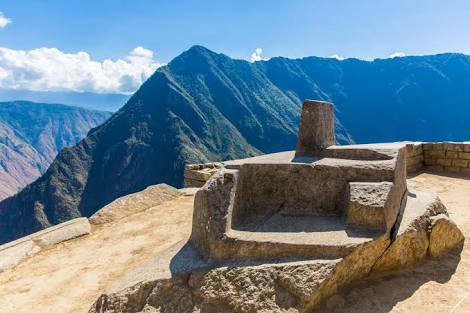
The sundial is just above the large alter they used for animal sacrifices.

It is believed that 1,000-1,200 Incas populated these ruins years ago. Its settlers abondonded the great city in 1572 so that it would not be discovered and conquered by the Spanish. Since its discovery 107 years ago, it has become a wonder of the world and is now the most visited place in Peru. 









