I’m writing my first blog post back from the Race from the subzero temperatures and snow mounds of Minnesota. I’m wondering if I should sign up for the Race again to escape this desperate reality. Kidding. I’m actually really excited to be home.
It’s been a huge blessing to spend time with family and friends over Thanksgiving and a trip to Florida. I presented my trip to a group of students that my mom teaches, and it went really well. They were very attentive, participatory, and curious. They asked a ton of questions and tried the traditional foods that we brought in. These foods included: arroz con leche (Central American dessert, consisting of rice, condensed milk, and cinnamon), pineapple and mango dipped in salt, a traditional Chilean once (tea, bread, spreads, cheese, cold cuts, avocado, fruit, pastries), baklava (European pastry with nuts, honey, syrup), tarator (Bulgarian cold soup with cucumber and yogurt), and chapati (Indian/East African tortilla). I was very impressed by them.
One thing that consistently interested me throughout the Race was language. Having studied Journalism and Spanish, I have always found language to be fascinating in its nuances with letter, sound, and construction. In each country, I took some notes about certain linguistic phrases or tendencies that struck me, included below.
COSTA RICA – Spanish
-Un gusto: You’re welcome, literally meaning “a pleasure”
-Typically, the phrase “you’re welcome” in Spanish is “de nada”, literally meaning “of nothing”
-¡Que dicha!: How nice!
-Chiva: Cool
-Tico/Tica: Costa Rican man/woman
-Pura vida: Great, literally meaning “pure life”
-Ocupar: To need/take up
-Ahora: Later
-Typically, the word “ahora” in Spanish means “now”
-Ya: Now
-Typically, the word “ya” in Spanish means “already”
-Panza llena, corazón contento: Full belly, happy heart
-Rezar: To pray (memorized prayers, like in the Catholic Church)
-Orar: To pray (personalized prayers, like in the Protestant Church)
-The formal version of “you” is “usted” and is used frequently even among peers
NICARAGUA – Spanish
-Dale pues: Let’s go, a filler phrase used frequently
-¿Que honda?: What’s up?, What’s going on?
-A la orden: You’re welcome, literally meaning “at the order”, similar to the English phrase “at your service”
-Nico/Nica: Nicaraguan man/woman
HONDURAS – Spanish
-Platicar: To chat/talk/converse
-Typically, the verb “to talk” in Spanish is “hablar”
-Andar: To walk/have/do/carry/take, has multiple uses
-Vaya pues: To go/leave, filler phrase
-Echar: To throw out/get/put, has multiple uses
-¿Cómo no?: Why not?, Of course
-Vos: You
-Typically, the word “you” in Spanish is “tú”
-Cheque: Cool, Okay, Got it, literally means “check”
CHILE – Spanish
Chilean Spanish was completely different than any other Spanish I had heard. It is spoken very fast and uses different vocabulary. Below I included the Chilean word, the typical Spanish word, and the English translation.
-Ave/pollo: Chicken
-Palta/aguacate: Avocado
-Choclo/maíz: Corn
-Bolero/camisa: T-shirt
-Frutilla/fresa: Strawberry
-Manjar/caramelo: Caramel
-Bacán: Cool
-¿No, cierto?: Right?, literally meaning “Isn’t that true?”
-Gallo y cabra: Married, literally meaning “rooster and goat”
-The word “po” is added to the end of phrases, doesn’t stand for anything but changes meaning
BOLIVIA – Spanish
-¿No ve?: Right?, literally meaning “Don’t you see?”
-Harto: Fed up/full/difficult/many
-Buen día: Good day
-Typically, the phrase “Good morning” is plural in Spanish as “Buenos días”
BULGARIA – Bulgarian
Bulgarian uses the Cyrillic alphabet, which is also used for Belarusian, Macedonian, Russian, Rusyn, Serbo-Croatian (for Standard Serbian, Bosnian, and Montenegrin), and Ukrainian.
-Baba: Grandma
-Le le: Wow, an exclamation
-Che: Name ending, added to the ends of names for distinction and affection
GREECE – Greek
Greek uses the Greek alphabet, which many Americans are familiar with because of its usage in sorority and fraternity organizations.
-Opa!: Oops!, Whoops!, also used frequently as a celebratory exclamation
ROMANIA – Romanian
Romanian is the only Romance language spoken in Eastern Europe.
-Varza: Tired/chaotic/messy, literally means “cabbage”
ETHIOPIA – Amharic
Amharic is spoken in Ethiopia and consists of a complex alphabet with seven variations of each letter.
-Boona: Coffee
-Farench: White person
-Habesha: Eritrean or Ethiopian
-Eshi: Okay, I’m here
-Undulating is very popular in celebrations. People yell something that sounds like “Lelelelelelele!”
-Distinct “k” sound that is popped
-For yes, they simply suck in air instead of saying any words
RWANDA – Kinyarwanda
-Smart: Nice, Good looking
-They say “Sorry” all the time (example: someone trips, something is dirty, there’s a snake in the road)
-Pronounce “k” as “ch” (example: “Kigali” is pronounced “Chigali”)
-Pronounce “l” as “r” (example: “Lucie” is pronounced “Ruthie”)
-Repetitively proclaim a few English phrases like: How ah yoo?, Ahm fine, Good aftahnoon
-The word “yes” sounds like “ayy” and the word “what” sounds like “ehh”
-To indicate “yes,” they tilt their heads up and raise their eyebrows without saying anything
-During a sermon, they click their tongues at points that strike them
UGANDA – Luganda, Swahili
-Mzungu: White person
-Boda Boda: Motorcycle, very common means of transportation
-In Rwanda and Uganda, the commonly found tortilla is called chapati. However, they are pronounced differently: cha-pah-tee (Rwanda) vs. cha-pot (Uganda).
-In translation, often they would call us “the whites”
-In a school we visited, the students would clap and chant “lovely, lovely, and nice” after a song, dance, or introduction
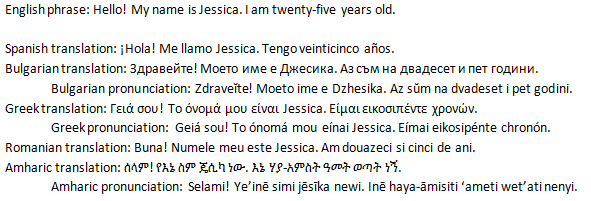
Here is an example of some of the languages translating the same English phrase. I wasn’t able to find adequate translations for the languages spoken in Rwanda or Uganda, but I included the rest.