
Petrova approached us after church one Sunday in her canary yellow dress and furry purple jacket. We’d heard of the woman in the church with all the paintings, but I didn’t think to prepare myself for the little elderly lady who arrived in a cloud of color and fabric throwing out rapid-fire demands in Bulgarian. She wanted “the Americans” to come see her artwork.
Shorty afterwards, our new friend ushered us into her home wearing a traditional Bulgarian dress and a small collection of medals which, as we would later discover, she won for various artistic achievements. The space, an ambiguous combination of home and gallery, was covered with paintings. Stacked of canvases lined the entryway, and the walls of all three rooms were almost entirely hidden. Furniture, pushed haphazardly out of the way, functioned only as storage for additional artwork. There were easily hundreds of paintings tacked and jammed into the small space.
As I walked through her gallery, it became evident that Petrova’s faith was her primary point on inspiration. From countless vantage points and in various stages of action, images of Jesus covered her walls. She grabbed my hand, pulling me along from painting to painting with an almost childlike enthusiasm. We stopped, she would offer some kind of description for the piece, usually in Bulgarian, until I could indicate some level of understanding, and then it was on to the next.
The crowing glory of Petrova’s collection was her floor to ceiling mural of Jesus seated at the right hand of God. The life-size mural was the final stop on my personal tour, unveiled only by a large pair of of red drawstring curtains and decorated with blinking Christmas lights. It was the strangest combination of beauty and eccentricity.
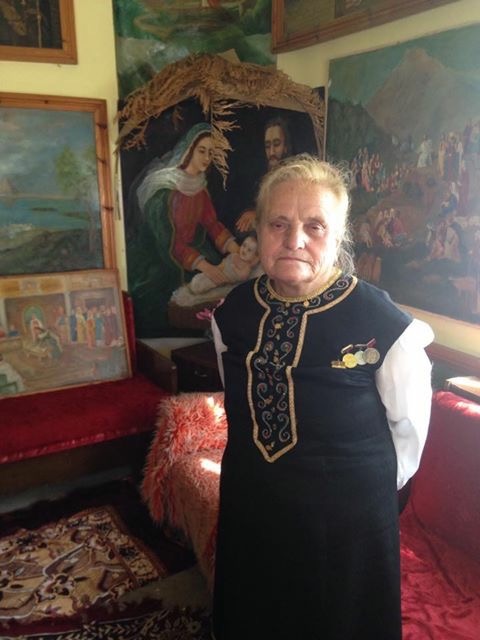
I only know small pieces of her story.
Petrova attended art school in Sofia, the capital of Bulgaria, from 1975-1979. The brief biography included in her self-published book says her paintings have been recognized by Bill Clinton and Mikhail Gorbachev, to name only a few. I don’t know the basis of these claims, but I can say the likenesses of Bill Clinton and Queen Elizabeth that appear in one of her more daring pieces were especially accurate.
The sheer multitude of paintings is the best evidence I could provide towards the longevity of her faith. At some point during the communist regime, she was almost arrested for writing and circulating Christian pamphlets. Police officers searched her house, looking for the typewriter and “religious propaganda” Petrova had buried in her backyard only two days earlier. The police later shot bullets at her husband as he was returning home one afternoon in an act of angry retaliation against the couple’s faith.
At eighty-five years old, Petrova now lives by herself. I don’t know anything about her family beyond the mention of her husband in distant a memory, and the single painting of him propped near the entryway of her house. He’s holding a bible.
She approached me again after church today, this time in a bright yellow jacket and black athletic sunglasses, instructed our translator to tell me about the illustrated children’s bible she is creating, nodded once, and left without another word. It was probably the most unique goodbye I will say to anyone in Bulgaria, but, thinking back to our visit, I can’t seem to forget the loud little Bulgarian lady standing alone with all of her paintings, image after image of Jesus. That picture, the woman and her work, the inexplicable combination of artistry and peculiarity, is perhaps one of the most beautiful expressions of faith I have ever seen.
At this point, I still have more than 5,000 dollars left to fundraise. If you feel inclined to provide any kind of financial support, I would be incredibly grateful and your donation would help ensure I stay on the field for the full eleven months. God bless!







