
Today my team left for Stoborasti, a village an hour from Draganesti. We will be here for 5 days, while Jason’s team is staying in Draganesti. While here we are staying in a Baptist church, with the pastors’ family. As soon as we got here we enjoyed some lunch and then rested in the afternoon until the heat of the day simmered down. It has been 35 degrees Celsius here. During this time I learned a lot from pastor Alex concerning the Gypsy people in Stoborasti.
The gypsy people originated from India, not Egypt, which may be the perception. The Persian emperor invaded India and took people who could sing well as slaves in Iran. The Turkish emperor then invaded Iran and took these slaves as their own back to Turkey. When the Turkish Ottoman Empire began persecuting their slaves, the Indian slaves fled to Romania, Russia, France, Hungary, England, Czech Republic, and other European countries. The majority fled to Romania and Russia and were soon taken as slaves by the native people. The slaves began learning specific trades; trades of the families who enslaved them. This brought about different gypsy groups such as brick makers and bear trainers for the circus (hmm I think I’m part gypsy if this is the case).
Further, when the gypsy people were free from slavery, they split into 3 groups: nomads, semi-nomads, and sedentary. The nomads had no home and were constantly traveling. The semi-nomads traveled in the warm months of the year. The sedentary gypsies settled in villages.
Seeing the gypsy people around Stoborasti and Draganesti, I am gaining an understanding of who they are today. Today they are not much liked by the Romanians because of their lifestyle. Their politically correct name is Roma, but the Romanians do not want to call them this because it is too close to the name Romanian and these peoples are not Romanian. In Draganesti we were surrounded by gypsy children as we left the market and they continued to press in on us until we got in the van. He proceeded to tell us that a study was done to compare the amount of money collected by a Gypsy versus a working Romanian and it was found that the gypsy families make more than the upper middle class Romanian. In Stoborasti, we see gypsy families move up and down the streets in covered wagons, selling wood or other materials. Their horses may be skin and bones and have scabbed backs from flies and from being whipped.
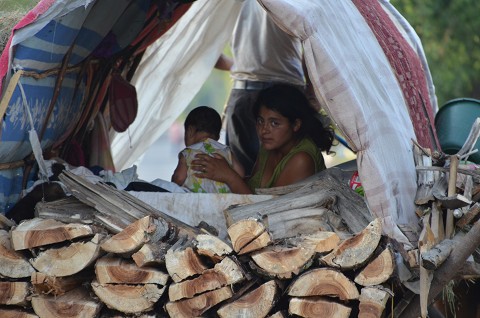
Their lifestyle now is a result of being uneducated as they do not attend school. They are hurt from society and do not want help from Romanians, and frankly most Romanians don’t want to associate with them. Pastor Alex has a heart for the Gypsy people though and so does his church. They work to educate the gypsy people in the area and while doing so, tell them about Jesus. When they receive a Bible though, they are not able to read it because most of them do not know how to read. These are the things Alex is working towards. Some villages now have gypsy churches and schools, still run by Romanians, but hopefully one day run by their own people.
Those gypsies who have become followers of Christ now see that they do not want to go about life the way they were taught as children. They do not want to marry their daughters at 12 years old or even 16 years old. They do not want to steal. They want to be educated.
Prayers:
Pray for Alex and his ministry in Stoborasti.
Pray for doors to open for other teams to come and work with Alex and expand his ministry.
Pray for the resources to educate gypsies in Stoborasti and the surrounding villages.
Pray for the hearts of the gypsy people to be transformed and renewed in Christ's love.







