
I want to talk about slavery; largely, about the fact that it’s not dead. Slavery is not a problem of the past; it is a very real and prevalent problem of the present. Globally, the human-trafficking industry (both labor and sex) makes $150 billion annually from exploiting men, women, and children. People are lured, coerced, kidnapped, sold, and deceived into joining this industry. The majority of victims are migrants, ethnic minorities, and stateless people. This is especially true in the country of Thailand where a large portion of the population are migrants. More often than not, these are people seeking refuge from their home country where corruption has run rampant or war has become a norm. Thailand is known for being a major hub in the human-trafficking industry. The U.S. Government states that conservative estimates have the number of victims in the 10’s of thousands in Thailand alone. Prostitution and trafficking are illegal in Thailand, but widely accepted. Sex tourism is largely unregulated and often ignored as there are no real laws surrounding it and because it generates revenue for businesses in the areas where it is widely practiced. Pattaya, Thailand is one of those places and its Red Light District is called The Walking Street.
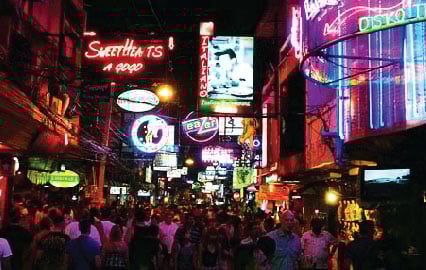
The Walking Street is like something straight out of a movie. As I made my way down the cobblestone street, my eyes skimmed over signs that read, “Virgins”, “Crazy Russian Girls” and “Good Guys go to Heaven, Bad Guys go to Pattaya.” Neon lights line every bar, strip club and massage parlor while girls in platform shoes and uniforms covering the bare minimum are stationed outside. Every couple of feet men thrust “menus” in front of you asking which “service” you would like to participate in. They have pictures and numbers, just as if you were at McDonald’s ordering a Big Mac and fries. I saw girls with numbered bracelets on their wrists indicating which choice they were. It reminded me of how farmers mark cattle to keep track of which ones they own. As I walked, I heard girls calling out to men begging them to come inside. I heard a handful of different languages amidst the loud music vibrating out of every building along the street and saw faces young and old. The entire atmosphere was filled with the scent of smoke, alcohol, body odor and waste. There were men who had girls probably 30 years younger than them, draped across their laps or hanging on their arm. Surprisingly (to me), the expressions I saw on their faces weren’t of amusement or pride, but emptiness; much like the girls. It looked like the life had been completely drained from them; like they had stopped believing in life and love.
The Walking Street is a haven for people looking to escape their lives and feed their desires without having to do it all too discreetly. It’s a place that doesn’t cater to intentional conservation or light-heart fun; in other words, you wouldn’t go there for a date or looking to meet your future spouse. There’s no room for love or compassion. It’s a place where hurt people hurt people, and in that way, create a vicious cycle that keeps the place running. I expected to have a plethora of emotions upon walking that street, but I didn’t. Everything about the street distracts you from forming a clear thought or being able to focus. Every hold you think you have is diminished. The courage you thought you’d have and the prayers you thought you’d pray suddenly disappear. Honestly, the only semi-logical thought I could form at first was, “Holy sh*t.” Now, I apologize for the coarse language, but I’m trying to be real with you. The blatant display of exploitation and dehumanization smacks you in the face. I couldn’t rightly process everything that I was seeing and experiencing around me in that moment. At first all I could do was walk.
I remember asking God, why and how, and what can I do? I think the first two very real feelings that I felt, after the initial shock, were anger and hopelessness. Anger because if there wasn’t such a high demand, that street wouldn’t exist and hopelessness because I felt small compared to the amount of brokenness and despair that was in front of me. I felt the pain that I know God feels when He looks down on that street and the despair that comes with being human and facing a harsh reality. I kept asking, “What am I supposed to do God?” I felt the need to really find where He was amidst the pain and hurt that hung like a cloud over the Walking Street. But I wanted a solution more than anything; how can we change all this?
My friend Alleigh and I decided to go into one of the bars along the street and see if we could talk to some of the girls inside. Unfortunately, the ones we attempted to have conversation with spoke hardly any English. We sat at the bar and decided to just pray for them. Sitting there, praying, was when we met Moy. She was a waitress of sorts, in an aqua blue tank top dress, heels, hair in a ponytail and black eyeliner caked around her eyes. I noticed she was hovering and staring at us every few minutes so when she came closer to us, I asked what her name was. We all began to talk and she told us she had been working at the bar for three years. She said she had to provide for her mother, father, and six year old son. She was so excited to show us pictures of her boy and said to us, “I’m a good mom!” And I didn’t doubt it for a second. She tried to teach us some Thai and we all laughed as we tried to pronounce the words. What I saw in Moy, in the short time I talked with her, was hope, light and love. I saw it in the way she smiled and in the way she talked about her son. And I felt it in the way she hugged me when we said goodbye.
I don’t claim to know what it’s like to have to take care of your parents and young child without any help; to live so far from home and feel like the only option is working in a bar on the Walking Street. This is why I could never judge her. She didn’t and doesn’t need judgment. And she doesn’t deserve it either. What she needed was someone to just talk to her, someone to listen, to step into her story and share in her joy. Someone to ask about her, pray for her, and to show her love in a new way; the kind of way that’s not based on anything but is simply genuine and unconditional, the kind of way that Jesus loves us. Jesus loves her the same as He loves the rest of the world, the same way He loves each person who walks up and down that street, and the same way He loves the man sitting at the bar.
I heard this story one time about starfish. An old man went to the shore every morning to do some writing and one morning, the beach had been covered in thousands of starfish. As the man walks down the beach looking at all these starfish, he notices a boy coming toward him, picking up a starfish every so often and throwing it back into the ocean. He asks the boy what he’s doing and the boy tells him that the starfish can’t get back into the sea by themselves and if he doesn’t help them, they will die. The old man then basically says to him there are too many and he doesn’t think it will make a difference. In response, the boy bends down, picks up another starfish, throws it into the ocean and then smiles and says, “It made a difference to that one!”
What I learned through meeting Moy was that sometimes it’s not always about the masses, it’s about the one. I was looking for the answer that would solve the greater problem. I looked at the entirety of the brokenness on that street and asked, “What am I supposed to do?” In doing so, I felt hopeless and incapable. I was thinking big picture, which isn’t necessarily wrong but the funny thing is, God brought me to one person. I think what He wanted to show me was that individuals are important, that even though it’s only one person, it still holds the same significance as a thousand people and that’s how we begin to solve the greater problem. We should never underestimate the power of simply asking someone about their life, of showing compassion and finding out who they really are.







