
This month we went to see the genocide museum here in Phnom Penh, Cambodia. We went to S-21 where the Khmer Rouge held, tortured and interrogated innocent prisoners.
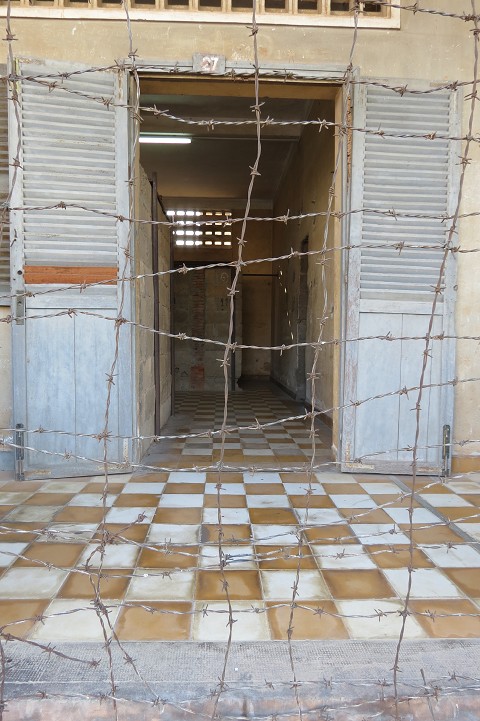
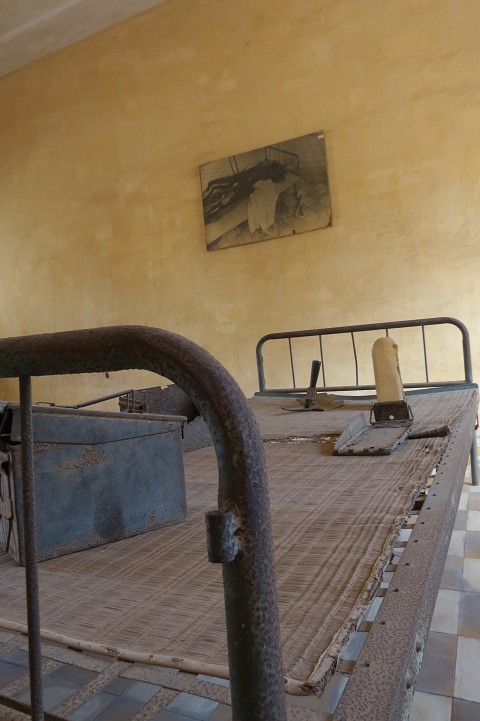
After the Khmer Rouge was overthrown by the Vietnamese, the last 13 victims at S-21 were found tortured and laying on their beds. It was very eerie to walk into the rooms with the beds and shackles and look over to see photos of the mangled bodies lying on the same beds that were right in front of me.
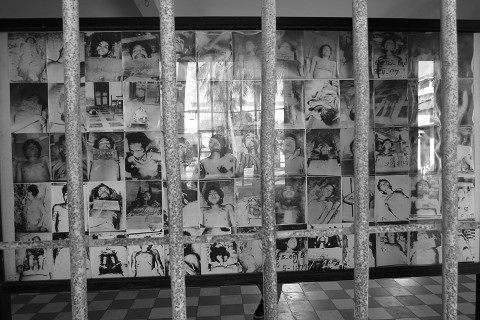
The museum was lined with photos upon photos of the faces of prisoners. In conjunction with the conditions of slave labor, starvation, physical injury, illness, and the mass amounts of civilians found “guilty” tortured and killed at the killing fields, the number of deaths estimated in 3 years of rule by the Khmer Rouge is well over 2 million.
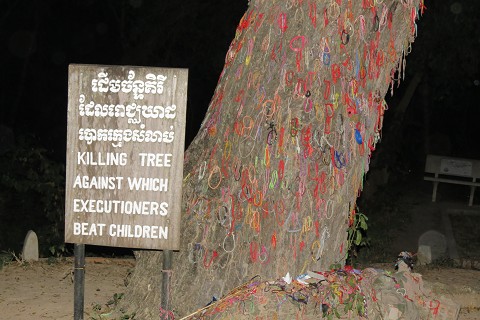
One of the worst things I saw was the “killing tree.” The Khmer Rouge didn’t want to waste so much money on bullets, so they killed a lot of people by beating them with tools. This tree is what they beat infants and small children against to kill them. They killed the children to eliminate the possibility of later revenge.
All of this was awful to see and learn about and many of us had never even heard of the Khmer Rouge or of the genocide. We don’t learn about this in schools, even though this was going on during the Vietnam War and America was involved; perhaps because it’s a fairly shameful part of our history. Here is a little bit about the history of the genocide:
The aim of the Khmer Rouge was to deconstruct Cambodia back a primitive “Year Zero,” wherein all citizens would participate in rural work projects, and any Western innovations would be removed. Pol Pot brought in Chinese training tactics and Viet Cong support for his troops, and was soon successful in producing a formidable military force. In 1970, the Khmer Rouge went to civil war with the U.S. backed “Khmer Republic,” under lieutenant-general Lon Nol. Lon Nol’s government had assumed a pro-Western, anti-Communist stance, and demanded the withdrawal of North Vietnamese and Viet Cong forces from Cambodia. The Khmer Rouge guerillas were finally successful in deposing Lon Nol’s government in 1975. Under Pol Pot’s leadership, and within days of overthrowing the government, the Khmer Rouge embarked on an organized mission: they ruthlessly imposed an extremist program to reconstruct Cambodia on the communist model of Mao’s China. It was these extremist policies which led to the Cambodian genocide.
In order to achieve the “ideal” communist model, the Khmer Rouge believed that all Cambodians must be made to work as laborer in one huge federation of collective farms; anyone in opposition to this system must be eliminated. This list of “potential opposition” included, but was not limited to, intellectuals, educated people, professionals, monks, religious enthusiasts, Buddhists, Muslims, Christians, ethnic Chinese, Vietnamese, Thai, and Cambodians with Chinese, Vietnamese or Thai ancestry. The Khmer Rouge also vigorously interrogated its own membership, and frequently executed members on suspicions of treachery or sabotage. Survival in Khmer Rouge Cambodia was determined by one’s ability to work. Therefore, Cambodia’s elderly, handicapped, ill, and children suffered enormous casualties for their inability to perform unceasing physical labor on a daily basis.
As many as 750,000 Cambodians died over the years 1970-1974, from American B-52 bombers, using napalm and dart cluster-bombs to destroy suspected Viet Cong targets in Cambodia. The heavy American bombardment, and Lon Nol’s collaboration with America, drove new recruits to Pol Pot’s Khmer Rouge guerilla movement. Many Cambodians had become disenchanted with western democracy due to the huge loss of Cambodian lives, resulting from the U.S.’s involving Cambodia in the war with Vietnam. Pol Pot’s communism brought with it images of new hope, promise, and national tranquility for Cambodia. By 1975, Pol Pot’s force had grown to over 700,000 men. Within days of the Khmer Rouge takeover of Cambodia in 1975, Pol Pot had put into motion his extremist policies of collectivization (the government confiscation and control of all properties) and communal labor.
All political and civil rights of the citizen were abolished. Children were taken from their parents and placed in separate forced labor camps. Factories, schools, universities, hospitals, and all other private institutions were shut down; all their former owners and employees were murdered, along with their extended families. Religion was also banned: leading Buddhist monks and Christian missionaries were killed, and temples and churches were burned. While racist sentiments did exist within the Khmer Rouge, most of the killing was inspired by the extremist propaganda of a militant communist transformation. It was common for people to be shot for speaking a foreign language, wearing glasses, smiling, or crying. One Khmer slogan best illuminates Pol Pot’s ideology:
“To spare you is no profit, to destroy you is no loss.”
http://worldwithoutgenocide.org/genocides-and-conflicts/cambodian-genocide
This dark part of the Khmer history still affects the country today. Almost everyone living has someone in their family that was killed during the genocide. Many of the girls in the dorm lost grandparents to the Khmer Rouge. It’s amazing how open and happy these people are even after all they have gone through and the hard ships of their past. Pol Pot’s regime completely destroyed the economy along with any western factories and industry and the country is slowly trying to rebuild what was lost. Sadly, probably the largest money making industry is the sex trade. It’s definitely the main tourist attraction. It’s also common to find men selling drugs on the street. But, while there is a lot of darkness there, I have great hope for this nation that is slowly turning to Jesus.
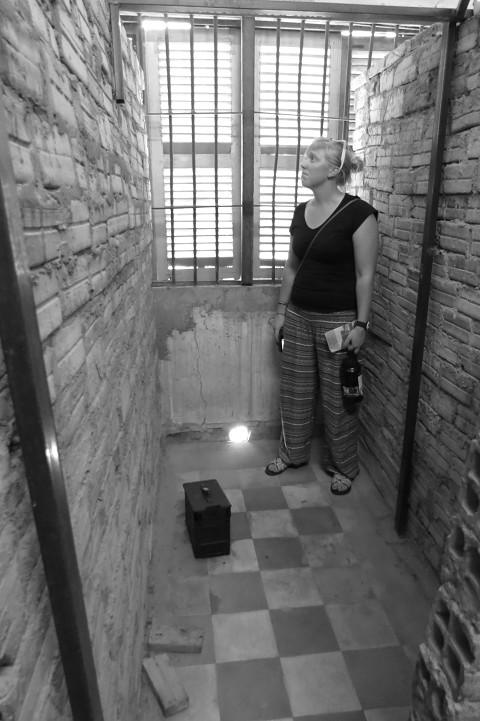
The tiny cells the prisoners were kept in.
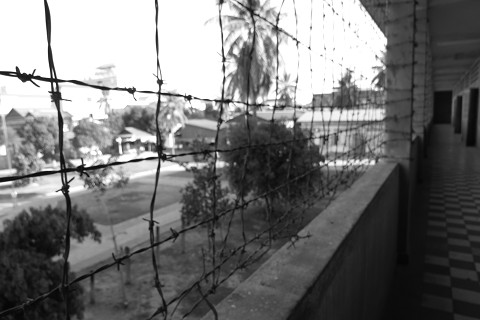
Wire covered all of the balconies so prisoners couldn't commit suicide.
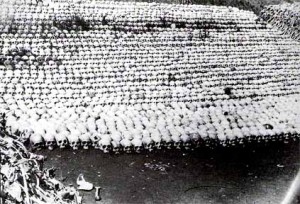
Some of the skulls found at the killing fields.







