
Swaziland is a tiny country in south western Africa that is home to 1.3 million people. Sadly many of those people will not live to see the age of 50 since the average life span is only 49 due to record rates of HIV/AIDS and Tuberculosis. Because of this many children are raised in children headed households because their parents have died. If the death rate continues to be what it is Swaziland will cease exist as a nation by 2050.
In Swaziland part of our ministry was to serve at a care point two days a week. At this care point children would come to get, for many of them, the one meal they would eat that day and once a week receive bible lessons. In exchange for attending bible lessons children would also get their school fees paid for.
Let me paint you a picture. Every Monday and Wednesday my team would wake up, lather on sunscreen, eat breakfast (often a bowl of yogurt and muesli or two boiled eggs), pack our lunch (a peanut butter jelly sandwich and a piece of fruit), grab our hopefully frozen water bottle, and head out the door to begin our 7km walk to the care point. The care points are fairly primitive. Ours had a church building, a row of holes in the ground to squat over (thankfully there were stalls built around each hole), a one room school house (that sadly had no teacher), a water tank, and an outdoor ‘kitchen’ that was three walls and a roof made out of metal roof sheeting and housed a giant black cast iron pot for cooking. The care point is maned by a grandmother who cooks and serves the children and a shepherd who runs the weekly bible study and does what she can to check in on the families who attend. Often the mom’s come to the care point with their children and sit talking while their children play. As no one at the care point speaks English our job was to help the children wash their hands and interact with the kids.
Our first day was the hardest. We left at 9am walking 7km straight in the blazing sun. And we sat there all day out in the sun until 3:30pm to make the 7km walk back again straight into the blazing sun. That walk home was the hardest walk of my life. My skin was burning, my stomach was starving, and my 1L water bottle was long empty. With every step I wondered if my legs would support another one and I began to cry as I stared at the dry rocky ground praying that if I were to faint that I wouldn’t hurt myself on the rocks. It was then that I noticed the footprints. Tiny footprints. Tiny barefoot footprints. Tiny barefoot footprints pressed into this rocky dry ground. These footprints reminded me of the kids at our care point who also make this long journey who are also starving. Kids who wear the same clothes every single day and that are full of holes. Kids who if they are lucky enough to have shoes have shoes that don’t fit. Kids who is will probably never see anything outside of the area they live in. It broke my heart in a way I can’t explain. The best I can do is share the poem I wrote about it.
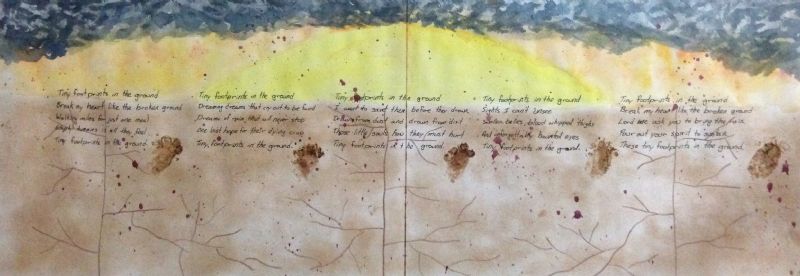
Tiny footprints in the ground
Break my heart like the broken ground
Walking miles for just one meal
Empty tummies is all they feel
Tiny footprints in the ground.
Tiny footprints in the ground
Dreaming dreams that cry out to be found
Dreams of rain that will never stop
One last hope for their dying crop
Tiny footprints in the ground.
Tiny footprints in the ground
I want to save them before they drown
Drown from dust and drown from dirt
Those little souls how they must hurt
Tiny footprints in the ground.
Tiny footprints in the ground
Sights I can’t unsee
Swollen bellies, blood whipped thighs
And unforgettably haunted eyes
Tiny footprints in the ground.
Tiny footprints in the ground
Break my heart like the broken ground
Lord we ask you to bring the rain
Pour out your spirit to sustain
These tiny footprints in the ground.
Out of all the poems I have written on the race this one is the most precious to me. I feel like it is the story of these children’s lives. Swaziland is in a state of emergency because of drought. The ground is cracked. The sugar cane fields are dead. Less than 10% of the crops will be harvestable. These children are dying. Dying of disease, malnourishment, and dehydration. Children would reach down our shirts grabbing at our breasts because even at the age of 5 many of them are breast fed because it is a free source of food. People on my squad witnessed children chase after a goat, knock it over, and start drinking directly from its udders. Their eyes are haunted because of what they have seen and experienced and witnessed. Many children have visual scars left by what looks like can only come from abuse. One boy had five neat rows of burn marks on his temple in a nice straight line from what looked like metal wire. Another boy who was naked and being hosed off at the care point on the first day we arrived bleeding from welted sores on the back of his thighs and bum that looked like they could have been received from a whipping. Like I said these children broke my heart. The other reason this poem is so special is because of the painting I made of it; a piece of my heart is forever in Swaziland and with this painting I will forever have a piece of Swaziland with me. I used the actually dusty, rocky, dry ground to smear onto the page and create the ground in the picture and then mixed it with water to create the mud used in the footprints.
The reason the first day was the hardest was because it was our longest. After that we decided we could no longer endure the long days on such little food and walks with the sun in our face. From then on out we started packing two sandwiches, bringing a 5L bottle of extra water for the team, leaving the house by 8am and heading for home at 12:30. It was clear that we were not cut out for the harsh conditions that is the reality these children live with every day of their lives. While we may think we have it better with our three meals a day, beds to sleep in, and clothes and shoes that fit, it is clear they are superior to us when it comes to surviving the harsh realities of life in Swaziland.
I want to close out this blog and this country on a positive note. I want to introduce you “Jackson” his Swazi name is pronounced Moon-ta-loom-ba, but I gave him the nickname of Jackson. Jackson was my favourite part of the care point. Every day when we would arrive him and the other children would come running to us. Jackson would always go and hangout with Marius first for 20 minutes or so but after that he was mine. He would come to me and climb into my lap, wrap his arms around me, and snuggle in for a nap. We would stay this way for about an hour and a half at which point lunch would be ready and he would wake up to the smell of food and then afterwards take off to play with his friends. Twice a week for an hour and a half I got to provide a safe comfortable place for this beautiful 5 year old boy to sleep while I rubbed his back, rocked him back and forth, and prayed for him. I loved this little boy so much that on my last day off in Swaziland I tried to search out someone who would be willing to make that 7km walk both ways with me just so that I could see him one last time. Sadly I never got to say a proper goodbye to Jackson. If I had known it would have been my last hug from him I would have held him a little longer, kissed his head, and told him how much I loved him and that I would miss him even though he would never understand what I was saying.







