
Just imagine. You live in a beautiful country; the weather is nice, your country has a rich history and lovely old architecture. Your father and grandfather built their families and business here, you went to college and have a good job. Three years later your country is broken into pieces, you have to leave your entire family and you are seeking asylum in Ridderkerk, the Netherlands. After wandering through a whopping 16 different whereabouts you are back at the boat landing sites in Greece. This is the story of Ibrahim, a volunteer at the Dutch Boat Refugee Foundation.
Damascus – Syria
Ibrahim is 27 years old. He earned his degree in electrical engineering, has two sisters, played soccer twice a week, and visited family often. His father owns a stone factory and had plenty of money for the family, a good and quiet life. Ibrahim had a ‘good’ life but he was not happy with his life.
Ibrahim, like many in his generation owned a smartphone and read news from all over the world. He has noticed his country of Syria is different from others, there are no trains, no subways and the power has been held by the same family for the last 40 years. In March 2011 he decided to organize a demonstration for democracy. The protests were hosted by the university, mosque or facebook networks. His father warned him; “Don’t do it, it is better for everyone.” But they continued to hand out pamphlets with slogans like; “no dictatorship, no Bashar al-Assad, freedom.”
Bashar al-Assad reacted with a ban on assembly. He also decided to start using tear-gas and arrest the youth. Most of those arrested were never to be seen again, only a tiny 10% are released. This was to serve as a terrible warning to others. One of Ibrahim’s friends underwent this fate and shared his horrible story. He was left standing on one leg for an entire week, hands bound above his head. He did not have any food or water until he figured that one hour of beating would result in one cup of water. He barely survived.
To avoid further arrests the demonstrations become shorter and less predictable. They spend 10 minutes protesting in one area and cover the entire place with posters. Because of this technique, al-Assad loses even more power and the new revolution gains status. Still Ibrahim had never heard any weapon being fired yet, but this changed quickly. The police started shooting and there were no safe places for the protesters anymore. What Ibrahim stresses the most is the complete imbalance and unfairness; it is weapons vs. freedom.
The countryside started taking up arms and the Free Army was born. They bought their weapons from corrupt army officials. The very same power they fought was supplying their enemies for extra cash. The resistance grew stronger, revenge is a big theme in the Arab culture and by then everyone had been personally hurt. Neighbors and families start fighting as well. al-Assad now has another problem; soldiers refusing to shoot their own friends. He responded by sending them to other cities. Homs’ soldiers in Damascus, Damascus’ soldiers in Aleppo, etc. Though many of them put down their weapons and flee in response. Bashar al-Assad sends tanks into the cities; it is war.
For Ibrahim it is no longer safe to travel to work; the roads are now battlefields. He has two options; fight or flee. He says; “Weapons, that is just not me” shaking his head. He escaped Syria on January 12th 2013 with his cousin Osama and his boss, through Beirut to Istanbul. He left all what is dear to him and his beloved country is broken.
Istanbul – Turkey
In Turkey, the boys met a real estate agent on the very first day; he arranged for a place to live and had jobs for them. Being illegal, Ibrahim ends up at a bakery where he is exploited by his new boss. For $400 a month, he worked 14 hours a day, 7 days a week. He barely managed to save any money and dreamt of a day off. When asked why he wouldn’t apply for asylum there and try to find work legally his reply is simple, “Turkey has no legal procedure to stay in the country, only endless camps with tents, no food and no work.”
After he managed to pick up a few English words, life became a little easier. He found a new job making furniture; same hours, same pay but only 5 days of work a week. After working non-stop for 3 months he finally tours a little of Istanbul. He speaks fondly of its inhabitants. After the Sugar Festival,his kitchen is filled with dishes from complete strangers and caring neighbors he had never met before.
Another 3 months pass by and he managed to get an even better job; for $1000 a month he worked construction. Finally he can start thinking about his future. He wanted to start studying again and find a ‘fair’ job but, both are impossible for him in Turkey. His friends want to go to Egypt or Algeria but Ibrahim fears their wars. He decided to approach a smuggler and takes a bus to Izmir to board a boat to Europe.
Ikarea, Samos and Athens – Greece
With 45 other people, he boarded a boat which is obviously inadequate. He told his mother he was going by car to stop her from worrying. He left all his money in Istanbul with his friends – it would be a shame if it sank alongside him. He has a life jacket, but he is not sure if it is a real one. Like almost all of the refugees, he has heard the terrors of the crossings, but those story just don’t begin to describe the journey. The steersman is also a refugee, who has never seen a boat before in his life. He followed a little light and drifted way off course. After 9 hours the group arrived on the island of Ikarea, Greece. Then they are transported to the island of Samos by the authorities.
All 45 of them are lined up in the Samos’ police station. Ibrahim is number 14. He has to hand over all dangerous goods, but all he carried are 50 euros, one pair of boxers, a shawl, a necklace his little sister gave him, and a bottle of his mother’s perfume. The necklace is deposited and the perfume thrown out. Ibrahim protests; it is the only memory of his mother he has left but the officer laughs at him and says he does not care.
The next three weeks the group is detained without any contact with the outside world. His cousin Osama calls his mother daily and lies about talking to Ibrahim and how he is fine. Nobody knows if he is still alive. In jail, all 45 refugees are forced to enter the room through a window every single day. You have entered Greece through a window, now you must do it to get food. There was a perfectly fine door right next to the window, but no one is allowed to use it, not even elderly or children.
Suddenly, they are released and receive a paper granting them access to Greece for 6 months. Ibrahim has zero intention of staying in this country and purchases a ferry ticket to Athens for 44 euros. With only 6 euros in his pocket and the Western Union offices closed, he has no other option but to sleep on the streets. The next day he is able to receive his money and slept in a hotel.
All the while, Europe has tightened many of its borders and there are no legal options for Ibrahim to travel north. A smuggler offers to take him to Germany for 4000 euros, but he does not have the money. He hears about fake Italian identification papers and decides to fly to Italy. Obtaining the ID card is easy; you step into a certain cafe and an Algerian lady approaches you, 80 euros and one day later you are Italian, on paper at least.
Ibrahim books a plane ticket and tries to get on the very next flight. Customs is looking out for cases like his and immediately spot him. After seeing his ID the officer starts rambling in Italian, and Ibrahim knows he has lost. His ID is ripped and he is sent back empty-handed. He repeats this process another 3 times and gets more and more disappointed.
The fifth time he lingers over the optimal strategy all week. He gel-spikes his hair, slaps on a magnet earring and carries a book under his arm. He walks towards the customs officers with full self-confidence and it works. He has made it through customrs! In the airplane he straps himself in straight away; no one will stop him now. He is very excited.
Milan, Paris and Amsterdam – Italy, France and the Netherlands
In Milan, Ibrahim plans on moving forward quickly. He buys a train ticket to Paris and starts thinking about his final destination. It became clear to him very sudden. When thinking of the Netherlands he pictures cheese, milk and windmills and he is crazy about windmills. He bought a ticket to Amsterdam and arrived at Central Station at 11 at night.
Without having any sense of direction he wandered the streets of Amsterdam. He smelled strange odors and was very happy, almost like he is flying. He does not remember how long he spent walking but he ended up at a police station applying for asylum.
Ter Apel, Oudhuizen, Wageningen, Arnhem, Dronten, Ridderkerk – the Netherlands
With a train ticket to Ter Apel in his pocket, Ibrahim started his journey to the Netherlands. He is sent to 5 different asylum centres. Six months after his adventures on the boat, he finally lands a proper home in Ridderkerk. The first year was lonely and he struggled to connect..
One night he saw some boys and girls building houses of cardboard on the streets. It turned out to be the ‘night without a roof’, a demonstration against homelessness. Because he knew what it was like to sleep on the streets, he joined in and slept on the street for one more night. He got to know some of the people and they invited him to hangout. He started joining them for soccer and made his first friends, including his good friend Rik. Rik, his mother, and her sister had plans to volunteer in Greece and invited Ibrahim to join them; he could act as an interpreter.
Lesvos – Greece
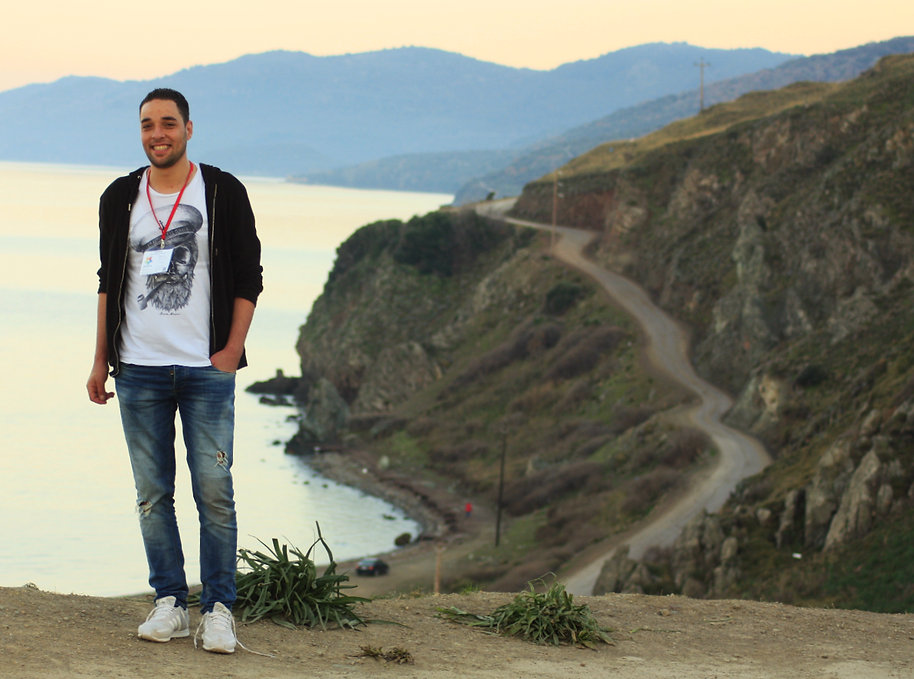
Standing on the Greek coast, Ibrahim is back where he once was, but so much has changed in the past six years. He is now a volunteer, a friendly face and interpreter for refugees who have just arrived. He is constantly smiling and has won everyone’s hearts. He is happy to help the refugees but feels sad at the same time for his country and his people. He is very open about his story, but adds that he has not shared all of it.
Ibrahim’s future looks bright. His Dutch is amazing and he is up for a final exam soon. If he passes, he is eligible for starting a next level Electrical Engineering course and will finally start studying windmills. He misses his mother dearly and hopes to obtain a real passport soon to visit her. He wants everyone to read/hear/share his story.
This story was first shared at http://joellepol.wix.com/thehumanthing#!From-refugee-to-volunteer/c1sbz/56b6ec6f0cf2dc1600e7cc1d by Joelle.







