
Thailand
Wat Mahathat, temple ruins
Thailand is next on the list of countries we are going to, and one I am very excited for. However, if you’ve been keeping up with the news you know that they are going through some inner political turmoil at the moment. If you don’t know what’s going on, the military has just taken over the government in a coup, suspending the senate and constitution, establishing a curfew, and halting television/radio broadcasting unless it is army material.
If you would like to know the whole political crisis, a good summary can be found here: http://www.cnbc.com/id/101699584
This is a good article from a few days ago that depicts the immediate social affects of the coup: http://www.thedailybeast.com/articles/2014/05/22/thailand-s-19th-nervous-breakdown.html
We’ve already had one country change (Burma instead of Laos), however, since Thailand has not yet been removed from our list of countries (and still open to foreigners), I’m going to proceed with Thailand as the next country.
THAILAND
or The Kingdom of Thailand
also called “The Land of Smiles”. Very encouraging nickname for a place we are heading to.
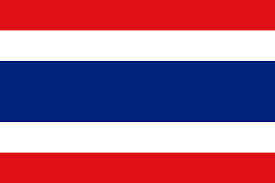
An interesting fact: Thailand is the only Southeast Asian country that was never colonized.
The red on the flag represents blood shed to retain Thailand independence (contrast this with countries where it represents blood shed to attain independence), the blue represents the monarchy, and the white represents purity and Buddhism.
Up until a few weeks ago, Thailand was a democracy with an executive branch (Prime Minister), a legislative (Senate and House of Representatives), and a judiciary.
Thailand’s king is Bhumibol Adulyadej, and he is the longest reigning monarch in Thailand’s history, having reigned 67 years.
The capital city and largest city is Bangkok.
The country has a tropical climate, influenced by monsoons and is characterized by three seasons: a cool season (November to February), a hot season (March to June), and a rainy season (July to October). Looking at worldweatheronline, it seems that the cool season averages about 25-28°C or 77-82.4°F, the hot season averages 30-35°C or 86-95°F, and the rainy season is about 20°C or 68°F.
Out of curiosity I looked up the weather for today and its going up to 100° F and feels like 114° F.
I think I got a little too carried away looking up temperatures. We’ll be there in the cool season I believe.
Moving on.
The official language is Thai, and depending on which website you’re reading, the population that speaks English is possibly about 27.16%.
Here are some phrases in Thai:
Hi = sa-was-dee
Nice to meet you = yin-dee-tee-dai-ruu-jak
Do you speak English? = kun-pood-pa-sa-ang-kgrit-dai-mai
I’m from the US = chan/phom-ma-jak-america
I like Thailand = chan/phom-choba-pa-sa-thai
I’ve been informed that certain phrases require specific endings based on your gender (“krup” for male speakers and “ka” for female). Such as the greeting “sa-was-dee” à “sa-was-dee ka”
When speaking to someone older, you can put “phee” in front of their name.
Also, “khun” denotes respect when used in front of someone’s name, such as “Mrs.” or “Mr”.
When greeting someone you can use the “wai”, which is when you bow with your hands pressed together. Like so:
You must return this gesture if it is given, but you are not required to initiate it, particularly as a foreigner.
Here’s a cool list of Thai customs.
If anyone has personal experience in Thailand, it would be awesome if you could share with me a little more about the cultural etiquette and language, and I’ll update this blog post accordingly, because now I want to know.
About Thai food: Thai food is amazing.
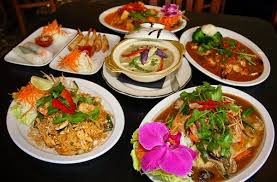
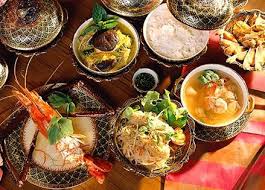 <—– Thai food. 🙂
Thailand has a population of 66.79 million according to The World Bank. The official religion is Buddhism, and this pervades almost every aspect of the culture. In fact, due to it’s extensive influence, Thailand is known as “The Land of the Yellow Robes”. Supposedly, most men become a monk for even a short period of time, and this short jaunt of religious practice earns their family respect.
Thai monks in yellow robes.
The Joshua Project estimates an unreached population of 66,043,000 and a Christian population of 1.33% (although that number, like all of these, varies based on which organization’s statistics you are reading).
The culture of Thailand is based on Theravada Buddhism. This website has a simple, and concise summary of Theravada Buddhist beliefs, and I would recommend taking a look at it.
The four main beliefs it cites are:
1. The importance of meditation – to change the way a person thinks and take the person to a higher state of consciousness.
2. Buddha became the Awakened One, and Buddhists follow his teachings with the intent of reaching an awakened state as well.
3. There is no one God, but “Gods exist as various types of spiritual being but with limited powers.”
4. People must individually choose to follow the Path to Enlightenment by following Buddha’s teachings.
Due to Buddhist influences, Thailand is very open to other religions. This has made it an easy place for missionaries to visit. However, Gospel availability follows a pattern that, from what I’ve heard and read, is replicated in many Asian countries. While Thailand is open to Christianity, the availability of the Gospel is limited to urban areas. This is similar, I think, to China, where people are aware of Christianity because of all of the Westerners who have come and developed their own schools and churches in the large cities (to accommodate the increasing number of Westerners living there). While Christianity is a presence, individuals don’t actually know the message that Christianity should bring.
Most of the population that has been unreached, therefore, is in rural areas, and there is a huge need for people to spread the Gospel out into those places.
Also, this interactive map is interesting. It shows the percentage of Christians in different areas of Thailand.
Buddhism as an influence is also mixed with traditional animist and Hindu beliefs. For example, you can find a ‘spirit house’ where people can make offerings to spirits outside of houses and other buildings.
A spirit house.
A huge problem in Thailand is prostitution and sex trafficking.
For one thing, I just googled “Prostitution in Thailand” and of the first handful of options, more than half were meant to educate guys on the best way and place to pick up Thai prostitutes. Not only does this show where our priorities are, but it reveals the fact that we can’t disassociate ourselves from social issues that seem to be the problems of other countries. Particularly, when our own culture is feeding into them. This is one problem, and I believe that it can only be healed through spiritual intervention, as with all social problems mentioned on this blog thus far. If you want, just google “bar girls in Thailand” and see what you come up with.
Three locations are notorious for prostitution: Bangkok – the capital and largest city, Pattaya – a beach resort, and Phuket – an island that focuses on tourism.
A further mistake is to immediately picture only these “bar girls” when hearing “sex trafficking”. You should know that Thailand is among the top five countries with the highest rates of child prostitution – and that means boys and girls. Incidentally, another two of the five countries are the United States and Canada. Surprised? Let’s recall that Google search mentioned above.
There are a number of missions aimed at reaching out to Thai prostitutes, such as NightLight, Dton Naam, Tamar Center, among many, many others.
I wish I could have had more time to research Thailand, as this covers very, very little. Please join me in praying for Thailand. Pray that the Gospel becomes available and understood throughout all of Thailand. Also, pray for the victims of sex trafficking and that they find healing in Christ, and for the spiritual growth of the country necessary to cure this social problem. Also, pray for Thailand in its current political crisis, and that it does not lead to violence and persecution for the Thai people.







