
Hey, ya’ll! So I’ve been slacking on taking pictures here in Nicaragua, but my wonderful teammate, Rachael, has taken some great pics and wrote a phenomenal blog. So why reinvent the wheel? I’m going to just share her thoughts which very closely mirror my own thoughts and experiences the past week and a half! She’s a talented writer and photographer. Enjoy…
We walked through an elaborate graveyard to get there. At the
front, there were the graves of the wealthy, elaborate concrete crosses
heading up a cement box. Many of which were encased by prison bars to
keep grave robbers out. Our contact said she wished she was kidding
about the grave robbers. Except she sees them on a weekly basis,
scavenging for anything of value, any piece of metal, any artifact that
might prove profitable.
The graves got skimpier and less ornate, or rather, tackier in
ornation, as we made it to the back of the cemetery. The dust kicked up a
little, as did the stench. On the horizon my eyes met a massive
landfill, littered with not just trash, but people swimming through it.
ornation, as we made it to the back of the cemetery. The dust kicked up a
little, as did the stench. On the horizon my eyes met a massive
landfill, littered with not just trash, but people swimming through it.
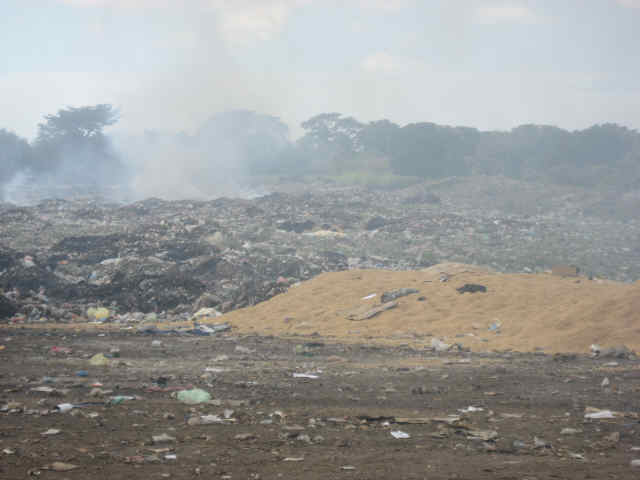
Welcome to Nicaragua. This is the Chinindega landfill.
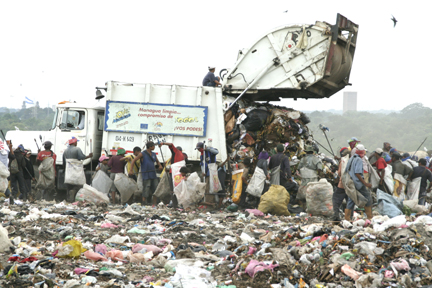
People live here. A lot of people live here.
Well. They live right behind it.
They stay close so they can have good access to the trash. Or
rather, the metal that the trash offers. Apparently, if one collects 100
pounds of metal in a bag, they can get money for it. Used to be that
people could get 12 dollars for each bag. Since the global market crash
in 2008, the price has dropped to somewhere around $2.50.
rather, the metal that the trash offers. Apparently, if one collects 100
pounds of metal in a bag, they can get money for it. Used to be that
people could get 12 dollars for each bag. Since the global market crash
in 2008, the price has dropped to somewhere around $2.50.
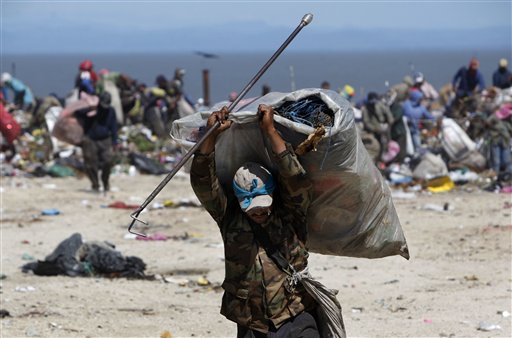
This area is known as the “Triangle of Death”. It is bordered by a
landfill, a graveyard, a sewage plant, and surrounded by the mucky El
Limonal “river.”
landfill, a graveyard, a sewage plant, and surrounded by the mucky El
Limonal “river.”
Smack in the middle of such toxicity are the jalopied houses. Some
made of old kiddie pool plastic and sticks, some with bricks. After
Hurricane Mitch caused a massive mudslide in 1998, displacing thousands
of people in the Chinidega area, the Nicaraguan government gave what was
supposed to be temporary tent housing to people right into this
carcinogen epicenter.
made of old kiddie pool plastic and sticks, some with bricks. After
Hurricane Mitch caused a massive mudslide in 1998, displacing thousands
of people in the Chinidega area, the Nicaraguan government gave what was
supposed to be temporary tent housing to people right into this
carcinogen epicenter.
This must have originally been a last resort. I mean, who moves
into the heart of sewage and trash because they want to? They were displaced. Homeless. Desperate.
into the heart of sewage and trash because they want to? They were displaced. Homeless. Desperate.

They had to set up shop somewhere, and this is where the government
provided the quickest solution. So they moved in.
provided the quickest solution. So they moved in.
Except. It’s 2011 and they’re still here. 13 years later.
This week we got to dig ditches on a water project with Amigos for
Christ, an organization that has created a new housing community and
business opportunities for these people to start a new life . We got
hang out in this new community called Villa Catalina, about 10 miles
from the dump, that has a school, a clinic, a playground, and each
house with a big plot of land for gardening. Many have left the dump
and embraced this hope and new life, but hundreds of other families
choose to stay in the dump.
Christ, an organization that has created a new housing community and
business opportunities for these people to start a new life . We got
hang out in this new community called Villa Catalina, about 10 miles
from the dump, that has a school, a clinic, a playground, and each
house with a big plot of land for gardening. Many have left the dump
and embraced this hope and new life, but hundreds of other families
choose to stay in the dump.
It’s what they know. What used to be just be tents and temporary
shelters for people have turned into bricks and flower pots and height
markings on door frames. Though given multiple opportunities to get out,
some people prefer the dump as a backyard. It’s easy here. Or so they
think. “If I don’t live next to the dump, how will I find metal…and if
I can’t find metal, how can I feed my family?” They have no
perspective that life can be any different, that there’s another way to
make it.
shelters for people have turned into bricks and flower pots and height
markings on door frames. Though given multiple opportunities to get out,
some people prefer the dump as a backyard. It’s easy here. Or so they
think. “If I don’t live next to the dump, how will I find metal…and if
I can’t find metal, how can I feed my family?” They have no
perspective that life can be any different, that there’s another way to
make it.
It might be easy to think that we are different from these pour
souls. There’s a desire to shake them and say, “look! There’s a better
way! You weren’t meant to live in a landfill and dig for trash for a
living!” But what I’ve realized, that I too, have often set up shop in
the dump. In bad situations, in my sin, in my pain or sorrow. I’ve made
what should have been a tent, a temporary visit, into a brick house.
I’ve nested myself in lots of dangerous, toxic places thinking that I’d
only be there for a season, but yet I stay for years.
souls. There’s a desire to shake them and say, “look! There’s a better
way! You weren’t meant to live in a landfill and dig for trash for a
living!” But what I’ve realized, that I too, have often set up shop in
the dump. In bad situations, in my sin, in my pain or sorrow. I’ve made
what should have been a tent, a temporary visit, into a brick house.
I’ve nested myself in lots of dangerous, toxic places thinking that I’d
only be there for a season, but yet I stay for years.
This landfill scene showed me how easy it is to get used to things.
To get locked in on a paradigm, on a view of life. No matter how
distorted or disgusting it may be. We can even get used to living in a
dump and learn to love it.
To get locked in on a paradigm, on a view of life. No matter how
distorted or disgusting it may be. We can even get used to living in a
dump and learn to love it.
Except for the fact, that we’re human beings. We’re not made to
live in trash, or snorkel through it, or have to dig through muck for
hours a day just to make a living. We’re not made to breathe in toxic
fumes. We shouldn’t have to walk through a graveyard just to go to the
grocery store. But if you make a house with a nice enough inside, I
guess it’s easy to forget there’s a landfill in your backyard.
live in trash, or snorkel through it, or have to dig through muck for
hours a day just to make a living. We’re not made to breathe in toxic
fumes. We shouldn’t have to walk through a graveyard just to go to the
grocery store. But if you make a house with a nice enough inside, I
guess it’s easy to forget there’s a landfill in your backyard.
Our physical beings weren’t created for this, and neither are our
souls. In our mess, we can build a pretty shelter for ourselves, hang up
pictures on the wall, put on some music, light some candles. But the
stench never really goes away. There’s always a pit in our stomachs
saying, this isn’t how it’s supposed to be. Just as our bodies
are made for clean air, clean water, living water, and a
healthy environment, our souls crave health too. They crave opportunity
and freedom and joy. Our souls know we’re not supposed to wallow in sin
and depression, but we do anyways.
souls. In our mess, we can build a pretty shelter for ourselves, hang up
pictures on the wall, put on some music, light some candles. But the
stench never really goes away. There’s always a pit in our stomachs
saying, this isn’t how it’s supposed to be. Just as our bodies
are made for clean air, clean water, living water, and a
healthy environment, our souls crave health too. They crave opportunity
and freedom and joy. Our souls know we’re not supposed to wallow in sin
and depression, but we do anyways.
We can so easily throw a coat of paint on the walls of our pain and
call it pleasure. We can so easily parade around in our sin, calling it
fun, but really we know its a cancer eating us alive.
call it pleasure. We can so easily parade around in our sin, calling it
fun, but really we know its a cancer eating us alive.
It is it time to move out? Are we willing to leave our mansions in the
landfill?








