
A brief history of Cambodia, courtesy of Wikipedia (sorry, this is a long blog…but stick with it!):
The Khmer Rouge was the communist ruling political party of Cambodia-which it renamed the Democratic Kampuchea-from 1975 to 1979. The Khmer Rouge is remembered mainly for the deaths of an estimated 1.5 million people or 1/5 of the country’s total population (estimates range from 850,000 to two million) under its regime, through execution, torture, starvation and forced labor. Following their leader Pol Pot, the Khmer Rouge imposed an extreme form of social engineering on Cambodian society-a radical form of agrarian communism where the whole population had to work in collective farms or forced labor projects. The Regime, heavily influenced and backed by China, immediately evacuated the cities and sent the entire population on forced marches to rural wor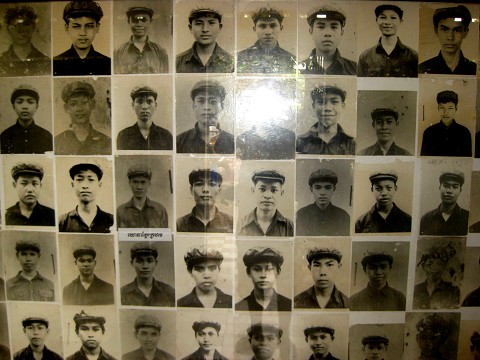 k projects. They attempted to rebuild the country’s agriculture on the model of the 11th century. They discarded Western medicine, destroyed temples, libraries, and anything considered western. Any person with trained skills, doctors, lawyers, teachers, were especially targeted. With that result, hundreds of thousands died from starvation and disease there were almost no drugs in the country. In terms of the number of people killed as a proportion of the population (est. 7.5 million people, as of 1975), it was one of the most lethal regimes of the 20th century. One of their mottos, in reference to the New People, was: “To keep you is no benefit. To destroy you is no loss.” The ideology of the Khmer Rouge evolved over time. In the early days, it was an orthodox communist party and looked to the Vietnamese Communists for guidance. It became more Stalinist and anti-intellectual when groups of students who had been studying in France returned to Cambodia. The students, including future party leader Pol Pot, had been heavily influenced by the example of the French Communist Party (PCF). After 1960, the Khmer Rouge developed its own unique political ideas. For example, contrary to most Marxist doctrine, the Khmer Rouge considered the farmers in the countryside to be the proletariat and the true representatives of the working class, a form of Maoism which brought them onto the PRC side of the Sino-Soviet Split. By the 1970s, the ideology of the Khmer Rouge combined its own ideas with the anti-colonialist ideas of the PCF, which its leaders had acquired during their education in French universities in the 1950s. The Khmer Rouge leaders were also privately very resentful of what they saw as the arrogant attitude of the Vietnamese, and were determined to establish a form of communism very different from the Vietnamese model and also from other Communist countries, including China.
Yesterday, we had the opportunity to take a tour of Tuol Sleng, the most notorious torture prison of the Khmer Rouge regime. Here are some excerpts from the brochure which was handed out at the museum:
In English, the word “Tuol Sleng” is recognized as the location where the Democratic Kampuchea (DK) regime, more commonly known as the Khmer Rouge (KR) regime, set up a prison to detain individuals accused of opposing Angkar. However, in the Khmer language, 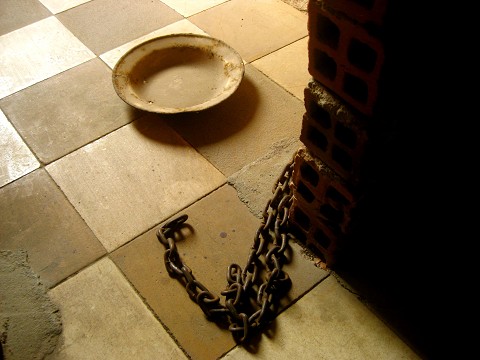 the word “Tuol Sleng” connotes a terrible meaning in itself. It is perhaps only a strange coincidence that the KR regime used this specific location as a prison.
According to the Khmer dictionary published by the Khmer Buddhist Institute in 1967, the word “Tuol” is a noun meaning the ground that is higher in level than that around it. The word “Sleng” functions as an adjective, meaning “supplying guilt” or “bearing poison” or “enemy of disease”. As a noun, “Sleng” is a poisonous fruit tree found in Cambodia. Therefore, from the above translation we can see that Tuol Sleng literally means a poisonous hill or a place on a mound to keep those who bear or supply guilt (toward Angkar).
The Khmer Rouge established Tuol Sleng (also known as the prison camp S-21) in May of 1976. Tuol Sleng was the most secret organ of the KR regime, Angkar’s premier security institution which was specifically designed for the interrogation and extermination of anti-Angkar elements. Prior to becoming a prison, S-21 functioned as a high school called “Ponhea Yat” from it’s inception in 1962 until being seized by the KR in 1975.
Covering 600 x 400 meters, S-21 was surrounded by two folds of corrugated iron sheets, all covered with dense, electrified barbed wired to prevent anyone from escaping the prison. All of the classrooms were converted into prison cells. All of the windows were covered by iron bars wrapped in barbed wire. The classrooms on the ground floor were divided into small cells, 0.8 x 2 meters each, designed for single prisoners. Two rooms on the top floors of the four buildings each measuring 8 x 6 meters were used as mass prison cells.
The number of workers in the S-21 complex totaled 1,720, divided into 4 units. Within each unit there were several sub-units composed of male and female children ranging from 10 – 15 years of age. These young children were trained and selected by the KR regime to work as guards at S-21. Most of them started out as normal children before growing increasingly evil. They were exceptionally cruel and disrespectful towards the prisoners.
The victims in the prison were taken from all parts of the country and from all walks of life. They were of different nationalities and included Vietnamese, Laotians, Thai, Indians, Pakistanis, British, Americans, Canadians, New Zealanders, and Australians, but the vast majority were Cambodians. The civilian prisoners composed of workers, farmers, engineers, technicians, intellectuals, professors, teachers, students, and even ministers and diplomats. Moreover, whole families of the prisoners, including newborn babies, were taken en masse to be exterminated. According to KR reports found at Tuol Sleng, here are the prisoner totals by year:
-1975…………………154 prisoners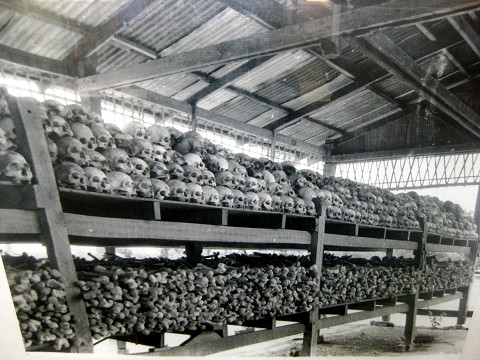
-1976……………..2,250 prisoners
-1977……………..2,330 prisoners
-1978……………..5,765 prisoners
These figures, totaling 10,499, do not include the number of children killed by the KR regime, which was estimated at 2,000. All but 12 prisoners who were sent to S-21 were executed.
The prisoners were kept in their respective small cells and shackled with chains fixed to the walls or the concrete floor. Prisoners held in the large mass cells had one or both of their legs shackled to iron bars. They were fixed to alternating sides of the iron bar so that they had to sleep with their heads in opposite directions. Before the prisoners were placed in the cells they were photographed, and detailed biographies of their childhood up until their imprisonment were recorded. Then they were stripped to their underwear; everything was taken away from them. They slept directly on the concrete floor with no mats, mosquito nets, or blankets.
Every morning at 4:30 a.m., all prisoners were told to remove their shorts, down to the ankles, for inspection by prison staff. Then they were told to do some physical exercise just by moving their hands and legs up and down for 30 minutes, even though they remained shackled. Four times per day the prison staff inspected prisoners for any foreign objects. The prisoners were forced to defecate into small iron buckets and urinate in small plastic buckets kept in their cells. They were required to ask permission from the prison guard in advance of relieving themselves; otherwise, they were beaten or received 20 to 60 strokes with a whip as punishment. In each cell, the regulations were posted on small pieces of black board. The regulations read as follows:
 1. You must answer accordingly to my questions. Do not turn them away.
2. Do not try to hide the facts by making pretexts of this and that. You are strictly prohibited to contest me.
3. Do not be a fool for you are a chap who dares to thwart the revolution
4. You must immediately answer my questions without wasting time to reflect.
5. Do not tell me either about your immoralities or the revolution.
6. While getting lashes or electrification you must not cry at all.
7. Do nothing. Sit still and wait for my orders. If there is no order, keep quiet. When I ask you to do something, you must do it right away without protesting.
8. Do not make pretexts about Kampuchea Krom in order to hide your jaw of traitor.
9. If you do not follow all the above rules, you shall get many lashes of electric wire.
10. If you disobey any point of my regulations you shall get either ten lashes or five shocks of electric wire
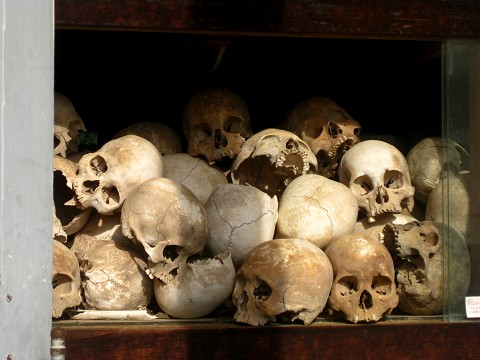
Upon our arrival in Cambodia we were given a briefing on the country by our local contact. One interesting thing that really stood out to me was that 80% of the population is currently 30 years old or younger. The atrocities of the Khmer Rouge regime has had long lasting, devastating effects on these people. Even today, 30 years later, Cambodians are still finding bodies in the identified “Killing Fields”, where the KR dug mass graves to dispose of the millions of dead corpses. Please pray for this country and it’s people as they continue to recover from the Khmer Rouge nightmare.







