
Lauren and I had the great opportunity
to interview with Joseph, manager of an internet cafe about Street
Kids in Eldoret, Kenya. The
following article is a paraphrased version of the conversation we had
with him.
to illustrate the perspective of the general public in Eldoret toward
Street Kids and not mine or the World Race’s.
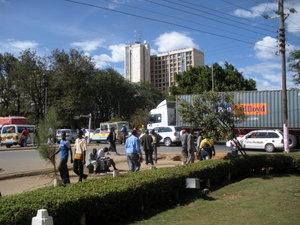 Joseph says that
Street Kids are big problem in Eldoret. Joseph himself took one boy
off the streets, gave him food and shelter in exchange for cleaning
up around his shop. The boy lasted only two months before going back
to the streets.
“It’s
easier for them on the streets,” he said.
“Let’s
say God was putting it on your heart to help these kids,” asks
Lauren. “What would you do?”
“That’s
tough. That’s really tough. Because the kids want to be there.
Life is easy.”
the streets by parents. “I am working, so you go work too,” they
tell their kids. The kids start with begging, “harrassing” local
people constantly for money. From there, they turn to stealing to
make more money.
“They
stole my phone,” he says. One day, Joseph was leaving his shop
when a mob of Street Kids surrounded him. It was their number, not
their use of violence, that allowed them to run away with his phone.
In Eldoret, there
is a “no-go-zone” near the market, he tells us. You can’t go
there after 7 pm because of the Street Kids. They steal purses from
ladies, phones, anything.
“Does
the government or the police do anything to help?” we asked. The
answer is no. The police will walk right passed a kid sniffing glue
and likely not even give them a glance. Even for the victims of
theft, like Joseph, if he went to them and asked them to track down
the theives he would first have to give a bribe for them to do
anything.
In 2008, the
police led a crackdown on Street Kids, arresting hundreds, but the
jails couldn’t hold them all. Most were released quickly.
When
we asked what is being done to help the Street Kids, Joseph told us
about a mazungu
missionary
who gives food to them, three meals a day. He feels though that this
isn’t helping. It encourages them to stay on the streets. Often they
even sell the food for money.
Drugs are rampant among the Street Kids. Mostly they use glue, but
also bhang, a type of marijuana. They can’t afford any hard drugs.
Some have gotten into selling drugs, but again, no hard drugs.
Usually just marijuana.
“You
don’t see many older kids or adults on the streets,” we ask.
“Why is that?” He tells us that most of them die young. Diseases
like malaria, typhoid, and the worst, AIDs inflict heavy tolls on the
Street Kids. The next biggest killer is violence. The kids go from
petty theives into fully fledged criminals. Then, for many, the
glue they sniff rots their brains to the point where they can no
longer take care of themselves.
Joseph has never seen a Street Kid get off the streets on their own
and grow up to be a self-sufficient adult without the help of some
kind of program. Those who do get into programs only have a 20% reform rate, according to Joseph.
Eighty-percent go back to the streets.







