
Navigating The Yard: A Gringo’s Guide to Salvadoran Prison Ministry
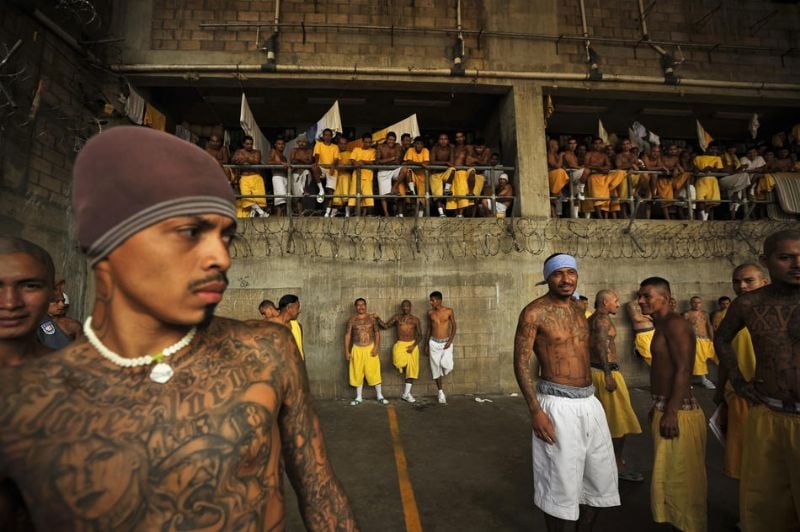
The Yard. The place where it all goes down. Whether you’re in grade school recess, or in a supermax on Guantanamo Bay, this is the place where the party gets started, where the rubber meets the road, and where push comes to shank. It is where Andy Dufrane hatched his plan for escape, and where Paul Crewe trained his team to defeat the guards. It is where inmates congregate, communicate, compete, conduct commerce, and determine one’s social status.
This past month we had the opportunity to serve in several yards across El Salvador. Each of these environments provided a unique opportunity to foster relationships with prisoners of various ages, genders, backgrounds, and gang affiliations. For any gringos (or other ethnic groups) that may be interested in pursuing similar ministry opportunities, I put together the following 5 guidelines that helped our team successfully navigate one of the most feral and tribal environments I have ever experienced.
Tip # 1: Know Your Audience
Knowing your target demographic is extremely valuable in ministry, as it is with pretty much anything. This is especially true in Salvadoran prisons where gang members constitute the majority of the population (and where their allegiances are more divisive than the 2016 U.S. election). In El Salvador the 2 main gangs are MS 13 and Barrio 18. Both of which brutally despise each other as well as have internal factions that don’t get along either (again, striking similarities to U.S. politics). During our visits, we quickly learned how the correctional officers take an inmate’s gang affiliation into careful consideration when facilitating daily activities. Everything from meals, to exercise, to Bible studies are carefully orchestrated with this sensitivity in mind. Learning about the ardency of the gang dynamic in advance was helpful for a variety of reasons, including providing us with a better understanding of what was considered appropriate in terms of conversation and apparel. Aided by our local partners, I quickly learned how any shirt with numbers on it was a bad idea. As an example, you don’t want to wear a shirt with the number 18 (or a series of numbers adding up to 18) when witnessing to a group of MS inmates. Any reference to the rival gang with one’s speech or clothing could be taken as a sign of allegiance, which would be counterproductive to our ministry (and potentially our safety.)
Tip # 2: ID the leaders, and Give Them Their Due Respect
When walking into a community that is structured strictly around a rank-and-file hierarchical system, it is helpful to understand who the big-dogs are. Luckily, the jefes were pretty easy to spot based on their demeanor and how others deferred to them for speaking cues and decision making. I remember how on one of our trips, a gang leader offered myself and another missionary a glass of Coke (the soda) which he had just purchased at the prison commissary. Despite the fact that it was 8 am in a sweltering prison cell, and that the Coke itself had to of been 90 degrees, we both gleefully drank our cups empty. Doing anything else would have been overtly disrespectful which is typically a bad idea when working with convicted felons. In addition to ensuring peace, working through the leaders helped us build a better rapport as it demonstrated respect for their preferences. Once more, the leaders represent a unique opportunity for evangelism as their personal convictions serve as an excellent conduit for witnessing to others.
Tip # 3 : Bring Junk Food and Movies
So this one is pretty universal as far as ministry work goes. Unless your evangelizing to a colony of communist crossfit nerds, movies and junk food are a sure fire way to get your foot in the door. On our first day in El Salvador we visited a jail with men ranging in age from 22-26. The movie we brought was the Passion of the Christ. Yes, this was a little heavy for a “first date,” but for guys who don’t have much access to media they were excited nonetheless. In all seriousness, watching a movie together was extremely helpful in the way it built an environment of equality. During the 2 hours the movie ran we all sat indian style around a cramped, musty, cinder block holding cell eating popcorn and sipping ice tea. There weren’t any dividing lines or handcuffs, and actually, there weren’t any guards either. While everyone in that room was born into different circumstances, some far advantageous than others; and while everyone there has made different mistakes in their lives, some far more egregious than others, during that time we were just a bunch of dudes hanging out. Most importantly, the bonds fostered through that basic commonality helped us better facilitate the message we sought to provide, that being; “The Son of God became a man to enable men to become sons of God.”
Tip #4: Walk in Authority
To clarify – when I say “walk in authority” I am not recommending strutting about in a Zoolander-esk fashion, but rather to walk with a profound sense of humility in one self with a simultaneous confidence in the Lord. Matthew 28 mentions how “All authority in heaven and on earth” has been given to Jesus, who subsequently charges his followers to “go and make disciples of all nations.” Knowing that God Himself has entrusted us to go out and proclaim his truth it’s imperative that we not walk meekly or with hesitation, but rather with a humble confidence in the One who has sent us. To borrow again from my main man C.S., Lewis, humility here “does not mean thinking less of yourself, it is thinking of yourself less.”
Tip #5: When in Doubt, Soccer
Whether debating between the supremacy of Messi vs. Ronaldo, or talking about your favorite club, soccer is a great way to break down barriers by connecting through a mutual interest. Actually playing soccer with the guys was also a lot of fun as well as an activity that ensured eager participation. One day while in the yard with Barrio 18 a pickup game broke out and I was chosen to play. I remember being excited that they picked me (even if I was the 2nd to last chosen) as well as feeling a bit conflicted with how to channel my enthusiasm. On one hand, I love sports and competition, and definitely wanted to make my teammates happy they chose me. On the other, I did not want to make a good play at the expense of a convicted felon, on his turf, and in front of all his buddies. Ultimately the game went by without any noteworthy occurrences (other than my team lost, which was stupid.) More than anything playing soccer with the guys reinforced one of my favorite aspects of sports, that they are universal in nature. I love how sports don’t require participants to know the same language, respect the same social norms, or obtain the same level of education. All they require is a basic understanding of the rules and a genuine will to compete.
—
Over the preceding months I’ve learned how ministry can often be a matter removing space between people groups so that a platform of trust and legitimacy can be built. Simply put, evangelism rarely occurs without the presence of a relationship. In prison I learned how the space that naturally occurs between people is amplified by the stark dichotomy of freedom vs. incarceration. This reality makes the need to remove space by leveraging commonalities all the more important.
During our time in El Salvador we were lucky to partner with an exceptional foundation named Sus Hijos who has already established various in-roads into Salvadoran prisons and begun the relationship building process. I witnessed how the men and women of Sus Hijos were integral in leading several prisoners to Christ as well as discipling them along their journey. What makes Sus Hijos efforts additionally vital is the fact that both of El Salvador’s gangs have a “blood-out” requirement for members. This means the only way for a member to leave the gang is through one’s death. Where Sus-Hijos comes in is the fact that some precedents have been set where a gang may allow an individual to leave under the strict condition that they commit himself to Christ.
On one visit I had the opportunity to meet an inmate named Marcos who is seeking to do just that. Marcos is 19 years old and currently in his 4th year of a 5 year bid for trafficking (I believe narcotics). Marcos was gregarious, affable, and a natural born leader. I liked him immediately. His love for the Lord was also extremely evident by the way he spoke life and brought energy to every interaction. Through a series of spanglish fragments and aggressive miming, Marcos described to me his hopes of becoming a missionary upon release. At the time I found myself admiring his intentions, but due to current circumstances, I was skeptical of the probability his dreams could come to fruition. At the end of our time together Marcos gave me a hug and said “Lucas, 1:37.” Later that night while having some quiet time with God I looked up the verse and felt a little sheepish about not believing in Marcos’ dreams, “for with God, nothing is impossible.”







