
 .
.
I grew up understanding missions trips to be altruistic adventures for college kids to go on over
summer break, or for families to complete when their kids reach an impressionable age and are in
need of an enhanced sense of appreciation. It also appeared to be common practice
for Christians to return from such trips and tell their family & friends about how inspirational it was to see God at work within different cultures, as well as to humble-brag as to how selfless they
were in using one-third of their vacation days.
While these sentiments aren’t entirely inaccurate (or intentionally nefarious) they nonetheless set a limiting precedent for how we as Christians decide to engage with others. The precedent of the term “Missions Trip” contributes to the fallacy that relaying Christ’s love, often to those less fortunate than ourselves, is best practiced as a selective and sporadic initiative. Once more, this term can also suggest the notion that intentionally loving others is an activity primarily suited for blighted urban areas, or for developing countries abroad.
The ironic reality is that we are called to live a Life – on – Mission, and not a life in a bubble with
mission trips sprinkled throughout. The inherent truth of a Life – on – Mission can be found throughout scripture, including Mark 16:15 and Matthew 28’s Great Commission . In addition to its scriptural basis, I believe the Life – on – Mission methodology can be understood in recognizing the different mode’s in which poverty exists. Western culture typically defines poverty as a concrete concept which is quantified in terms of material wealth. And while material wealth (or the lack thereof) can impact one’s quality life, poverty of spirit as well as a poverty of purpose can be similarly debilitating to a life hallmarked by joy, gratitude, and one where we reach our personal potential.
Learning the inherent truth of a Life -on – Mission has been partially convicting for me as it sparked
a myriad of memories of when I felt comfortable in my “bubble,” and did not utilize my personal
sphere of influence to live a Life – on – Mission. Alternatively, using a Life – on – Mission
perspective has also encouraged and empowered me to see the divine potential associated with
every day interactions, as well as with all people, regardless of their socioeconomic status.
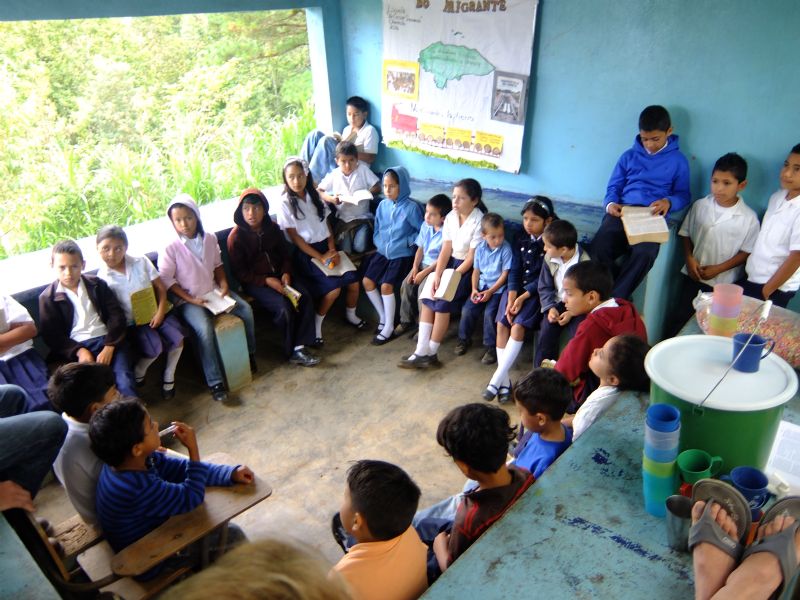
Over the past week the idea of Life-on-Mission has gained new meaning for me as I’ve begun the first leg of a year-long international missions experience. During this time I’ve had the opportunity to do life with full time missionaries David and Scarlet Jones . About 6 years ago David and Scarlet
founded a charity named Hope at Hand, a youth outreach program located in Valle de Angeles, Honduras. The experience of living with and viewing their daily process has reinforced what it means to live a Life – on – Mission. In light of David & Scarlet’s experiences I know that my personal journey of Life -on – MIssion has just begun, and in all likelihood, it will be difficult for a recovering efficiency-holic like myself to remain open to what opportunities God places in my life on a daily basis. At the same time, I am very excited about the opportunities that lay ahead, and hopeful that I can play a small role in extending Christ’s Kingdom by shining a light in some of this world’s darkest corners.







