
DC Metro Station on a cold January morning in 2007. He played six Bach
pieces for about 45 minutes. During that time approx 2 thousand people
went through the station, most of them on their way to work. After 3
mins a middle aged man noticed there was a musician playing. He slowed
his pace and stopped for a few seconds and then hurried to meet his
schedule.
4 mins later the violinist received his first dollar:
a woman threw the money
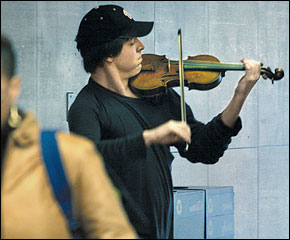 in the till and, without stopping, continued to
walk.
6 minutes, a young man leaned against the wall to listen to him, then looked at his watch and started to walk again.
10
mins: a 3 year old boy stopped but his mother tugged him along
hurriedly, as the kid stopped to look at the violinist. Finally the
mother pushed hard and the child continued to walk, turning his head
all the time. This action was repeated by several other children. Every
parent, without exception, forced them to move on.
45 minutes;
the musician played. Only 6 people stopped and stayed for a while.
About 20 gave him money but continued to walk their normal pace.
He collected $32.
1 hour; he finished playing and silence took over. No one noticed. No one applauded, nor was there any recognition.
No
one knew this but the violinist was Joshua Bell, one of the best
musicians in the world. He played one of the most intricate pieces ever
written, with a violin worth $3.5 million dollars. Two days before
Joshua Bell sold out a theater in Boston where the seats averaged $100.
This
is a real story. Joshua Bell playing incognito in the metro station was
organized by the Washington Post as part of a social experiment about
perception, taste and people’s priorities. The questions raised: in a
common place environment at an inappropriate hour, do we perceive
beauty? Do we stop to appreciate it? Do we recognize talent in an
unexpected context?
One possible conclusion reached from this experiment could be:
we do not have a moment to stop and listen to one of the best musicians
in the world playing some of the finest music ever written, with one of
the most beautiful instruments …. how many other things are we
missing?
could be preaching in the DC subway and many in the crowd might ignore
him too. What is the point? As human creatures, too often what we value
is often determined by the “crowd.” If the crowd, by its sheer or
growing numbers say its important, then we have to assume it must have
value… even if only a temporary or a phase or fad or 15 minutes of
fame value.
would dare say, had the experiment run on for several days and word had
leaked out who was actually down their playing or how good this guy
really was, the crowds would have grown,
perhaps even at some moments exponentially, because, in the end, the
individual values the crowd’s judgment, pure and simple. If there is a
crowd there, there must be something of interest, something worth
seeing, a dead man on the platform, a fire, a fight, something unusual,
out of the ordinary, etc, something that has perceived or initial
value, otherwise people would not be gathering to stop. So more people
stop. Then more people stop, but by this time it is to see what other
people stopped about. They are stopping not because of the original
reason, but merely because there is a crowd, regardless if the outer
edges of the crowd can see anything. But then like concentric circles
of attraction or interest, the crowd grows, with each layer or circle,
still unable perhaps to see the original perceived value. But it
doesn’t make any difference. We are attracted to the crowd.
we fail as individuals to know or remember is that once the process
starts, it is not what was of original value, or the alleged source of
the original interest, that is being valued, it is our human instinct
that if there is a crowd present, then we had better get in on the
action before we miss something. This is our chance. Quick. Hurry or
you might miss it. Instinct takes over. The mob builds quickly. It’s
infectious. Contagious, like the 1918 Spanish Flu epidemic (that by
some estimates wiped out as many as 50 million lives; actually in this
case, people would have run and did from the contagion, if only they
had known how effectively), and before you know it, what we thought was
of value because it had attracted a crowd, has now run it’s devastating
course. Why? Because we didn’t have time to find out what the contagion
is all about. We were merely attracted to the contagion, good or bad.
line…all too often, we allow the growing presence or anemic absence
of the crowd, fad or contagion to determine what we initially perceive
is of value or worth, rather than taking the few extra seconds to
observe and discern is something of value to us or to remind ourselves
that crowds are not perfect and can be incredibly unreliable.
this is how Christ was crucified, or at least he went from possibly
Messiah Golden Boy to rejected martyred in just a matter of days or
perhaps even moments or hours. And yet two thousand years later, via a
slow, grass roots retelling and rethinking of those moments, a perhaps
eternal movement has been firmly established.
line…Be your own judge, first. Beware the crowd’s judgement. If it
has value to you, it has value to you. Stop and smell the roses. Be an
independent thinker. And for those believers in the bunch, the more you
know Christ and his values, as revealed in the Scriptures, or even
personally, what you perceive is of value will probably change.
brothers, whatever is true, whatever is noble, whatever is right,
whatever is pure, whatever is lovely, whatever is admirable-if anything
is excellent or praiseworthy-think about such things. Whatever you have
learned or received or heard from me, or seen in me-put it into
practice. And the God of peace will be with you.” the Apostle Paul to
the Philippians, chapter 4, verses 8-9.







