
So you've committed to the Race and you're starting to wrap your head around it: fundraising, meetings, facebook, gear?!
We'll be highlighting some gear over the next few weeks to help you get an idea for what you want to purchase/procure for your trip – starting with your brand new home-on-the-go!
TENT
FREE STANDING
 You may need to pitch your tent on concrete or some other hard surface (like the desert) that won't really take a stake. You want a free standing tent. This means you'll be able to pitch your tent so it stands without being staked into the ground. The poles will tension themselves against a loop or grommet on the bottom of the tent.
 In that same vein, you want to find a rain fly, or vestibule, that doesn't need to be staked to the ground either. Most tents are going to have a separate rain fly that comes with it, but a lot of those will need to be staked out to the ground. That's doable, you can tie the rain fly out to some bricks or something, but it's easier if you can be totally free standing. [both tents pictured are technically free standing, the one on the right has a rain fly that needs to staked out]
SIZE
You want a 2-person tent. This should minimize weight, while still giving you enough space for you and your pack. I've seen people make it work with a 1-person tent, but I wouldn't be excited about it. Married couples likely want a 3-person tent, that way you have room for both of you and packs, one of you carries the tent, and the other has room for more/different
WEIGHT
Pay attention to it. When I was originally shopping for my tent, I would not have thought to look at how much it weighs. You're going to carry this thing around the world and you're going to have to make weight on some international flights. The less your tent weighs the more underwear (or souvenirs) you can pack.
FOOTPRINT
You're going to want some sort of tarp to go under your tent. This keeps the tent floor from ripping if you're on a hard or abrasive surface. You can find a tarp specifically made for whatever tent you buy (sometimes you get it for free depending on who you're ordering from), called a footprint. Compare costs of a footprint and a regular tarp and, again, consider weight.
SLEEPING BAG
SYNTHETIC VS. DOWN
 There are two types of filling for your sleeping bag (the stuff that keeps you warm). A true down bag is lighter and will pack smaller. It's also more expensive and apparently is real tough to deal with if it gets wet (as in, it gets REAL gross smelling). A bag with synthetic filler is a bit heavier and won't pack down as easily, but is no problem if it gets wet. I would highly recommend a synthetic bag for the Race as you never know when you might get rained on or something, and you'd hate to have to wait a day or two for your bag to dry out.
MUMMY VS. NOT MUMMY
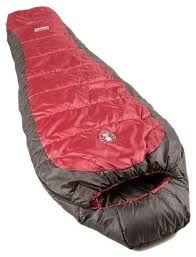 When I got ready for the Race I had only known a sleeping bag as the one my dad kept in the attic. I didn't realize they made sleeping bags in anything other than rectangles. Apparently they make some that fit your body a little better. It's called a mummy bag. It'll also cinch around your face. In the even that you end up in a real cold spot, which will probably happy once or twice, you'll be glad to have a warm bag. [the above bag is a regular shape, the one on the left is a mummy bag]
SLEEPING BAG LINER

There may by times when it's too cold to sleep on top of your sleeping bag, but too warm to sleep inside. You can find what's called a sleeping bag liner to use in this instance. They sell some that are made of silk. You can use it as a standalone item when you want a little less than a bag, or you can use it like a sheet inside your sleeping bag. A cheap alternative is to bring an old sheet with you that you can curl up in. I did without either of these, but there were a couple times when it would have been nice to have.







