
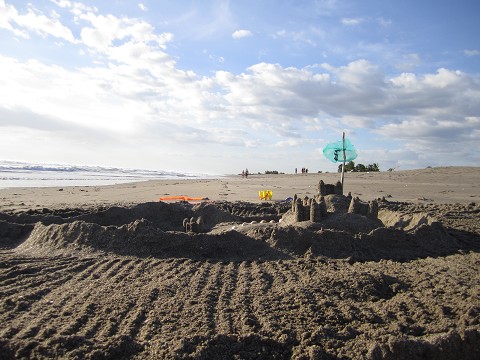
I’ve been thinking a lot about castles lately and it’s your fault. I haven’t been able to stop thinking about it since that sandcastle we built in Nicaragua. Mostly, I’ve been thinking about why they’re built in the first place. Here’s the thing most people forget about castles, sand or otherwise: their primary purpose is defensive, protective. They guard something precious.
I’ve done some research over the last few days—shocking, I know—and I wanted to tell you what I found. Castles are the private fortified residences of nobility, mainly European in origin. They were simple structures really, exploiting the natural defenses around them (being built on a hill, for example, or clearing the forest around the base of the grounds, so that the enemy had nowhere to hide) and protecting a central tower called “the Keep.” Although every part of the castle, from the moat to the curtain walls (the defensive wall around the castle) was meant to protect the Keep, the Keep also had a special purpose: it served as the watchtower.
I thought about some of the castles I visited in Europe and the sense of awe I had standing in the courtyard, enclosed by the castle walls and looking up at the Keep. I remembered Haute Konigsberg in France, how the massiveness of it, the sheer strength of it combined with elegance that together stole my breath. One was indivisible from the other.
Then, I started thinking about some of our conversations about the biblical roles of men and women. We’d agreed that men and women—contrary to conventional wisdom—need each other desperately. A woman needs a man’s strength; he needs her vulnerability. She needs his pursuit; a man needs a woman’s affirmation. It’s the same as a castle: the Keep has to be protected by the curtain walls. The curtain walls will only be effective if the Keep calls out for its strength. They are necessary to each other.
It’s no surprise to me that when I started praying into this, the LORD led me to Joshua 2, where Rahab rescues the Israelite spies from Jericho. Rahab, a prostitute from Jericho, is the first person to assure the Israelites, “I know that the LORD has given you this land” (Josh. 2:9). She affirms what they are called to be: conquerors of this foreign place. She calls them into greatness because she’s heard of what the LORD has done for them. “No one has the courage to fight after hearing such things. For the LORD your God is the supreme God of the heavens above and the earth below” (Josh. 2:11). It is her testimony that gives the spies—and by default, Joshua himself—confidence to take Jericho for the LORD.
Rahab’s family, in the tower with a scarlet rope hanging from the window, is the only group protected by Joshua when Jericho falls. Her life is spared, and not only spared but honored, since she appears in the very lineage of Jesus (Matthew 1:5), along with three other women. If nothing else, the story of Joshua and Rahab is a perfect example of the partnership of biblical masculinity and femininity.
Biblical masculinity brings out biblical femininity, calls to it and says, “Your heart is safe with me. I will protect it like a curtain wall protects the Keep, like Joshua protected Rahab.” In return, biblical femininity asks biblical masculinity for its strength and says, “I trust you. I will help you, calling out what the LORD has for you, like a Keep calls out for the curtain wall, like Rahab called out for Joshua.”
When we built that sandcastle, I joked that there was probably some kind of deep introspective meaning in it, that a castle was a great metaphor for, well, something. I guess that something is all of this.







