
Today, they tell us, we’ll be visiting a school. Ten World Racers pile into a little white van and drive off. We head down the highway to a little single-lane dirt road. As we drive, we’re told that we are going to be visiting a settlement called Bikeke – that’s translated literally into “white ant hill” – Termite Mound City. We drive for about half an hour, our driver skillfully avoiding potholes when it’s possible (and apologizing for the bumps when it’s not). We drive past a large open field, grazing cows sharing space with several dozen schoolchildren at play. This is the local public primary school. Our driver tells us there are 1300 students attending kindergarden through eighth grade in the many tin-roofed, barracks style classrooms visible in the distance. A small boy pokes his head over the fence and with a hushed voice bordering on awe whispers, “muzungo!” It means “white person” in Swahili, and we’ve all prepared to answer to it for the next three months. We later learn that this school is overcrowded and understaffed – the average classroom holds a hundred students, with the one teacher barely able to keep the kids entertained, and education is a distant secondary goal. Public schooling in many areas like Bikeke is nothing more than a thinly-disguised daycare.
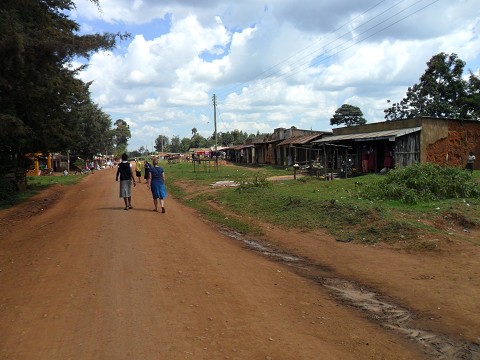
We stop to pick up Pastor John, both the head pastor of the Bikeke church and administrator for the school we’ll be visiting. He’s glad to have us visit, like most Kenyans we’ve met. We continue down the road to the market – ‘downtown’ for twenty thousand people. It’s not much larger than main street in the average small Midwest town. Children stare, adults wave, and as Pastor John tells us not to worry, that white people are common enough sights here that we’ll find a warm reception, cows trim the storefront grass. I’m beginning to suspect that I may indeed be entering a world well beyond even my wildest expectations. Ken, one of the teachers at the school, joins us in the market. We somehow make room for him in the van.
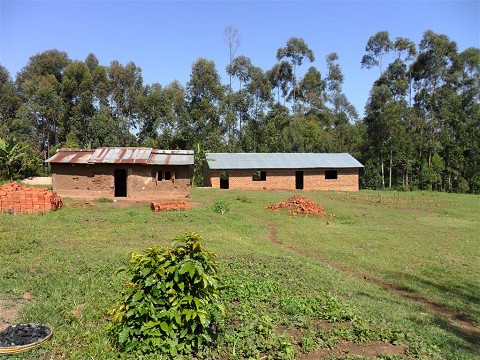
Ten minutes later we pull up at the school. Our overloaded van high-centers trying to pull in to the drive, so we pile out and some passing Kenyans help get our driver back on the road. He’ll be back in 6 hours. We’re greeted by the staff of Liberty School, and while the children enjoy morning recess we are given a swift overview of the school and its history. Last year the school met in a rented building in the market, this year they occupy two acres of former homestead. It’s a great place to have recess, but the actual facilities need a lot of work. There were two mud houses on the property when the school purchased it – one of them is now serving as both kitchen and office. It’s slightly larger than a 15-passenger van.
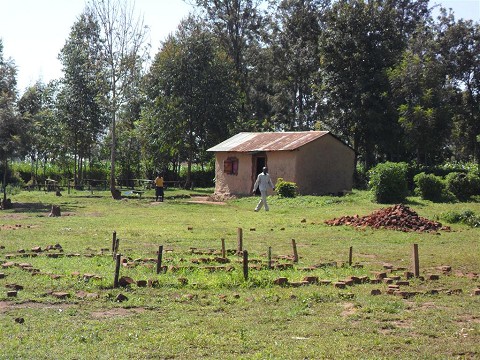
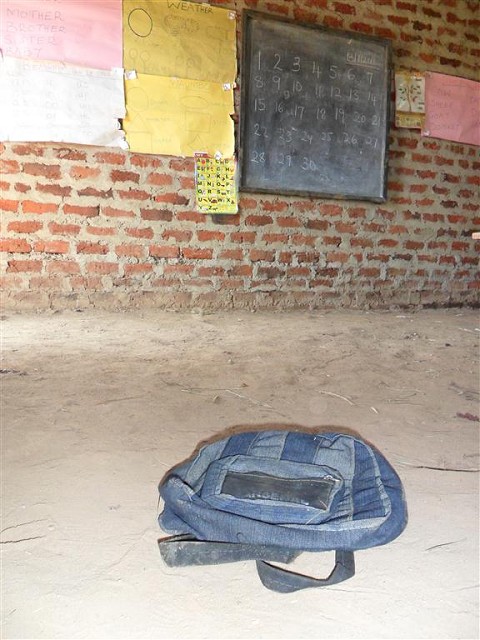
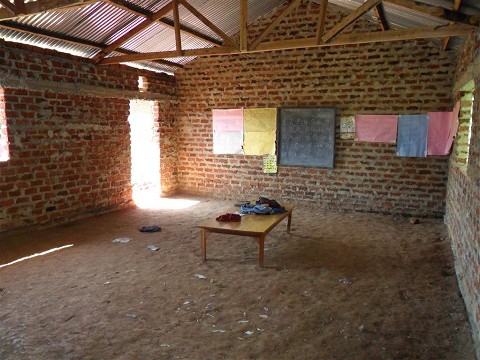
The other house, big enough to be divided into three small rooms, houses classrooms for the third, fourth, and fifth grade students. There aren’t many students in any of those grades, but I still cringe to see classrooms half the size of my bedroom. The other classrooms are in the only other building on the property, a long low brick construction, recently added. The building is split into half, one for the first and second grade students, and the other for the kindergarden. There is one small low table, and fifteen chairs, for twenty-one students. A backpack lies discarded on the dirt floor.
Pastor John shows us a pile of bricks, and some timber and sheet metal above the ceiling in the office, that is earmarked for the outhouse. They still need cement to put the building together, and without a functional constructed toilet structure the government will shut them down in two months. For now, the children wander off the property into one of the two neighbors’ outhouses. They’ve received some complaints, but so far neither neighbor has taken to locking the door. My mind is reeling, and then Jon, the headmaster, tells us with pride that the school is one of the highest-performing in the district. My jaw hits the floor.
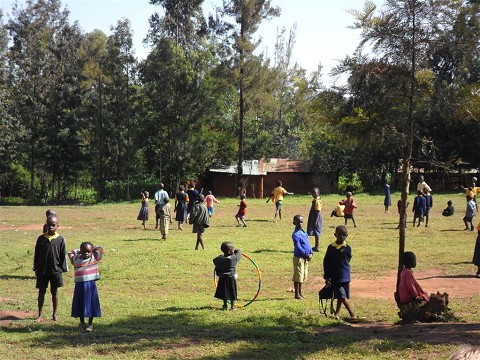
The 72 students at the school are about half uniformed. Some of them are in clothes that barely stay on, and some in what is clearly the only outfit they own. We’re told that half the students are either ‘destitutes’ – children of households well below the poverty line – or “total orphans”. My heart follows my jaw to the dirt when I realize that it is so common to have abandoned children, or children in single-parent households, that there is a distinction made to specify the children who honestly have no living parents. The staff goes on to explain that many of the orphaned children live with guardian families, sometimes distant kin, who treat the children with no more respect than indentured slaves or furniture. If they get sick – too bad! Money is rarely spent to give these children even the substandard healthcare available in the region. They’ve started a feeding program, they tell us, because when the children have gone three days without food they’re too hungry to learn anything. The money is only sufficient to feed the 15 or so worst off – the rest go home over the noon break, hopefully to a lunch meal. Liberty is the only school that even cares about these kids.
Part of the future construction goals for the school is a housing unit for these kids, to get them off the streets and out of the abusive families they live with. None of the orphans or destitutes can afford school fees. This is very similar to what I’ve seen at the other schools we’ve visited here – mission-operated schools are often orphanages as well, and now I know why. It’s a small surprise indeed to discover housing on school grounds for children in situations like this.
After a quick tour, we’re ushered into one of the two larger classrooms where all of the students are assembled. We’re treated to a choreographed song and dance number welcoming us to the school – it’s very good. Next on the program is a drama. It was the story of Nopeke, a very lazy young boy. He refused to do chores, and because he never did homework the school eventually kicked him out. Upset with his family situation, Nopeke runs away to the city, where he is found, starving on the streets, by a mission. The story ends with Nopeke, nursed back to health, leading a song to the gist of, “I won’t go back to the way I was.” The 8-year-old child with real acting talent is a rare breed, so I neither expected nor encountered an Oscar-worthy performance, but I did for just a moment freeze in my tracks. The opening scene, where Nopeke is being berated by his mother for not watering the chickens, chilled me to the core. As soon as the sweet little girl opened her mouth, a chill settled on the room. The children shrank back, and even we muzungo flinched. She proceeded to unleash the most terrifying volley of abuse I have ever heard a child say – and I realized that the unsettling authority her voice carried was the authority of experience. All the other adult roles in the drama were played as caricatures – the boy playing the elderly school administrator comically stuffed a sweater under his jacket to create a paunch – but the shrieking mother was carried out exactly as the children saw at home. I spent the rest of the drama barely holding back tears. What kind of life do these children lead, that the only adult they know how to accurately represent is the abusive mother? How much of a ray of light must this simple, impoverished school represent to these children that they can laugh and play even in the face of what they have to go home to each day?
It’s a somber note to end a blog on, but I spent a lot of the day in a somber mood. Education is something that hits close to home for me, and more than anything I’ve seen this school really has awakened me to the seriousness of the poverty problem in Africa. Part Two is coming up, where we go visit the community of Bikeke.







