
Where did the time go? Ministry in Guatemala has come to an end, and it’s an end that came as a sad surprise.
Guatemala Month 2 0002 from MichaelNicosia on Vimeo.
We asked the Lord what to do every day and had very little structure to our ministry apart from that, yet the month felt packed with activities.
Kevy and Margarita. Man, I love those kids. This brother-sister duo sells cashews and woven bracelets to tourists every day, from 9 AM to 9 PM. Kevy is 6 years old and Margarita is 11. Their cousin, also named Margarita, and their aunts also roam the streets of San Pedro doing likewise. Kevy and Margarita’s mom lives in another city hours away and they don’t know their dad. They live in one house with all their aunts and uncles and cousins and their maternal grandmother.
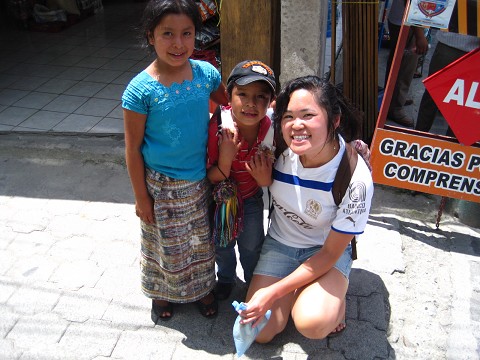
I met these two the way they meet all North Americans. Cashews? Un Coca-Cola para mi? Un taco para mi?
Every day in town Kevy and Margarita would come up to us trying to sell us nuts or ask for food. It was hard to constantly say no to them, but were we there to work for the Lord or the Red Cross? It’s easy to slip from missionary to humanitarian effort (not that they can’t be combined in some cases), but years of being around Development Studies majors has ingrained some teaching about ‘white man’s guilt’ and how giving can often hurt more than help.
So what could we do to show them the love of Jesus, something far more valuable than a 5 quetzeles bracelet? What could I do?
We let them be kids. We asked them about their stories, we asked them to teach us words in Keecheh, their native language (Spanish is the second language for most Guatemalans around Lake Atitlan. Most of the towns around the lake speak a Mayan language. San Pedro and San Pablo both primarily speak Tzutzujill.) I bought a coloring book and crayons and we colored together in the afternoons (Tienen tiempo para dibujar? Do you two have time to color?). Sometimes they came up to me at a coffee shop, sometimes at a restaurant—it didn’t really matter. I was learning to live life and love actively at the same time.
Halfway through our time there, they stopped asking us to buy things when we saw them. Instead, we were all greeted with shouts of Ootza-weh? (How are you? in Keecheh) and the best hugs and kisses.
I had the opportunity to share with them the story of Jesus before leaving. (How exactly do you talk about Jesus to children anyway? Do you start with Bethlehem? Adam and Eve? A description of sin?) In awkward Spanish, I recounted the love of our Father, how desperately He desired to be with us that He sent His only Son, Jesus Christ, to die for our sins and be resurrected in triumph so that we can be reconciled with our Heavenly Daddy. Note that this story took about 30 minutes, and I did not actually use the words triumph or reconciled since they aren’t in my Spanish vocabulary, and let’s be real, probably not in Kevy or Margarita’s either.
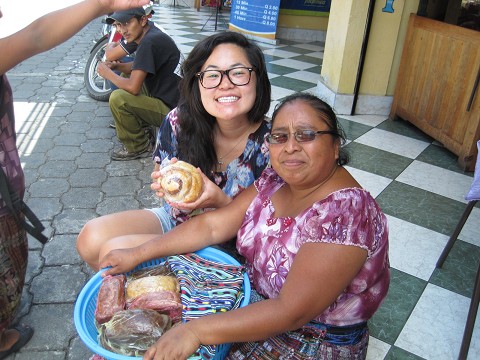
Yolanda the bread lady
On our last day in San Pedro, Margarita asked me to write down the names of my team in her notebook, and she painstakingly wrote down her name and Kevy’s in mine. We took them out for tamales and ice cream and gave them final hugs. In broken Spanish, I told these two that they are in my heart (estan en mi corazon) and explained that it was our final day. It broke my heart to leave these two, my biggest questions were, Who will look after them now? Who will make sure that these kids can be that, simply kids?
The Father has been showing me that He has always seen me, He has always known me. Even in my broken junk, even in my depravity, the Lord has always been present. It seems like a lame, Christian-ese answer that He watches over us all, but it’s the truth.
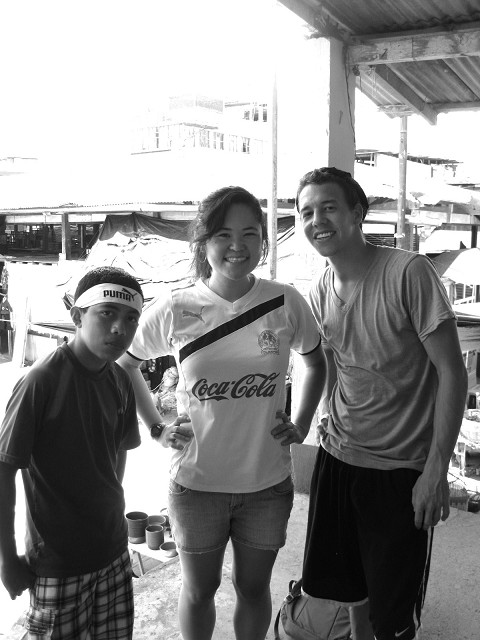
Mike and I with Pedro, Pastor Antonio's son
Please pray that Kevy and Margarita will know the truth of Deuteronomy 31:8, He will not leave you nor forsake you, do not fear nor be dismayed. These kids are close to our Father’s heart, and now mine. This month has been a privilege.







