
I’m not going to make it sound nice and pretty: El Salvador and Honduras were rough for me. It was like as soon as I left Asia I had to re-gather my feet under me and I just couldn’t. It wasn’t so much that someone was pulling the rug out from under me, it was more that the rug just kept bunching and tripping me up. If I wasn’t struggling to find joy in the ministry I was doing, I was struggling to find joy in our ministry hosts; my heart wasn’t always a pretty place for a couple months, guys. I had some high times, but for the first time since last August, I felt like I was ready to be done with the Race. Or at least Central America.
I had looked forward to Guatemala, but I found myself apprehensive. I started to doubt my own memory of my first mission trip here as a senior in high school: it couldn’t have been that good. Surely I’m mis-remembering or mis-attributing some aspect of that experience, because Central America is just not my jam.
Thank God, I was wrong.
________________________________________________________________________
As soon as we left Honduras, drove through El Salvador (hello, San Salvador, for the 3rd time) and arrived in Guatemala, I felt the spiritual funk from Honduras dissipating. As our squad rejoined for a couple days at the Adventures base in Antigua, I already felt lighter and brighter. Hiking a volcano and reuniting with my squad besties certainly helped, too. 😉
Since leaving Antigua, my team and I have been in Chichicastenango. On our first day our ministry host, Juan, spoke in such a way that left me feeling so much better connected with this place than I ever felt in Honduras. As he spoke about his home and country, he beamed with passion. Juan speaks in a way that is at once both humble and confident; I think this is what happens when you are operating in God’s Will and know it.
Juan’s ministry is called “New Generation,” and that’s exactly what he’s passionate about: reaching the next generation. Juan commits five hours every day to teaching English at the local school, from kindergarteners to sixth grade. We go with him every other day (trading off with the other team that’s with us this month), and I so greatly admire his perseverance.
He told us passionately on our first day, “I know I’m starting this ministry with kids. They’re so young. But they can be leaders one day. We might not see the fruit of our work for 20 years-we know that. English is just our tool right now, and I just know that if they can get the Word, their generation will make a difference.”
Juan’s vision is to get the truth to the children he teaches: that God has already paid the price for them to be able to be forgiven and to draw near. Juan plants seeds that can bear fruit to more than just their young generation. He desires his students to get their parents asking questions, too.
Chichicastenango is in an area of Guatemala that is 95% Mayan and Chichi is a kind of cultural center for the region. With so much of the population descended from the ancient Mayans, the influence of their ancestors is still very present: I love hearing their dialect, Quiché, spoken alongside Spanish.
But the locals have kept more than their ancestors’ language: they have kept their gods.
Like probably every middle schooler in North America, I learned about the Mayan, Aztec, and Inca people. I’d seen textbook pictures of alters and idols. I’d wanted to see Mayan ruins so badly that for a brief time in 6th grade, I’d thought I wanted to be an archaeologist.
On our second day, Juan took us to see the Mayan altars and idols and I realized a side of spiritual oppression I wouldn’t have considered.
Before we went, Juan shared some of the costs of idolatry here in Chichi. He showed us a video taken during Holy Week in Chichi: an enormous Jesus-in-a-casket was being borne by young men and women through the streets. Juan explained that families paid large amounts of money for their sons and daughters to be able to carry the casket all around town for a day. It’s believed that if you’re sore the next day from bearing that heavy load that means your sins were forgiven; if you’re not sore, that means you were good the whole year.
Obviously, as a Christian, I believe that the Jesus that they’re bearing a giant model of would not agree with these strange additions to the Gospel.
Juan had many reasons for the misguided practice, but the one that stuck with me was that the children growing up in this region simply don’t know what they’re doing and why they do what they do. They don’t know the truth to be able to recognize the lie. And so they see what their parents do: attempt to buy forgiveness.
In addition to the Holy Week spectacle is the general outright worship of the Mayan gods, which we saw at the Mayan altars.
To get to the altars, Juan took us through a graveyard. It was the most colorful graveyard I’ve ever seen. Amidst the color and stately monuments, a long, open building of sorts housed fires. I could see people laying things on the fires they tended, such as dried flowers which I’d seen hung on graves, and other offerings being burned. Juan explained that it was likely a Mayan sacrificial ritual.
As we walked through the graveyard, I started to feel unwell. I am someone who does not feel spiritual things heavily or easily, but I remembered the sick-to-my-stomach feeling I’d often experienced in Nepal, another country in which idolatry is the norm.
We arrived at the Mayan altars and stood outside of the area, observing and praying as people worshipped various stone altars/idols. There was a small fire burning outside of the ring of statues, but there was a large piece of scorched ground inside the ring, too. A woman lead her children to the tall statue in the middle, while another group gathered around in a circle on the scorched ground in front of a smaller statue of a snake.
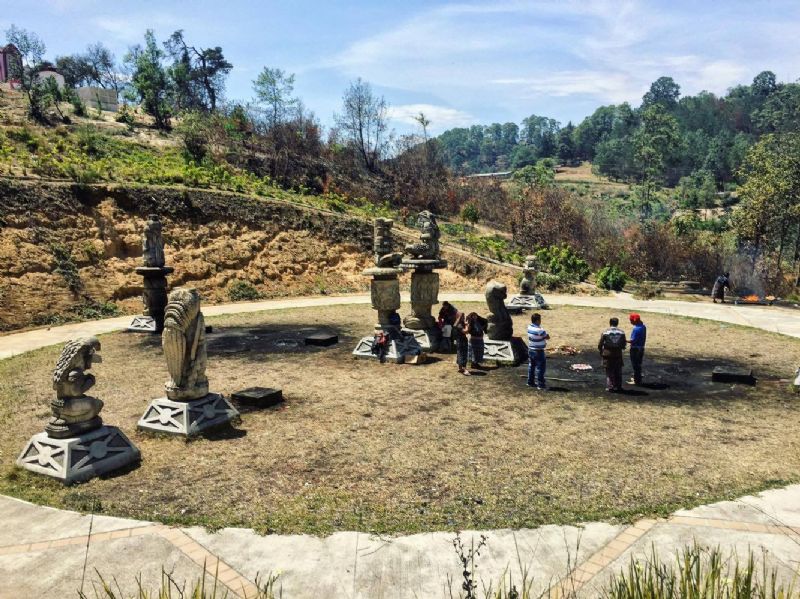
Juan’s words echoed in my mind: They don’t know what they’re doing.
Juan had told us that people have to pay a lot for various sacrifices, depending on what they’re offering. He told us, for example, that the lion idol at the front of the ring of altars takes alcohol. They pay to carry the Jesus-in-a-casket. Every day, we hear resounding, continual BOOMs as locals light fireworks at nearby altars to ask the gods to bless the new planting season.
They pay for their offerings, they pay to worship—they pay to draw near and be heard. Juan pointed ou a link between idolatry and Satan that I somehow hadn’t considered before: “They pay for all these things for idols, but these are people who can barely afford to feed and clothe their families. Idolatry costs money, and it’s hurting families. The Enemy is taking the whole family down this way.”
For some reason in my ponderings about idolatry, the physical monetary cost had never occurred to me- in Nepal, where I’d seen people pay for blessings and pay to be able to see their priests, it had just struck me as backwards (which, of course, it is). But Juan’s words stuck with me as I had a realization: idolatry was harmful on more than the spiritual front, because on the physical front Satan sneakily uses it to destroy God’s provision.
I realized, also, that it’s not just the Guatemalans that Satan attacks in this. How often do I think I need to “pay” or “get something right” to be able to draw near to God and be heard? How many altars have I built in my attempts to satisfy whatever idol I think can provide for me?
The need for truth in this community has made me retrospective. I’ve known so many people who just don’t know what they’re doing. They do what they do because they don’t know the truth about their actions, they don’t know that they can die in their sins-they could die still enslaved to them. They haven’t been told that they could die still trying to fill the holes in their lives with whatever idols seem to fit. They’ll spend themselves and they’ll spend everything God gives them. My heart hurts thinking of all the people I’ve lived alongside of that I didn’t tell the truth to because I wasn’t bold enough or because I was doing the same things they were.
It hurts to think of my friends in high school, Germany, and Juneau that I never told. “You can die in your sins, but you don’t have to. The way to freedom has already been made.“
But it also makes me excited to be here and share about our God who has finished it all for them. My God who sacrificed for their wholeness, if they’ll accept the truth. Being in Guatemala reminds me so much of being in Nepal, and experiencing the spiritual reality of both of these heavy places is sometimes daunting.
But it also reminds me how limited Satan’s time is, how darkness is scrambling and fleeing, and how all creation is waiting for Truth to win.
It reminds me that God is victorious on all fronts, both in Asia and in Central America, and my role, too, hasn’t changed in Him. And my role, no matter which country I’m in, will never change: to tell them that the Way, the Truth, and the Life has been offered to them and the only altar needed is one built in their heart.







