
Living here in Phnom Penh, the capital
of Cambodia, I have been learning a lot about the history of this
little country. I am ashamed to admit that before arriving here I
didn’t really know much at all about Pol Pot, the Khmer Rouge, or
anything that happened here between 1975-79, and I wasn’t really that
interested either. I mean, the Holocaust is something to pay
attention to, but who ever talks about Cambodia? I probably just
skimmed over this little tidbit of history in my textbooks in
highschool because it was probably only a small section and didn’t
catch my eye like the report on the WWII Holocaust of the Jews.
 This is changing for me. I am trying to
spend my free time this month reading up on the history of Cambodia,
and my team just went and visited a couple of the major sites here in
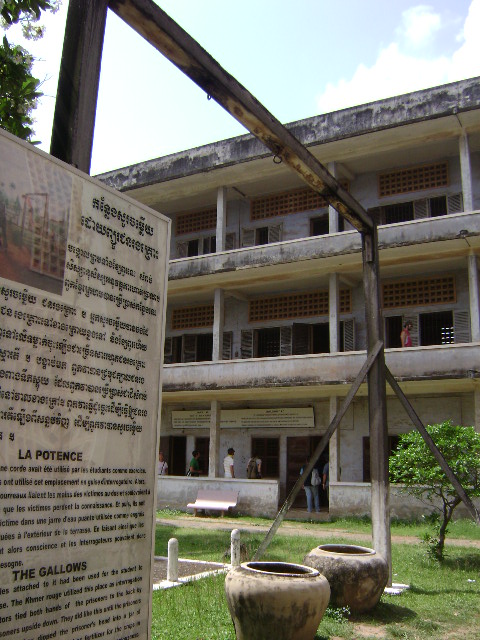
Phnom Penh. We went to Tuol Sleng (S.21) and the Killing Fields just
outside the city. S.21 was originally a high school. There are still
some of the blackboards in the classrooms-turned-prison cells. The
Khmer Rouge made this school the center of their torturing here. It
is now a museum and there are instruments of torture left in the
rooms and in many there are also pictures on the walls of men and
women being tortured. In some of the other rooms there are picture
displays set up of all the pictures of the men, women, and children
taken to S.21 and tortured. 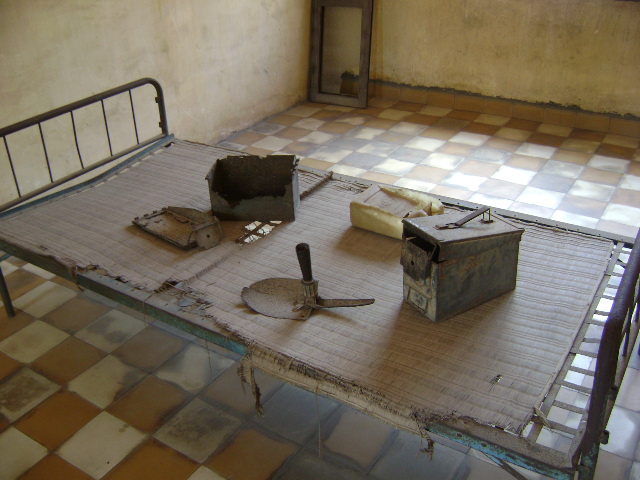 It is reported that 14,000-17,000 people
were tortured there. These men, women, and children were then taken
by truck (at times about 300 per day) to the killing fields where
they were summarily killed and “buried” in mass graves. There is
also a tree there that soldiers used to beat children on. They would
hold the little kids by the legs and smash their heads against the
tree until they were dead. Entire families were executed in this way
because the Regime didn’t want anyone left who could someday exact
revenge.
Many of the graves at the killing
fields here in Phnom Penh have been excavated and there is a massive
monument in the center
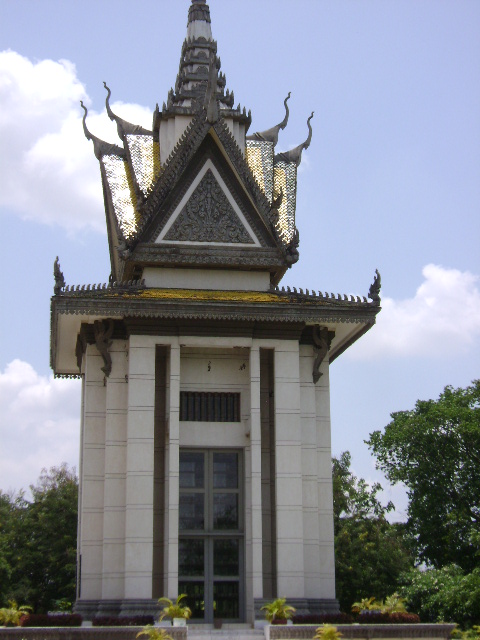
of the field that houses the bones and
clothing of those people. There are signs on random trees asking
visitors to keep quiet out of respect for the dead. This is a
Buddhist country and so there is a lot of superstition, but there’s
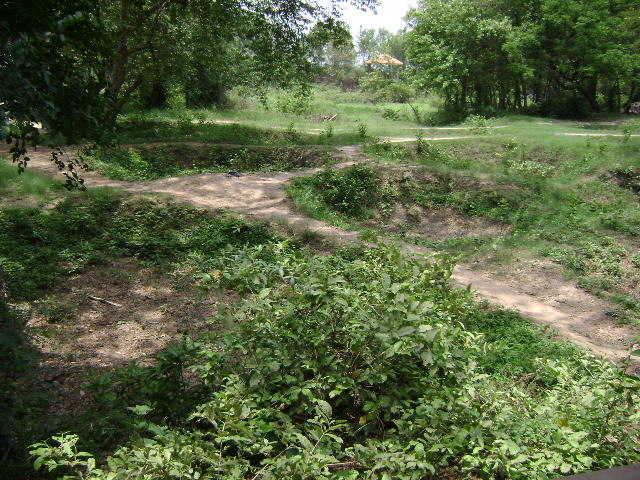
nothing to be loud about anyway when you’re walking on trails that
wind between massive holes in the ground that used to hold up to 450
people’s bodies. There is a section roped off where there are pieces
of bone and teeth revealed in the dirt that have not been collected
and taken care of yet. There are signs telling of how the prisoners
were killed and which farming tools were used to kill them.
 It was a very sobering day. Nearly 2
million Khmer people lost their lives during this time (about 1/3 of
the population!) at the hands of their fellow countrymen. About 90%
of the Christian population at that time also lost their lives
according to the book I’m currently reading called Killing Fields,
Living Fields. We asked
our contact the other day a little about this time in Cambodian
history and she said that it isn’t spoken about by the older
generation; it’s not mentioned in the schools; and it’s just too
horrifying for her to even think about or to want to know more about
it. Our generation of young people in Cambodia are growing up without
knowing their own history!
One of my teammates later commented
that our parents’ generation was living during this time and most
just turned a blind eye. She reminded us that there are similar
genocides happening today in Darfur and in North Korea and asked us
what we are going to tell our children when they ask us what we did
to help those people? What can we do? Like most American young people
I have kept my own little bubble pretty well insulated from the
plight and cries of the suffering around the world. This trip is
changing that. But knowing is only half the battle, and sometimes
it’s not even that much. How can I turn my knowledge into action? I
don’t have the answer and I know it’s not going to be an easy one,
but once I do know it I’m going to have to act on it or live my life
knowing that I could have done something but didn’t. Live knowing
that I could have changed a child’s life but didn’t. Live knowing
that Jesus was asking me to love Him and I didn’t. And you’ll have
the same decision to face. What will you do?







