
Never doubt that a small group of thoughtful, committed citizens can change the world; indeed, it’s the only thing that ever has. -Margaret Mead
About a week ago, I wrote a blog about the very thing I am about to share with you, but something stopped me from posting it. Nothing in particular happened, I just didn’t get around to it, kept thinking I would edit it or try to battle our ridiculously slow picture-loading feature to add some photos.
I am pretty sure God kept me distracted because He knew I needed to experience this stuff before I tried to speak on it. The problem at hand was sad, scary, and complicated, but up until that point it was still something I had only been told about.
Then yesterday, I stared this mysterious monster in the face as it reared its ugly head to settle in and lay claim to yet another young life. A 23 year old man, Juan Carlos, is on the front porch of his shanty home, too sick to come to the clinic in which I have been seeing patients with Dr. Martinez this month. He probably will not live more than a few more days.
He is leaning forward, gasping for breath around 40 times per minute; his blood pressure is 184/110; his skin is sallow; his feet and hands are thick and swollen with fluid; he has a persistent ache in both flanks and a pounding headache. He desperately needs a costly dialysis treatment to relieve his body of excess fluid and toxins, as his creatinine, a level we use to measure kidney function, was over 20 times the normal limit at last check. Unfortunately, Juan Carlos is one of thousands of young men in the area suffering from kidney failure.
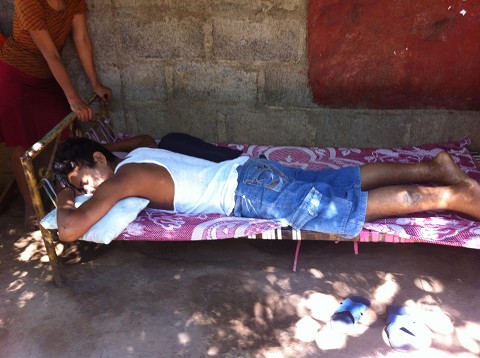
Let me back up. Juan Carlos began working in the sugar cane fields when he was 17. Employment of any description is hard to come by in Nicaragua, and many, many men turn to working on banana and sugar cane plantations as early as age 13 or 14 in order to support themselves and their desperate families. They earn about $3 a day.
Long hours of physical labor in the 100 degree heat, combined with extremely limited water breaks or rest, results in chronic dehydration for these men. This alone would cause a great deal of health issues for these men over the course of their lives.
But the real monster is trying to stay hidden, to avoid receiving a name or becoming known; it is trying to convince the public that it isn’t a contributing factor in the mysterious epidemic of chronic kidney disease, or CKD, among otherwise healthy young men. Never mind that it can kill insects and full-grown rats in a never-ending cloud of poison; surely it has nothing to do with the death of humans who live in it each day.
According to what I was told and the research I have done, the pesticide used on sugarcane in Nicaragua was outlawed in the USA very quickly after it was found to be causing health issues. Most unfortunately, the concern for human life did not appear to stretch beyond our borders, and it continues to be exported to third world agricultural companies. The men who work surrounded by this toxic killer in Nicaragua absorb it in their skin, lungs, and mucus membranes each day that they spend in the fields.
Although there isn’t “conclusive evidence” to support the theory that the pesticide is causing the otherwise unexplained CKD, all pieces of the puzzle continually point towards it. The name of the main pesticide is hard to definitively nail down, as both the government and sugarcane companies will not release it. At the moment, both cost and convenience (because what else matters?) make it their most appealing “poison of choice.”
So I guess I better shut my mouth before I get myself in trouble making too many assumptions. What I DO know is that the numbers of men dying in their 20’s, 30’s, and 40’s has reached epidemic proportions, and they usually leave behind young widows to struggle to raise several children alone. This further complicates the cycle of poverty in what is already the second poorest nation in the Western hemisphere, and some women have even taken on work in the sugarcane fields themselves in a desperate attempt to buy food for hungry mouths.

One of Juan Carlos' little cousins. Her father also works in the sugarcane fields.
Until we have more definitive answers, I just want you all to be aware of what is happening in this humble corner of our earth. If this were happening in a community in the States….if our brothers, boyfriends, sons, and husbands were dying right and left at age 23 of the same disease with the same likely cause….you better believe something would be done.
This issue is unbelievably complicated and multi-faceted; there is no easy fix. Believe me, our group has talked this through over and over with people who have been dealing with it for years, trying our hardest to figure out how to help. At this point, all I can ask you to do is pray that God opens the doors and that the appointed people step through them to attempt to finally give these people hope.
Will I be one of them? I don’t know at this point, with being on this Race and having so much heartache that is, sadly, sure to come. But I refuse to ignore it all together, as if these men don’t deserve to be advocated for, to be able to work safely to care for their little ones.
For me, to act as if human life is disposable is to slap its Creator in the face.
Our ministry host this month, Vision Nicaragua, was initially begun to assist in the massive damage caused by Hurricane Mitch, in which entire villages were destroyed. After being one of the prime contributors to the rebuilding of homes, schools, and lives in the village of Bethel, the organization turned its main focus to improving the economy by educating young adults in trades so that they could avoid the sugarcane fields. Vision Nicaragua also provides free medical care, healthy food for the kidney patients, education, and much more to the people of Bethel and the surrounding area. They also employ and strive to meet the needs of the many widows left behind from the kidney disease epidemic. Dr. Martinez tells me that since Vision Nicaragua came to Bethel, the improvements in health, families, and education has been “unbelievable.” I am so thrilled to be a part of this ministry while I am here.
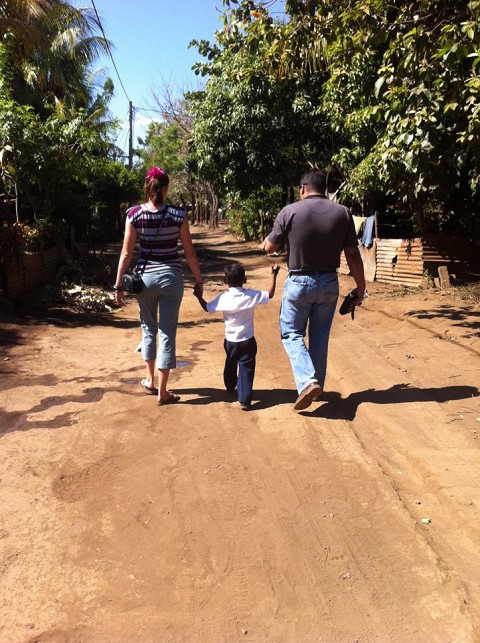
Dr. Martinez and I going to see Juan Carlos, accompanied by a little school boy.
Please pray for this issue to be brought into the light and action taken to save these men. We are currently working together with the team of college-aged kids who have been here since January to make a video to begin trying to advocate for these men. Also pray that God continues to guide me, my team, and Vision Nicaragua in attempting to serve and love His children here.







