Eleven months is a long time. There is absolutely no doubt about that. It’s not a long enough period of time for your brain to get on “real life” mode—the mode that doesn’t count up or count down time— yet it’s not a short enough period of time to get by on the heightened emotion and exotic newness of a place. Furthermore, the constant (monthly) changing of seasons interjects a deceptively fresh feel to the accumulation of months, thus making the putting off of finding sustainable daily habits plausible.
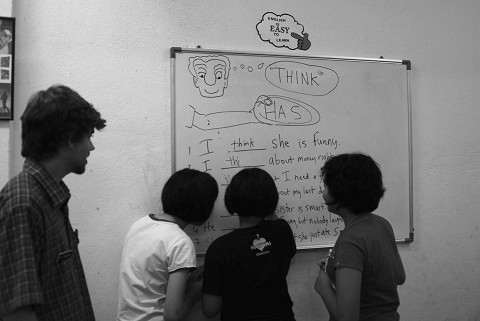
This started to sink in as we taught English classes to a group of fourteen to seventeen year olds from 8-10 P.M. this past Thursday night. Thursdays are our long days. Though I tried my best to engage in the lesson—simple present and present progressive verbs—my mind kept wandering to a few of the things that I would need to pray about soon.
Keeping my focus definitely requires a constant, conscious, battle that it just didn’t require at the beginning of the Race. Though I taught math in Nepal, rather than English, the teaching was very similar in that it involved a whiteboard, ESL students, and the dissemination of oddly-put-together information via an intuitive mix of simple English, exaggerated hand motions, and universal facial expressions. Despite this similarity of process between now and Nepal, a whole lot more focus is required for me to do what was previously second effort.
As I pondered this, it worried me a bit. “Shouldn’t I be experiencing just the opposite?” I thought to myself—“Shouldn’t ministry be getting easier and easier?” Some of this is undoubtedly related to our circumstances, both Malaysia-related and “end of month nine”-related. The lack of ability to openly share the Gospel is definitely taking a toll on me as it has kept me from the type of Jeremiah 20:9 release I so crave. We sleep in the same place that we work, and though I am happy to know that this represents good Kingdom stewardship, it can certainly create a bit of cabin fever!
Over and above these challenges are the challenges that any month-nine World-Racer will face. Personal and communal challenges can no longer be overshadowed by the raw excitement of travel, and the aspects of the passionately abandoned lifestyle—I did my laundry today by hand, in the sink, with expired soap, and hung it over a plastic chair underneath a fan to dry—can be more tiresome and time-consuming than funny and quirky.
The victory in all of this, however, is that as the missionary-esque challenges that made the World Race so fun (initially) are now becoming burdensome, I can simultaneously see something that used to be burdensome—or, at the very least, dry—becoming vibrant and enticing. I refer here to the pursuit of God.
At the beginning of the race, the pursuit of God was fun, but only in small doses. I almost felt as if it took away from my ability—and I meant well (I think) in thinking this—to enjoy all the other, even spiritual, aspects of ministry and the race. I thought this even more so during my week-long mission trip to Honduras before the race started. I knew I was supposed to read my Bible and pray and meet with God while I was there—simply because those are beneficial things to do daily—but I almost didn’t want to, as I felt like doing so would rob me of valuable time to experience the Central American landscape, throw kids over my shoulder, and snap a multitude of awesome pictures.
That cultural high that I was on from Honduras certainly carried over into my pre-World Race thoughts. Before the World Race, I thought astonishingly little about what I wanted to see God do on the Race. Granted, my thoughts from nine plus months ago are a good but fuzzy, but I definitely remember being more wrapped up in and more excited about The World Race itself than about what God was going to do to me and through me while using the World Race as his vessel.
This was very much the sentiment of the squad as well—and I assume this is normal. Our “World Race July Two” Facebook group was covered in thoughts, predictions, and excitement about which cameras we were bringing, which countries we were most excited for, nasty foods we had heard rumors of past World Racers eating, and whether it would be smart or excessive to pack winter jackets. On the other hand, there were very few, in comparison, conversations about preparations for spiritual warfare, prayer requests, theological questions, or talk of that nature.
“The World Race”, in and of itself, was the talk of the squad. Everything I posted online or talked about with friends had the number “11” in it, and the world map was plastered on many of my friends’ support-raising merchandise. Though I look back on this season with greater perspective, I do not look back on it with even a bit of contempt. The fact that I idolized the World Race, to me, was not a bad thing, simply because a) I try not to be embarrassed at any prior step of my faith journey, as sanctification is a long process and our past mistakes only serve to highlight God’s grace, and b) because God has a funny habit of using imperfect means to unexpectedly woo his children into deeper relationships with himself.

Now, however, that it is month nine, and I can observe with greater perspective what the World Race has done for me, I can see a whole lot of wisdom—possibly in the founders of the World Race’s minds, certainly in God’s mind, and probably in both. I had relied—we all had—for so long on the World Race as an institution to be our source of joy. This has less to do, in my opinion, with the unique attractiveness of the Race to young Christians, and more to do with the age-old relationship of human beings to all things that aren’t God.
We have a sinful tendency to put an extraordinary—and unfair— weight of pressure on created things to satisfy us when we were created to run on God alone. In heaven—which is the representation of how earth is supposed to be now, we don’t have marriage (Matthew 22:30), because God is our full source of love, or we don’t even the sun (Revelation 21:23), for example, because God is our full source of light and warmth! The difference between then and now is not at all that, in this season, God has ordained created things to give us joy—because that is where idolatry starts!—but rather that God alone is still what gives us joy and we simply have to go against the grain and fight our depraved minds and hearts to comprehend that truth and put it into practice.
So, I am realizing that “the experience of the World Race” is amazing, beautiful, thrilling, riveting, challenging, and awe inspiring—yet I am realizing that it is all of these things for reasons other than I had expected. To summarize: “The World Race is not nearly what it’s cracked up to be, and God is way more than he is cracked up to be.” Or, for future World Racers: “As many blogs as you are reading right now, and as many pictures as you are looking at right now, The World Race will not satisfy you like you think it will. God, on the other hand, will satisfy you, over the course of eleven months, infinitely more than, at the deepest levels of your heart, you think He will or expect he can—despite what your lips say.”

I don’t think that the founders of the World Race, World Race staff, or anyone back home reading this blog that may be connected with the World Race would take the slightest bit of offense to this statement. They know what the World Race was created to be. In the end, the World Race, like so many other things—friends, marriage, work, school, money, sex, clothes, and yes, even ministry—are only designed, by the author of the universe, as scaffolding. They are flimsy pieces of wood that we stand on to build our masterpiece and to watch it be built. At the end of the project, the scaffolding is always removed.
Sometimes, the whirlwind experience of foreign mission work creates a spiritual high so infinitely complex that it is difficult to tell how much of our joy is coming from God and how much is coming from our circumstances, our scaffolding—they are intricately intertwined. Sometimes, the only way to tell is to remove the circumstances that form the scaffolding, so that we may stand back and examine the product of our faith journey. 1 Corinthians 3:11-14 describes this concept so perfectly:
“For no one can lay down a foundation other than that which has already been laid down. That foundation is Jesus Christ. If anyone builds on that foundation with gold, silver, costly stones, wood, hay, or straw, each one’s work will become obvious, for the day will disclose it, because it will be revealed by fire; the fire will test the quality of each one’s work. If anyone’s work that he has built survives, he will receive a reward.”
God has been gracious enough to remove the scaffolding for me this month, through a variety of means. It’s as if I am taking a cast off and seeing if I can walk on my own. The result—the state of my faith and the state of my Christian walk—is a beautiful mix of many victories and a few defeats—Mount Rushmore with a crooked nose.
God loves us relentlessly enough to guarantee that our “joy-substitutes” will fail us. If our circumstances are giving us the most joy, he will change them. If people we love are giving us more joy than God is, he will remove them from our lives. If something we own is giving us more joy than God is, he will see too it that it will break or get lost. In the end, though, God is only accelerating the natural outworkings of created things—our friends will fail the deepest longings of our soul, our bodies will fail us, our possessions will acquire moths and rust, and our own lives will end. God knows this, and, out of love, blocks these things as paths for giving us temporary joy:
“For (Israel) thought, “I will go after my lovers,”…Therefore, this is what I (God) will do: I will block her way with thorns, I will enclose her with a wall, so she cannot find her paths…Then, she will think, “I will go back to my former husband, for then it was better for me than now.” (Hosea 2:5b-7).
Praise be to God that he points us towards the one thing that remains after the scaffolding is torn down: Himself.