
There have been several moments this month when one of the seven of us has stepped back and remarked something along the lines of, “man, we live a weird life,” or “We must be on the World Race!” These moments usually come after we do something or think something that we probably wouldn’t do or think back in North America—like smelling our clothes to see if they are clean enough to wear or walking twenty minutes down the road to the “big store” to buy a Sprite as a legitimate form of entertainment.
As I pondered the apparent “weirdness” of it all, however, it all started to seem less and less “weird” and more and more, well—normal. From the outside, our days might seem abnormal, but I believe that what God has been showing me about the way we live is meant to be much more than a seasonal abnormality for me and is instead meant to be the gradual putting on of a new, more permanent—sanctified—lifestyle. But first, here is a bit of a glimpse into that odd, yet oddly satisfying, strange, yet strangely normal daily life we live in Kanchanaburi, Thailand:
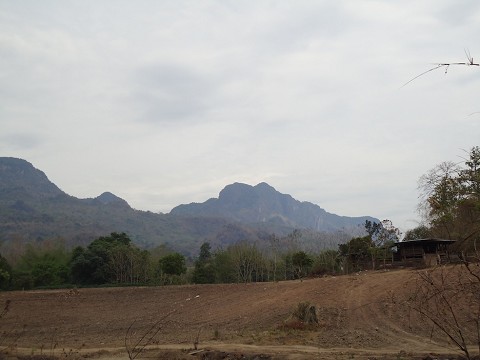
6:45 AM: I usually wake up earlier than 6:45, but don’t actually get out of bed until 6:45, as my physical soreness from the previous day’s labor, coupled with sleeping on my inflatable, red sleeping pad serve as an early-morning reminder that “I’m not in Kansas”—or New Jersey—anymore. I unzip the flap on my North Face tent and look out over a recently harvested tapioca farm, split down the middle by a dirt road lined with banana trees. Further out in the distance stand green hills, covered with red-brown brush.
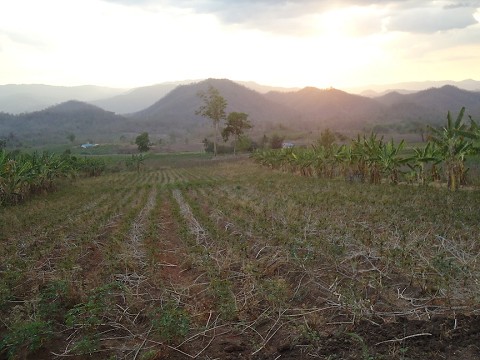
Though I don’t always feel like running in the morning, I ask myself (literally), “Are you living for a great comfort or a great cause?”—not that the running itself will make a huge difference in my Christian life, but more so the fact that I am not conceding to my flesh is what will make the difference, ultimately. I pray a short mental prayer to God for his help throughout the day as I groggily look out to the hills, a stunningly literal fulfillment of Psalm 121:1-2: “I lift up my eyes to the hills. Where does my help come from? My help comes from the Lord, the maker of heaven and earth.”
7:00 AM: I go for a short run on a hilly dirt road, past small (and large) farms. I very rarely pass cars, or any vehicle for that matter. Occasionally, I will share the road with a tractor or a motorized scooter, but even then I barely have to change my path. I will sometimes do a double take, and ask myself, “Is that an-eleven-year-old girl driving a motorcycle on her own? Yes, that is indeed an eleven-year-old girl driving a motorcycle. Wow. Okay.” I labor to breathe in this new humidity, as I realize, stride by stride, that my lungs aren’t nearly as capable as they used to be, all the while enjoying the feel of the sweat on my forehead nonetheless.
8:00 AM: By now, I have showered—cold water only, of course—and sat down outdoors for breakfast. We eat buttered toast and drink instant coffee. We eat breakfast every single day, though breakfast itself apparently isn’t as common a meal in the eight countries we’ve been to thus far. In some countries, breakfast isn’t even eaten at all. We do the dishes by hand and leave them out to air-dry. I write in my journal until it is time to leave for work. At home, this would have been a prime hour for Facebook, but here, with a limited capacity internet stick (another thing I didn’t know existed until I came on the World Race), internet is pretty much limited to about twice a week and is used for sending pre-typed e-mails and posting pre-typed blogs.
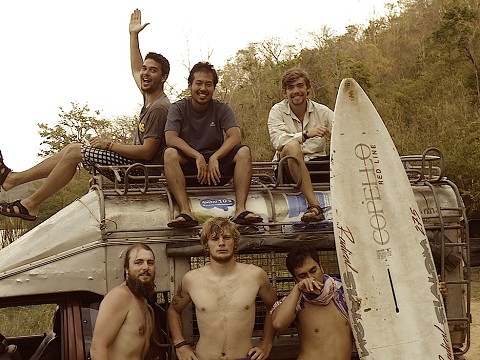
9:00 AM: We ride to work on the top of our translator, Big’s, truck. Though riding on the top of vehicles is certainly a fun (and new) thing for me, I will let out audible cries of pain as we go over big bumps in the road and my behind smashes down on the metal caging lining the top of the truck. We will let go of the metal railing beneath our feet and quickly lay down with our backs to the top of the truck to avoid being clotheslined by the oncoming drooping Palm trees. I like to think of myself as James Bond during these times. When it comes to transportation this year, the unspoken motto has been “If it moves, we’ll ride it!” Seatbelts are unheard of.
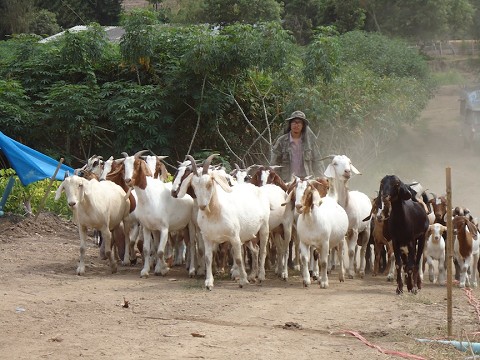
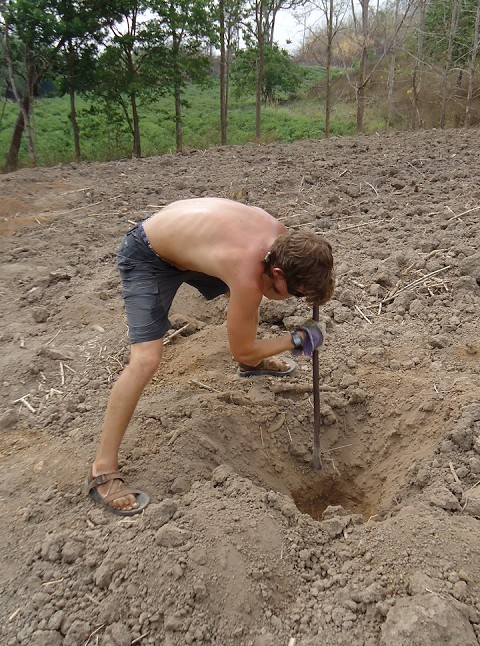
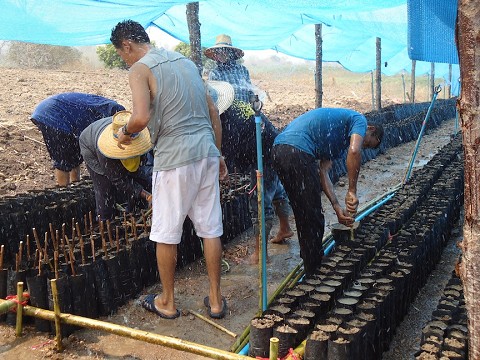
We feed the goats and wild pigs banana tree stalks as we enter the farm then proceed to work in the hot sun for about three hours until it is time for lunch. Each day’s work has been different—pruning rubber trees, planting rubber trees, destroying stone columns, building a green house, dumping fertilizer, for example—though these past two days have been spent digging 150 holes to later plant trees in. Our shirts are off by fifteen minutes into the day, and we’re covered in sweat shortly after. By noon, the temperature has reached the mid 90’s.
12:00 PM: At noon, we break to eat the lunch that our contact, Pang’s, mother, Ma (I have yet to learn her real name!) has brought us. Ma is a hilarious and feisty older woman, with the energy of a 20 year-old. She gets by just fine by blending Thai, facial expressions, hand motions, and the few English words she knows into her own unique, yet effective language. I spend what’s left of the hour walking by myself and praying to God, for and about anything that comes to mind. I am always amazed at how refreshing these prayer sessions are.
1:00 PM: We return to work, digging holes as we had done in the morning. By the end of the afternoon, my hands are blistered and my back is sore, but both feelings make me feel as if I have truly worked.
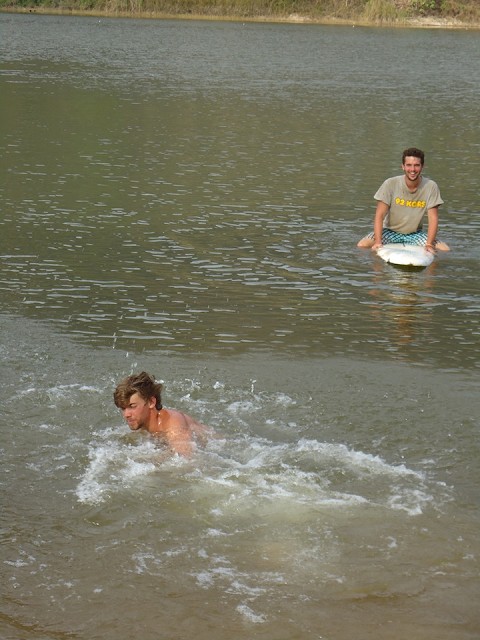
4:00 PM: We return home. Some days, Big will take us to a nearby lake to swim and cool off. Sometimes, we will even bring shampoo and “shower” at the lake. Other days, I will shower at home and sit by my tent and read the Bible until the sun sets. I have found that this daily devotional time is absolutely essential to my day. The word of God has an addicting effect and it is continuously becoming more and more akin to actual nourishment for me.
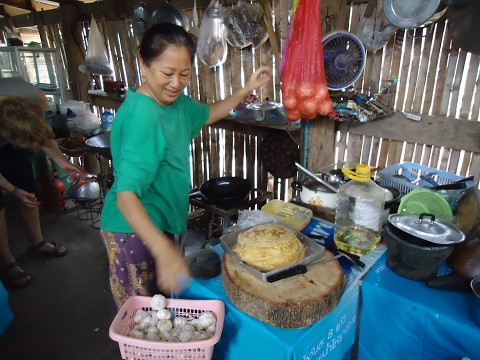
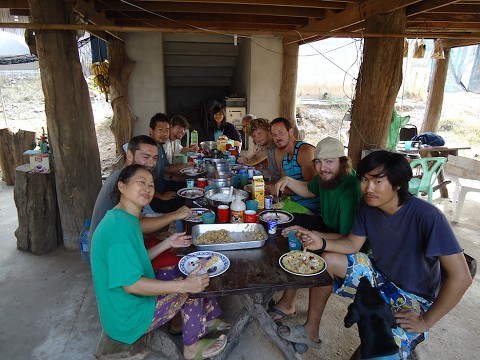
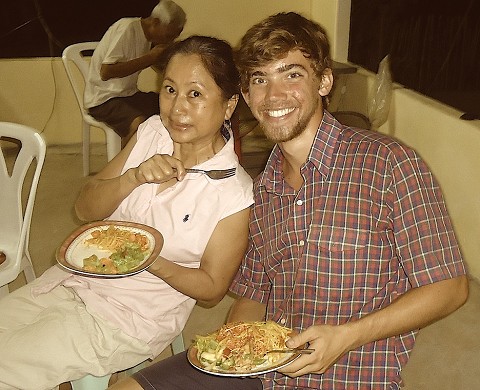
6:00 PM: We eat dinner—homemade Thai food, made by Ma, again. Dinner is definitely one of my favorite parts of the day, as meals on the World Race are so much more than meals. Meals are social gatherings. We eat, laugh, joke, eat more, and do everything together from dishes to even (occasionally) helping Ma prepare dinner. Again, dinners are so much more than mere times to alleviate hunger and they convince me that we are truly built for community. Pang reminds me to use Q-tips to clean my ears, once per day; Ma tries to convince Cody to eat full spoonfuls of her spicy sauce, and Mike yells at Logan for finding his own iPod then planting it in his tent in an effort to frame him.
7:00 PM: After dinner, we study the book of Romans together then take turns leading some sort of team activity for the night. Sometimes, we will have one of our more musically inclined team members (thank you, Frank!), play guitar and lead us in worship, sometimes we will listen to a sermon, and some nights we will simply relax and play poker. “Team time” is preceded by “feedback”—a time to give each other both encouragements and constructive criticisms regarding the goings-on of the day.
9:30 PM: Though I would never go to sleep this early at home, I certainly do on the World Race. I look out at the stars through the mesh on the top of my tent, exhausted, yet satisfied and fulfilled. The stars themselves provide a show worth paying money to see! “The heavens declare the glory of God. The skies proclaim the work of his hands.” (Psalm 19:1).
The schedule varies, almost entirely, month-by-month, as this month’s high concentration of manual labor is certainly not the norm for the World Race, but the overall mindset of “putting a great cause before a great comfort” remains the same.
So, as I pondered some of the “weirdness” of my life, it started to seem, almost ironically, less and less weird. I remember being surprised as I thought, during month one in Serbia, “that’s weird that Serbians do X, Y, and Z in this way,” only to find that they did those things (think smaller portion sizes, lack of Internet access, dirty bathrooms, old cars, poor roads, community living, over-the-top hospitality, for example) in Romania too! I then proceeded to label those things as “Eastern European”, rather than just Serbian. I ran into a problem, however, when people did and endured “Eastern European” things in India, and then Nepal—and then Africa—as well. Little by little, I realized that these things were pretty much “everywhere in the world except North America” things, and that it was I who was living the “minority lifestyle”, so to speak, by the rests of the world’s standards.

What has been even more impactful to me, though, has been the realization that I am used to this lifestyle now—as are my squadmates. Granted I do miss my family and friends greatly, but I am referring here to the “creature comforts” I would have thought I would by dying to have—hot showers, new clothes, constant entertainment, a cell-phone, and a Chick-Fil-A sandwich with waffle fries! Don’t get me wrong here, either, I have had more than a few conversations about the string of fast-food restaurants I plan on hitting up the second I reach the States, but beyond all levels of joking, I really don’t feel as if I need these things.
This realization has massive implications for the rest of my life. I—we—can get used to things very easily. I often hear people say (well-intentioned) things like, “I could never go there! I need my (insert “creature comfort” of choice here) too much!” Though I certainly know these statements are meant well, they are lies. The fact that human beings truly can get used to just about anything should compel us—and certainly compels me—to think bigger thoughts about the type of lives we live in the future.
At training camp, a former World Racer once told us, “If your only conclusion, after going on the World Race, is that you now appreciate your luxuries more than you had previously appreciated them, you will have missed the point. The World Race will show you that you don’t even need them—or, even better, that you don’t even want them.”
I used to want to make a lot of money, so that I could live a luxurious lifestyle and help the poor and needy simultaneously. To this day, even after seeing many developing countries, I still believe that we make a false dichotomy between generous, well-stewarded living and comfortable, luxurious living. One doesn’t necessarily preclude the other. After all, I know many people who are both wealthy and living confortable lives and incredibly generous—and, if I were truly honest with myself, I would have to admit that I wouldn’t be in Kanchanaburi, Thailand without them.
But, as I have realized the increasing normalcy of this new daily life, and the deep, deep satisfaction that it brings, I am realizing that the radically-stewarded, purpose-driven, creature-comfort forsaking lifestyle is neither a burden nor a requirement—it is a gift, an opportunity.
I have scoured the Bible—and believe me, I have scoured it—in search of what I have to do and what kind of daily lifestyle I have to live, yet found nothing, no bottom line. I have realized, however, that it is not at all about what I have to do, but about what I get to do. Instead of rejoicing in the fact that God technically permits me to live a comfortable, luxurious lifestyle (which is true), or sulking at the fact that God requires me to live with radical abandonment (which is not true), I can instead rejoice in the fact that I get to live a radically abandoned life, that I get to experience the deep, lasting joy and fulfillment that comes from this lifestyle, and that I no longer have to be a slave to the shallow, fleeting bouts of happiness that come from feverishly stringing together creature comforts in a vain attempt to fill the deeper longings of my soul.
If God is knocking at your own door, urging you—pleading with you—to take a leap of faith and live the type of lifestyle that begets deep joy—my encouragement for you is this: Do it. Don’t let what you currently think you “need” get in your way, because you will be truly amazed at what you will be able to “get used to.” “For what does it profit a man if he gains the whole world, yet loses his soul?” (Matthew 16:26).







