
I love being a man. The very fact that I paused for a good while after writing that first sentence is evidence enough that God was wise in creating us as equal, yet distinct (Genesis 1:27)—male and female. This first week in Thailand has only confirmed it.
When we landed in Bangkok after flying from Uganda, through Nairobi, Kenya, it was clear that we were in a new continent. If Africa was a dance, Bangkok was a march. Africa swayed to the rhythm of its surroundings, loveably carefree, but Bangkok set its tempo. Even the airport bore witness to this, as it became clear that things were labeled, succinct, stamped, stapled, double-checked, fast-paced, wireless, clean, efficient, and hi-tech. Though this jarring change of pace and sudden change of culture captivated me for a day, maybe two, it was powerless to keep my attention—God still wanted me elsewhere.
On Monday, the six other men on the squad and I headed to the rural town of Kanchanaburi, Thailand—the town made famous for its Bridge on the River Kwai, and corresponding movie, for a month of manual labor. The drive itself to Kanchanaburi clued me in to the fact that this would be a special month. Blue skies became purple and purple skies became hazy orange, as majestic green palm trees’ broad leaves, now black in the dim evening light, cut sharply into the blurry background, as if vying for space on God’s Thai canvas. “We are out here,” I told Jason, as the road, once relatively suburban, snaked into land considerably more rural.
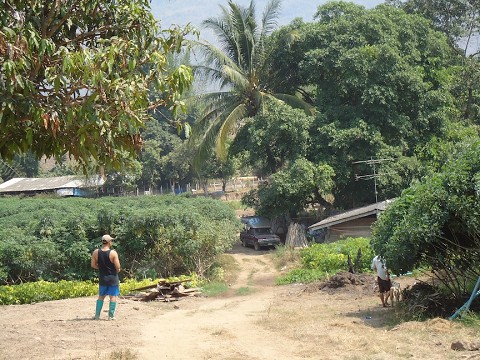
We arrived at our house, an old farming residence, late at night, so our surroundings were largely a mystery to us, as the black sky, though studded with stars, cloaked the property. When we woke up, we found that we were mere specks in a large green landscape—the way God intended it. This is a month of all-men’s ministry, as the seven men of X-squad have come together to glorify God through hard work, and our physical setting, from day one, has only reinforced that idea. This place is more than Kanchanaburi, Thailand—it is God’s jungle gym.
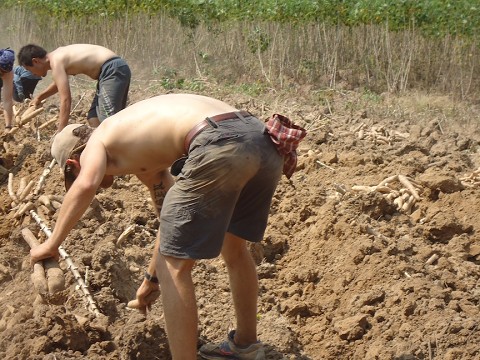
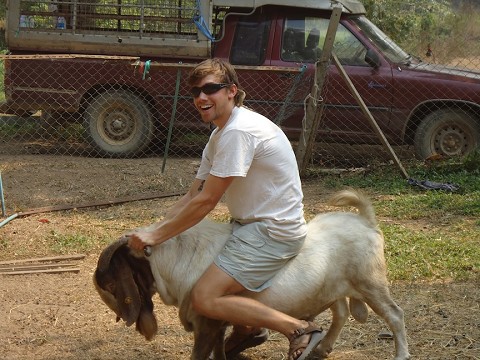
Every last ounce of this month appeals deeply to my inner man. We sleep under the stars, use old bathrooms, ride on top of a truck, and work on a goat farm! Each day consists of long hours of manual labor. We have harvested tapioca, fed goats and pigs, cleared brush, moved topsoil, fertilized and watered trees, and done just about anything else that can be done on a rural goat farm. Our dirt stains are deep, and our sunburns and blisters are both fresh.
No, I do not believe that God has placed a calling on my heart to do great deals of manual labor as part of my eventual vocation, and no, I’m not the strongest man alive either—how far I am from that! What the manual labor and the physical setting represent, however—a connection between my heart and soul and the earth around me, is what appeals to my inner man, more specifically.
Being “in-touch” with one’s surroundings is a concept, nowadays, that has taken on all types of vaguely spiritual, though not exactly Christian forms. Being “in touch” is a often a core component of the worldview of those who self identify as “spiritual, but not religious”—the worldview that attempts to say, “I am not so cold-hearted as to posit that the world has no meaning, but I am not so arrogant as to suggest I know what that meaning is.” For this reason, I tend to avoid writing about any Christian concept that can be confused with a muddle of unchristian ones, lest the definite, eternal beauty of Christ be thought of as interchangeable with the muddy waters of the “pick-your-own-spirituality” worldview.
Nevertheless, I permit myself an exception in this case, as I believe that God has allowed me to feel so “in touch” with his creation—and by extension, himself, so that I may glorify his name. The realness of this month—the dirt underneath my fingernails, the sweat that drips onto the nose of my sunglasses, and even the brownish-pink sunburn on my shoulders—all help to cut against the numbing effects of much of my manicured day-to-day life.
The dirt is more than dirt. It is something that God made, and made tons of. He made it for Adam (and us) to sift through, spread, lift, and plant in—fulfilling his original purpose to cultivate the earth (Genesis 2:15). The sweat is more than sweat. It is a reminder of Adam’s curse—that he would eat his bread “by the sweat of his brow” (Genesis 3:19)—and also a hope; a sharing in the hope that creation, now “groaning with labor pains” (Romans 8:22), will soon be released from its bondage to the earthly decay so inherent in this fallen world.
Everything is more than what it is. Oh, that this poetry would not be sucked out of life! Thanks be to God, however, that we do not have to divorce poetry from realness. If God were not real, then dirt would be nothing more than a collection of molecules, the sun would be nothing more than a ball of flaming gas, and any attempt to inject pseudo-grandeur into either one of them would be nothing more than a sad attempt to romanticize an otherwise, well—boring—world. However, because God is real, the poetic marrow of earthly life can now be celebrated as something real and intended, rather than as something fabricated by man in order to spice up life.
Where vague secular spirituality proposes that through our surroundings, we can become “in touch” with some amorphous, undefined, life force, the Christian life proposes that through our surroundings, we can become “in touch with” a person—the triune God of the universe.
Perhaps nothing has let me feel more than my small North Face tent. The apostle Paul describes this earthly body (2 Corinthians 5:1-3) and earthly life as a tent—something temporary. My North Face tent is something that is understood, in every way, as something temporary. It looks like a tent, feels like a tent, and its fabric even makes it smell like a tent. It will never be a house and nobody would even dream of using it as such. As I sleep in my tent each night, though, I can peer through its clear mesh top and see a gorgeous array of stars. When I sleep in houses—“permanent” dwellings, however, I cannot see the stars. It was only when I moved to something temporary, makeshift, on the fly, so to speak, that I could truly gaze at and appreciate that which is eternal—the stars. The same is true of life, I believe. It is only once we realize that we are, as Paul says, “aliens” and “sojourners” in this life, that we can truly have our eyes opened up to that which is eternal—namely, God.
The stars, pieces of God’s own workmanship (Genesis 1:15-16), looked like magistrates in a heavenly court. “The heavens declare the glory of God; the skies proclaim the work of his hands. Day after day they pour out speech, night after night they communicate knowledge.” (Psalm 19:1-2).
I am reminded of a line from the song “Orphans, Kingdoms” by Brooke Fraser. She sings, “We are wandering where the wild wind blows, we are happy here, ‘cause the wild wind blows.” I think that she hits the nail on the head with that line. Out in Kanchanaburi, Thailand, the wild wind blows on the goat farm, among rows of tapioca trees. The wild wind brings me in touch with my creator, Yahweh, and allows me to feel the poetic realness of this earthly life. I am happy here ‘cause the wild wind blows.







