This is a blog that I hope future World Racers will read. These past few months have been easy sailing. Every sea-soaked sailor knows, however, that the warm trade winds only last so long—on this side of eternity’s door—before the ship will inevitably pass through turbulent waters. When that time comes, it is of little use to fight the forces of maritime nature as the sovereign God to whom they answer has ordained them to perfect your sailing abilities. Calm, blue-green Caribbean waters are best enjoyed by weathered sailors; hands already callused from hoisting masts over the stormy, gray Atlantic.
Spiritually, this is the season in which I find myself. It would be a step too far, however, to say that this is a bad thing. There is indeed something thrilling about the feeling of spiritual saltwater on my face. The scene from Forrest Gump comes to mind, when lieutenant Dan, dwarfed in the middle of a rainstorm, shouts, like a maniac, from atop the ship, “It’s me verses you, God!”. This time, of course, it’s “me with you.”
Regardless of the fact that Rwanda is a beautiful country and that we have been blessed by our host, Pastor Robert, it is month six of eleven—“hump” month. We are much too far into race for anything to feel new. The tourist part of our mindset departed from us months ago. It was never supposed to be permanent anyway—God alone satisfies fully. We are also not far enough into the race to hunker down and stay in the mental “here and now”, with the knowledge that home and family are right around the corner. Any good miler knows that you can’t start sprinting at the beginning of lap three and still finish strong.
It is at this time—“no man’s land”—that runners tire. It is this time that Satan waits for eagerly, like a well trained archer with an eye for finding even the smallest gaps in the saints’ armor through which he can thread a poisonous arrow—just as skillfully as when he took his first shot in the garden—into exposed flesh.
Thoughts of my future keep me up at night. I toss, turn, and reposition myself, as if constantly alternating which one of my two hipbones will slide into the ridges of my red, inflatable, sleeping pad and which one will lie open to the night air will somehow prompt divine revelation. Things that I used to regard as mere “World Race peculiarities”—twenty people sharing one bathroom, dependence on bottled water, and traveling great distances by foot, for example—can occasionally transcend the realm of “peculiar” and penetrate the realm, as small as it is for my easy-going self, of “bothersome.” Skype, though helpful, is no substitute for real conversation, and our unplugged daily lifestyle only accentuates that difference.
All this goes to say that month six is a good storm—a sanctifying storm—but a storm nonetheless. The saving grace in it all, however, is not the fact that blue skies are on the horizon. Who am I to presume upon God’s timing, for he holds the watch and I hold the oar? The saving grace is the fact that the ship holds six of us and the same rain falls on all six of our shoulders. God has provided me with a team that runs as a well-oiled battle unit, and for that I am thankful. This type of community, however, was not an idea invented by the front office of the World Race to promote a successful eleven months, but a cornerstone piece of theology that soaks almost every page of scripture.
In Ecclesiastes 3 and 4, Solomon ponders the tough questions of life. Next, though, in what seems like either an anticlimactic author’s tease or a flat-out scribal error, Solomon leaves these questions completely unanswered! Instead, he starts speaking about the importance of community. The mysteries of God won’t be answered until we reach the other side, but on this side we have each other. The fact that, no, the deep longings of the soul to “know why our circumstances are the way they are” are not revealed until heaven may be agonizing and the fact that yes, the best the Bible offers us is, in this area, is not an answer, but a coping mechanism—community—should not discourage us. Yes, coping is only temporary, but so is everything in this life. Marriage is temporary. Our bodies are temporary. Even the cross, an object of eternal glory, is a temporary mechanism in this age, as there will be no need to respond to it in eternity.
“Two are better than one because they have a good return for their efforts. For if either falls, his companion can lift him up; but pity to the one who falls without another to lift him up. Also, if two lie down together, they can keep warm, but how can one person alone keep warm? And if someone overpowers one person, two can resist him. A cord of three strands is not easily broken.” (Ecclesiastes 4:9-12).
In the book of Acts, the early Christians lived in close-knit and vibrant community, as they sold and used their property communally (Acts 2:45) and met and ate together daily (Acts 2:46). Many times, I feel like our team is living a 21st-century book of Acts lifestyle. I realized this last night, as I laid down for bed. I was listening to Brandon’s iPod and using his spare set of sheets (to prevent bedbugs!) as he was using my laptop. My team eats all three meals together every day, seven days a week, and we do just about everything in between together as well. We know which food to put on each other’s places and which foods not to. It is not uncommon, either, to find a team member wearing clothing that you have seen before on another team member or squad member.
Every night before bed, Brandon and I have deep theological discussions. Every day, Stephanie tells me to pray and I tell her to “set (her) mind on things above” (Colossians 3:2). Hannah, Stephanie and I run together every morning and Brandon and I do push-ups. There is rarely a moment where we are not within feet of each other. One of the first observations that God made about his signature piece of creation, man (though every observation that God makes, he has known all along), was that “It (was) not good for the man to be alone.” (Genesis 2:18). I don’t think that God was prefiguring marriage here, but community in general, as the first thing God did after that statement was to make animals and birds, not Eve (Genesis 2:19).
When we get back from ministry each day, we do “feedback”—a time for sharing specific, positive, encouragements and highlighting room for improvement and growth. Feedback is not always without tears and emotion—but this merely means that we are a true family, rather than a Wednesday-night youth group.
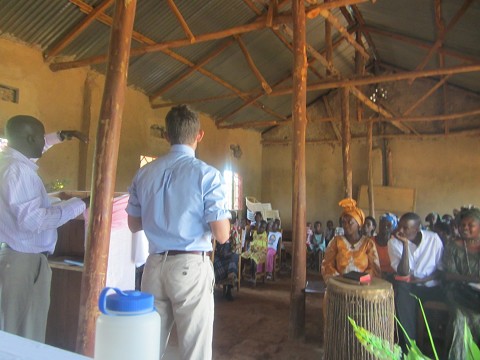
Like any good team, we took turns “throwing each other under the bus”, metaphorically speaking, during children’s ministry this past week. You learn to stay mentally nimble because you can never anticipate when the next, “_______, would you like to show us how _________ is done?” or “_________ will sing us a song” is coming!
Jesus and the apostle Paul often describe what we should do in less-than-ideal situations. Paul tells slaves how they should relate to their masters (Colossians 3:22-25), though the institution of slavery is contrary to God’s “Genesis 2” created order and is sure to be dismantled by the Gospel. Jesus tells us to love our enemies (Matthew 5:43-44) and John tells us how to provide for the poor (1 John 3:17), but both poverty and the existence of enemies are expressions of less-than-ideal situations. Notoriously absent from the extensive list of ways to behave in less-than-ideal circumstances, however is how to act when one lacks community. I believe that this is because the idea of living solitary Christian lives must have been absolutely inconceivable to the New Testament writers—and even to the prophets of old.
Humans are not only encouraged to live in community, but we are built for it. If wolves roam in packs and geese fly in formation, what makes us think that humans—the hallmark of God’s creation, yet created beings nonetheless, are somehow better served through independence. Part of it, I believe, is pride—a universal product of the fall. It is harder to glorify one’s self when your onlookers might so frustratingly attribute your success to your team as a whole! I imagine that this universal product of the fall is only fueled by the Western “self-made man” ideal, as if “roughing it alone” were the only feasible alternative to parasitism.
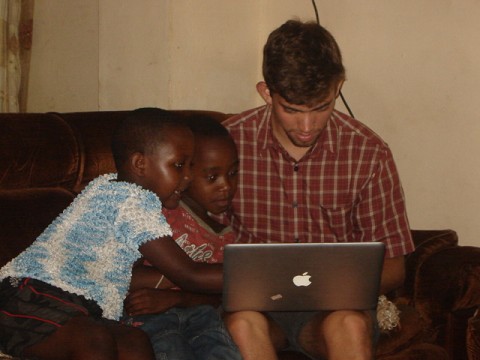
It’s not that I felt empty before I started living in community, but that I simply didn’t realize that community feels (and works!) better. Trucks are indeed capable of running on watered-down gasoline, but their drivers realize, in an instant, that their trucks run better on pure diesel.
I thank God for providing me with the opportunity to live in intense community while on the race. Like most things on the World Race, however, community is not the peculiarity of a unique year, but the beginning of a lifelong lifestyle. This is not to say that living in community does not come pre-packaged with its fair share of frustrations, but these frustrations are a product of our own fallen nature, rather than indicators that living in community is a bad idea. Even so, the benefits of community far outweigh the occasional negatives.
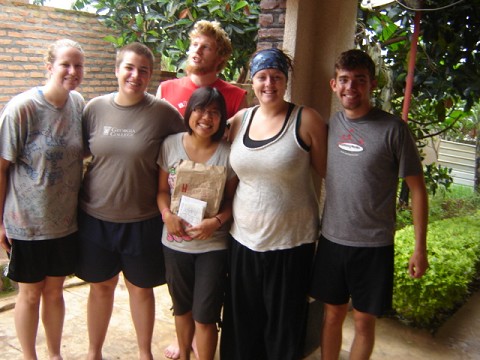
Team Deep Roots rolls six-deep. I do not know the circumstances of my future, but I know that I will be in the company of a large body of saints.