
Though we have been in Rwanda for only four days, thus far, I can honestly say that Rwanda has been the country that has surprised me the most on the World Race. Less than a generation removed from the haunting scars of genocide, Rwanda seems to be an oasis of life in East Africa. Even as our bus crossed the border from Uganda to Rwanda, the terrain changed almost immediately from flat, worn, dirt to lush, green, rolling hills—as if the land’s geography was well aware of the national boundary lines. As we snaked through the northern foothills on our way to Kigali, the capital city, my senses feasted on the displays of God’s goodness that were before me— the mud houses helplessly unable to conceal the smoke from their kitchens as it wisped lazily upward and faded into the afternoon sky and the banana trees leaning so densely together as to almost guarantee that the road we were driving on was a late addition to the picture.
We walked most of the way to our pastor, Robert’s, church this past Sunday and, because busses are too expensive for us to ride consistently, we ended up walking for an hour and a half (each way!) to get there. Normally, I would have considered such a long walk a pain or an inconvenience, but this time it was well worth it as I only got to continue experiencing the beauty of Rwanda. I was incredibly vocal about the scenery as my shallow self-consciousness was forced to bow in submission to the child-like elation of my own soul and as that elation was consummated by verbal praises—some under my breath and some not—with each new round of a bend.

I began to realize, fairly quickly, the reason why I felt such joy in my surroundings. I think that when we are caught up in somewhere greater than ourselves, it provides us with a valuable and much-needed escape from ourselves. Often, there is nothing I need more than to escape my own self.
This is precisely because Ben Friedman is thoroughly unsatisfying. When I crawl through the deep recesses of my own mind, I am often disappointed at its skeletons. Even if I am able to conjure up a momentary buzz of satisfaction by pondering my own seemingly righteous acts, that buzz is inevitable dampened—very quickly—by the realization that the motivation for my good deeds is selfish and competitive, more often than not. “I saw that all labor and all skillful work is due to a man’s jealousy of his friend.” (Ecclesiastes 4:4). When I picture my achievements in running, I can always picture a better runner and when I picture my achievements in school, I can always picture a better student. When I saturate my own mind with thoughts of myself, it is a thoroughly unsatisfying experience.
Upon realizing, via nothing more than repetitive personal experience, the dissatisfaction brought about by my meditations on my own self, I realized that there were two possible conclusions I could draw. Perhaps there are more than two, but I can think of two now. First, it is possible that I am an incredibly depressed person and over-critical of my own self. I don’t really feel as if this is the case, though, as I am legitimately happy for almost twenty-four hours a day, seven days a week. The second option is that I simply wasn’t built to focus on myself. I was engineered to behold and experience something, somewhere—or someone—greater.
Shifting the emphasis away from oneself is nothing new. After all, there is nothing new under the sun (Ecclesiastes 1:9). However, my own de-emphasis of self is new—to me—in the sense that it comes not as an idealist invoking a “golden rule”, but as a pragmatic out for his own joy.

One of the strongest witnesses for Christianity, in my own opinion, is that it is an incredibly self-evident belief system. C.S. Lewis once said “I believe in Christianity as I believe that the sun has risen: not only because I see it, but because by it I see everything else.” It seems self-evident that we live in a world based on grace (even if you still, at this point, call it luck). All one has to do is juxtapose the unearned, undeserved lifestyles of a person born in suburban America and rural Africa to realize this is true. It seems self-evident that we are born sinful from the womb. Babies bite and kick until they selfishly get their ways—despite the fact that nine out of ten babies have never once witnessed their parents biting and kicking each other. It seems self-evident that whatever the answer to the world’s problems is, it’s certainly not more money—or even more education. Fifteen minutes of watching NBC silences that argument. The Bible reads us far more than we read it.
All of this goes to say that one of the beautifully self-evident truths of Christianity is that we are made to feel small. For this reason, people take camping trips to remote and majestic areas to dwarf themselves. For this reason, movies will almost always begin with panoramic views of beautiful scenery. The doctrine of “common grace” refers to those simple pleasures that God has bestowed on every human being—the shining of the sun, a view of stately mountains, a spring rain, a good piece of red meat, or a tee-ball game.
I want to be careful here—and I almost considered not posting this blog, as not to lead anyone astray—because it is common grace that Satan has used to lure countless people into false assurances of salvation through the misguided notion that enjoying common grace alone—with no trembling reverence for its source, no participation in the mission of its source, and no stewardship of that common grace—reflects a heart posture that has been significantly shaken up by the grace of its maker. We are not called to live “Bless me and I’ll thank you” type of lives, in relation to God, but rather, “I consider every (common grace) thing as loss compared to the surpassing greatness of knowing Christ Jesus my Lord, for whose sake I have lost all things. I consider them garbage, that I may gain Christ,” type of lives (Philippians 3:8). In this way, hedonism is avoided.
We are to behold uncommon grace—the type that is marked by a cross and only comes once in an eternity—as our greatest treasure, and we are to use common grace as foretastes—opening acts—for the surpassing glory that is to be revealed. Pastor John Piper, in a sermon on Romans 9, once said “I believe that God created the small pleasures of this world, not as temptations to sin (granted we don’t idolize them), but as appetizers of Glory.”

With that lengthy disclaimer aside, I can say that it is with great joy—in the minimization of my own self—that I have been blessed to enjoy the Rwandan environment. My happiness is directly proportional to the degree to which my Genesis 3, fall-of-man, self is out of the picture.
I actually realized this principle—though I was nervous to admit it, even to my own self—before I even became a Christian. This shouldn’t be surprising because, though it takes a supernatural act of God to open a heart to his uncommon grace and a mind to his parables, our hearts are nonetheless coded, from the womb, to find joy in Christian truth and to run on Yahweh’s gasoline. Our souls like to go camping before we read that we were created to behold God’s glory and our souls realize that there is something—over and above size and shape—that separates human beings from grasshoppers before we read that we were the only ones created in God’s image (Genesis 1:27).
As ridiculous as this may sound, I was actually angry at my soul’s delight in common grace before I became a Christian. Yes, some of this is due to my own competitiveness, but I would be legitimately flustered by the fact that my greatest joy was in the things that I did not earn. For example, when my family took a vacation to go rafting through Utah, my soul would feel so much happiness, deep down, at the sight of the beautiful red rocks on either side of me, before my mind would stunt the happiness of my own soul, twenty minutes after. My mind would say, “Ben, you are supposed to derive your utmost joy from your running—that is what sets you apart from everyone else—not this scenery that is being enjoyed by hard-workers and lazy-people alike!”
Perhaps I was (or am) just a head case. I don’t rule out that possibility. But, perhaps my soul was onto something, five years ahead of my mind. The soul does often work ahead of the mind, as the soul pants for God (Psalm 42:1), but in our pre-salvation state, we are “enemies (of God) in our minds” (Colossians 1:21). And again, the Bible reads us like a book. Perhaps my soul was onto something in that it felt comfort—as it should have—in beholding and enjoying most that which it did not earn—grace.
Christianity—or, more accurately, Christ himself, offers us something one step beyond the type of escape from oneself that the secular world offers us. The secular world offers us distractions. We don’t want to think about ourselves, so we got to the movie theaters. We watch movies about people that live out love-stories we will never live out, shoot guns we would never shoot, and take risks we would never take. Where the secular world offers us distractions from self, Christ offers us deliverance from self. The Bible says that our selves (who are saved by grace) have died with Christ (Colossians 3:3). I thank God that my biggest barrier to deep happiness and deep joy—not Satan, but Ben Friedman—has been eliminated.
Let us not stand at the doorway to uncommon grace—the salvation of our souls and the hope of glory (Colossians 1:27)—and refuse to enter and enjoy the feast that has been prepared for us (Psalm 23:5), because we are so entranced with the doormat we call common grace. For if we look long and hard enough at that doormat, we will recognize that its purpose is not for standing on—idly—but for welcoming us into a mansion. “In my father’s house, there are many rooms; if it were not so, I would not have told you.” (John 14:2).
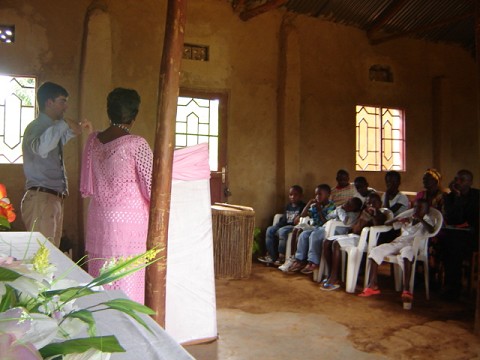
This Sunday, I was given the honor of preaching the sermon at our Pastor, Robert’s, church, Apostolic Church. When I sat down afterwards and thought about “my” performance, I quickly realized all of the mistakes I made and all the things I had forgotten to say, and I quickly wished I had done better (thank God for grace). As I was preaching, however, I was so wrapped up in the principles of God and the works of His hand that I felt unspeakable joy. Perhaps it was because Ben Friedman was lost—or eliminated—in translation.







