
Yesterday marked the first time that I had ever been away from home on Thanksgiving. Though it was sad, during certain parts of the day, to subtract the eight-hour time difference and picture what my family and friends were doing during that particular hour of the holiday, there was great solace in the fact that the festivities were merely representative of the concept of thanksgiving, but not the concept itself. The idea of thanksgiving, I have realized, is one that is magnified and easier to recognize on the foreign mission field.
I have never been strong in the concept of thanksgiving, particularly because it has always been so boring to me. Can we at least admit that our fallen souls generally find the act of thanksgiving uninteresting? When I was a kid, I always liked opening up presents, but never liked writing thank-you notes. There is something thrilling about opening up a wrapped present, but writing the thank-you note is so anti-climatic—it’s a chore, essentially. It’s not that I wasn’t thankful, but that the act of giving the thanks wasn’t all that captivating. I didn’t even like receiving thank-you notes! My eyes would light up at the sight of a square blue envelope; secretly hoping it was a birthday-party invitation, then dim again when I realized the envelope merely contained a thank-you note chronicling events that were gone and passed.
I think that my prior lack of enthusiasm for thanksgiving (the concept, not the holiday) was deeply rooted in the fact that I was a future-minded person living in a future-minded culture. As Christians, we don’t thank God for the future, because to do so would be to presume that our next breath is guaranteed, an assumption that is unbiblical to the core. In addition, my small, human-sized brain is typically inept at recognizing God’s blessings in the present because my sinful human tendency categorizes them as products of my own doing. Thus, it only follows that the past is the only area of the timeline where thanksgiving is fit to dwell. Again, because we live in such a future-minded world (and this is not necessarily a bad thing, either), it only makes sense that we are uninterested-in and weak in thanksgiving, as it is a past-oriented topic.
Most of our idioms and maxims about the past are even negative in connotation—“Don’t dwell on the past”, “He or she is so wrapped up in the past”, or “What’s done is done,” all come to mind. Similarly, most of our idioms and maxims about the future are positive in connotation and wrapped in manifest-destiny grandeur—“The future belongs to those who believe in the beauty of their dreams!” As Christians, though, we once again stand directly at odds with the world and cling to what’s been done for us in the past.
Christianity offers hope for the future and guarantees things yet to come, but these promises are only so because of concrete past events. Our hope for eternal life and the resurrection of our souls is not the product of fanciful fantasizing or wishful thinking, but the product of a concrete historical event in the past—namely, the actual death and bodily resurrection of the Mediterranean rebel we call Jesus of Nazareth (1 Corinthians 15:1-34). Regardless of how the remainder of earthly history plays out chronologically, the most climatic event in human history occurred 2,000 years ago on a wooden cross.

Thanksgiving is a Biblical concept to its core because thanksgiving only applies when we receive what we don’t deserve, a concept central to the nature of the Gospel and God’s nature as a giver. Nobody writes a thank-you note to their boss for their latest paycheck, because they earned it. As Christians, though, our eyes are opened to see the depths of what we did not earn, because we are sinners (Romans 3:23) and included in this category of “blessings we did not earn” is everything under the sun, save death (Romans 6:23).
During our month-four debrief session, we heard a talk that really pierced through to my soul. The talk was on the importance of remembering what God has done for us in the past and that when we remember the great things God has done for us in the past, we will be more likely to believe that God can do great things for us in the future. In Psalm 78, Israel’s army had to turn back from battle, in fear, because they had forgotten what God had already done for them (Psalm 78:11)! This talk was comforting to me, because I still held that very worldly opinion that thinking too much about the past was a bad thing. When the talk was over, I listened to my iPod and played mental movies of the events surrounding my salvation, previous summer in Wyoming, support-raising process, and Baptism at First Baptist Tuscaloosa. When I saw how God had, time and time again, changed me and others through me, it became less and less ridiculous for me to expect him to use me as a vessel for his glory in the future.
Through the process of sanctification, I am continually realizing just how much of what I have I did not earn. God makes sure to drill this very idea into the heads of the Israelites before they conquer the Promised Land and receive his blessings. “When the Lord your God drives (your enemies) out before you, do not say to yourself, ‘The Lord brought me in to take possession of this Land because of my righteousness.’”, Moses warned the people (Deuteronomy 9:4). He also says that God is bringing them into a land with “large and beautiful cities that you did not build, houses full of every good thing that you did not fill them with, wells dug that you did not dig, and vineyards and olive groves that you did not plant,” (Deuteronomy 6:10-12).
Lest we think that there are still a few things that we do earn, we need not forget that it was God who even gave us the ability to “earn” them. In Deuteronomy 8:17, Moses again tells the people, “You may say to yourself, ‘My power and my own ability have gained this wealth for me,’ but remember that the Lord your God gives you the power to gain wealth.” I might have legitimately worked hard in college, but it was a free, undeserved gift of God that landed me in the top 2% of the people in the world who got to enroll in universities in the first place. My parents may have worked hard to pay for me to be in that 2%, but it was God’s grace alone that allowed them to be born in the United States and earn that type of money. There really is nothing—and this not a hyperbole—that we have truly earned, at the core. There is absolutely nothing.
The second I try to come up with something that I did, in fact, earn, all I have to do is look one level deeper and I find, without fail, that my ability to “earn” it was bestowed upon me by the grace of God and that large masses of the world’s population did not have that specific ability bestowed upon them. Even if you don’t identify yourself as a Christian, this problem is still ever-present for you. It does not disappear in the slightest. The only difference is that you are forced to attribute your blessings, as oddly timed and “coincidentally” dispersed as they are—to the abstract concept of luck, rather than to the holy and perfect creator of the universe, who has revealed, through his scriptures, that he is a God of blessing (Psalm 23).
Thanksgiving has become so much easier since I became a Christian because I not only have so much more to be thankful for, but because I have someone to thank. Honestly, how was I previously supposed to give thanks for my healthy physical body? Was I supposed to say, “thank you…luck?” That is comical! No, logically speaking, the comical nature of “thanking luck” does not guarantee that God exists, but it does guarantee, because luck doesn’t exist, that not only am I not responsible to thank anyone or anything for my good fortunes, but also that I am not able. So, since the day of my salvation, the sphere of things for which I am able to give thanks for, both logically and literally, has blown up a thousand fold!
It is a pure joy to realize, step by step, the number of things that I did not earn, and can thus be thankful for! And, though it sounds like realizing how much I did not earn would be depressing, it is actually quite the opposite, because the vast bulk of my blessings are no longer tied to my worthiness, merit, or effort. When my blessings are no longer tied to my worthiness, merit, or effort—all of which are things that are impermanent and change with the seasons—I have much more of a hope of receiving them in the future. Philippians 4:6 says, “Don’t worry about anything, but in everything, through prayer and petition with thanksgiving, let your requests be made known to God.” Here, our requests for the future are intricately linked to our thanksgiving for the past, a concept that should, as the verse itself says, lead us to “not worry about anything.”
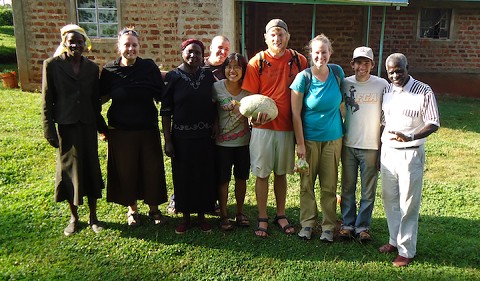
There may not have been a turkey this Thanksgiving day, as chicken is much more popular here. Though we did enjoy a beautiful 75-degree day, it rained all evening and night. Great friends and great hosts surrounded me, though there was no football or 5k race in the morning. Yesterday, though, none of that mattered, as my depths of what I could be thankful for were deeper than I had ever experienced them being.
Thanksgiving, in the Christian sense, is less about fulfilling an obligation to thank, and more about positioning ourselves rightly beneath God, as thanksgiving is the open admittance of our unworthiness to receive blessings and God’s goodness in bestowing them anyway. That idea—our unworthiness swallowed up by God’s goodness— captures the very essence of the Calvary’s cross and is the very nature of the thanksgiving that will, in the end times, melodiously flow from the mouths of the angels, elders, and four living creatures around the throne of the very One who gives thanksgiving its meaning (Revelation 7:12).







