 With month four solidly underway, it is more than safe to say that we are into the heart of the World Race. There is no longer room to say, “this will be a year of (insert desired personal growth or missionary goal here)” as if projecting into a future that includes the whole of the World Race, because we are deep in the middle of this thing. All observations, realizations, and goals are now made “on the fly”, so to speak, because day-to-day mission work consumes the bulk of our time, thoughts, and emotional energy. Almost all of what’s left gets poured into building up the team to be a sanctified, well-oiled machine of God.
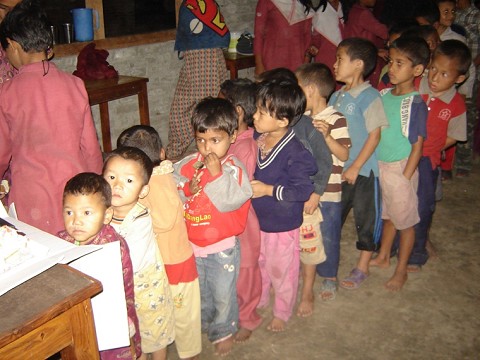
Our first four full days of work in Nepal are complete and they have been exhausting, but incredibly rewarding. We have done both construction and teaching, though teaching has taken up the majority of our time. A lot of the activities we’ve made for the students (I teach grades one through four) have been creativity-centered. Students, for example, have had to write and illustrate their own stories and will soon present them to the class. I now have a whole new respect for schoolteachers, to say the least! On about day two, it hit me that teachers have to plan entire lessons on a daily basis! Even more difficult than that is the fact that with first, second, third, and fourth graders, almost any lesson you want to teach has to be put through a “translation process” of sorts. My brain has a much different understanding of plot, character, and setting than a nine-year-old’s brain does.
In addition to teaching, it has been a blessing to spend time playing with the children. It is obvious that they need tangible love. By watching their reactions, we can tell that the smallest signs of love—holding hands, smiles made with eye-contact, or even simple words of affirmation—go a long, long, way. In all of this, the goal is to express the love of Christ.
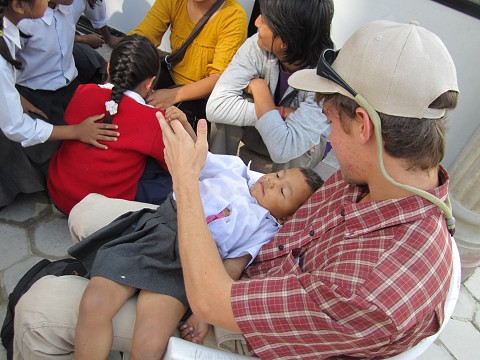
Sometimes this Christ-like love is expressed in terms of sacrifice. Though I can happily pour everything I have into teaching from 10:00AM to 3:30PM, there are a lot more self-gratifying things on the top of my flesh’s to-do list at 3:31 than slinging yet another kid over my shoulders. The love of Christ, however, is often expressed in this very deliberate re-ordering of priorities—a reordering that puts others’ joy before my own happiness. I firmly believe, however, that there is absolutely no room for stoicism in the Christian life (Luke 18:29-30) and the great irony in this reordering of priorities is that it actually ends up bringing me so much greater joy at the end of the day than anything else could.
As I look back on the World Race thus far, the greatest thing I’ve learned has been about the role of redefinition in the sanctification process. Though sanctification has definitely been a key word for me this year (it’s all over my blogs), my understanding of it now is incredibly different than before I left home. I used to view sanctification as an improvement process, but now I believe differently. I believe sanctification is much more about redefinition than it is about improvement. It is, of course, dangerous to let my experience define my theology, but I do believe that the full weight of scripture would support this idea as well.
When Jesus, for example, talks about yokes and burdens, it is understood that His yoke is always easy and His burden is always light (Matthew 11:30). For us to benefit from this beautiful realization as we are sanctified, requires us not to (even if gradually), improve which yoke we carry, but rather to redefine which yoke we carry. Though it may appear as if we are gradually taking the world’s yoke and all the worries that come with it off our shoulders and replacing it with the easy yoke of Christ, I would argue that at the core, we are experiencing redefinition. We are realizing Christ’s easy yoke has been on us all along—beginning at salvation and sealed by the cross—and we are just gradually beginning to act accordingly. If I were to express this idea in one single sentence, it would be this:
A truly “improved” Christian life comes not from extraordinary levels of effort, but from appropriate levels of effort applied to redefined situations.
This idea can be seen clearly in the financial realm. For example, though I still consider myself to be incredibly hard-hearted with my finances (and my standard of comparison in this area will always be Christ, not other people), I can see marked improvement in this area of my life since the World Race started. These improvements, however, were not borne out of above-and-beyond compassion. They were borne out of appropriate, run-of-the-mill compassion towards redefined people. To use a figurative example (this event never actually happened), consider the idea of “brothers and sisters in Christ.” It would not be ridiculous at all for me to spend $75 on my sister, Hannah, around the holiday season. After all, she’s my sister and that type of compassion is expected. It wouldn’t even be called compassion. If I were to spend $75—or 5,600 Nepalese rupees— on a Nepalese sister-in-Christ, however, it would be considered ridiculous, over-the-top compassion. When we recognize, though, that “sister-in-Christ” is a relationship that literally puts me at equal proximity to others as genetics does (for bonds in Christ are stronger than bonds in chromosomes), spending $75 on a Nepalese sister is no longer over-the-top compassion—it is run-of-the-mill, appropriate compassion towards a redefined person.

I just have to imagine that redefinition is what makes the seemingly radical commands we see in the Gospels doable. Actually, I know this is the case! I have experienced it in my own life. It is much easier to follow Jesus’ command to follow Him to the point of death when we have a redefined sense of the place of earthly life. This is exactly why Paul said “Oh death, where is your sting?” (1 Corinthians 15:55). It is much easier follow Jesus’ command to “sell all your possessions and follow me” (Luke 18:22) when we have a redefined sense of treasure. Didn’t the man who sold all he had to buy a new field with new treasure (Matthew 13:44) do so because he has a redefined sense of treasure? Jesus command to “let the dead bury their own dead” (Luke 9:60) is much easier to stomach when we have a redefined sense of eternal life and eternal reunion with loved ones. In fact, I would argue that redefinition is what reconciles Jesus’ radical commands with His promise that His burden is easy and His yoke is light.
In my last blog, I talked about being Christians in a secular environment here at Happy Home Nepal. I say this because the idea of redefinition also applies to the missionary battle. When we view the missionary enterprise as a primarily earthly one, then it is very difficult. We must scour our brains for gimmicky ways to reach people and we must create well-planned Gospel sales-pitches. Similarly, our words and our circumstances must both be perfect. We must make sure people are well-fed, because God only knows people cannot accept the Gospel on an empty stomach (though all evidence of the spread of Christianity in the East suggests otherwise)! Everything has to be fine-tuned and stressed-over if we believe that missionary work takes place primarily in the earthly realm.
When we essentially move the fight to a new battleground, however, and realize that the missionary’s battle is a spiritual one (this is redefinition), everything changes. This is exactly what has happened during this first week of ministry here in Kathmandu and I can already tell that God is about to blow our minds. Before our first day of ministry started, we decided as a team (though we never mentioned it outright) that we would try to win souls the way our forefathers in the faith won them—without gimmicks and through prayer, love, and the Gospel. We prayed intensely that God would glorify His name at Happy Home and that God would “hand Nepal over” to us. In one of my prayers, I actually asked God to (word for word), “supernaturally hand us this thing on a silver platter.” As far as I can see, that is exactly what has happened thus far.

During our cultural briefing, our main contact told us that he would like us to teach the children about the Bible because they have never learned about it before. We don’t even need to walk the balance beam I mentioned in my previous blog between honoring our organization’s requests and slipping in Gospel hints because our secular organization flat-out asked us to teach the Bible.
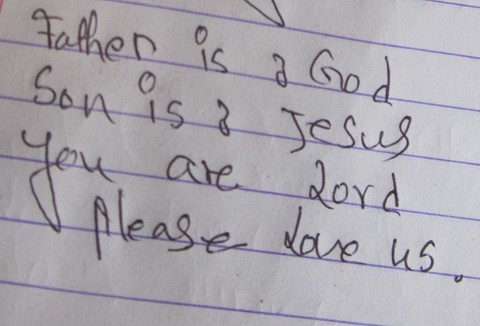
Yesterday morning was our first Bible class and it went incredibly well. It was awesome to teach scripture (they learned John 3:16), Bible stories (the parable of the prodigal son), and songs to children who had literally never even heard them once before! As we were teaching, the leader of Happy Home walked in and started speaking in Nepali to the children. This made me pretty nervous. After all, I thought we had definitely told him we would be doing this and I thought he even asked us to! Then, he turned to us and said, “I just told them, in Nepali, that they need to carefully write down everything you teach them,” before walking out of the room. They begged us to come back and asked us intelligent questions about prayer when our session was over. One boy, Obesik, even wrote us a poem when we were done:
Later in the day, we took the children to the park to play soccer, fly kites, or just relax. Two little girls, Laxmi and Mingmar, came up to me (unprovoked), and told me, outright, “We want you to tell us about Jesus.” I was caught off-guard, of course, because I wasn’t expecting this at all. All I could say was “When?” I was hoping that they would say “later”, because not only had I not planned anything, but I was nervous because many adults were around and I didn’t know how they would take it. They wanted me to tell them right then and there, however, and they took me by the hand and sat me down. Noticing what was happening, about eight more little children, both girls and boys, sat down around me as well.
I asked if they wanted to hear about Jesus’ life or Jesus’ death in an attempt to shorten the conversation and lessen the awkwardness created by the adults who were in the area and who were also clearly listening. They, of course, answered “both.” So, I had the pleasure (and I really do mean pleasure) of telling them, for their first time, all about Jesus’ birth, life, miracles, death, resurrection, and the Gospel. They were clearly intrigued and this was shown by their questions. Again, this was only day one.
Before we left for the day, many hours later, we nervously asked our contact if we could teach the Bible again in the morning. His response was: “I want you to teach it daily.” We prayed, God answered. Praise God for silver platters.