
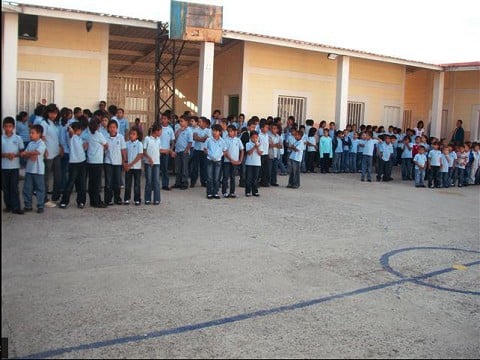
 It may be ironic to write this on this particular website, but the phrase “mission trip” hadn’t always struck a pleasing chord with me, even long after I became a Christian. There was definitely something about the idea of a mission trip that, to me, seemed almost childish. Mental images of bleeding-heart idealists came to mind, or middle-school youth groups, all clad in matching bright colored t-shirts.
Though I certainly recognized the vital importance of The Great Commission (“Make disciples of all nations”; Matthew 28:19-20), I somehow classified The Great Commission as something entirely different than what people on mission trips did. I pictured those who carried out The Great Commission as sharp businessmen who met in foreign boardrooms, discussing (with fancy vocabulary) the best ways to redirect funds to the third world. This picture is, of course, completely unbiblical, yet it was still the first thing that came to mind.
I pictured those who went on mission trips, however, entirely differently. Those who went on mission trips had admirably soft hearts, but were merely doing the “auxiliary” work of God. They picked up the scraps of the fallen world we live in via children’s games and holding babies. Somebody needed to do that kind of work, but certainly not me. I wanted to be on “the front lines”.
After hearing this diagnosis, you’re likely wondering why I decided to go on The World Race in the first place. To put it most clearly, I originally decided to go on The World Race to redefine how I viewed material wealth, pursue God, and share the Gospel. The World Race blogs I read dealt with a whole bunch of “mission-trip-esque” work (children’s’ games and holding babies), but I figured I could put up with less than a year of it to accomplish my other goals.
This past week’s mission trip to the Good Shepherd’s Children’s Home in Honduras, however, completely rocked my false notions of what doing God’s work looked like to the ground. The second we flew into Tegucigalpa, the capital of Honduras, I knew I was not in America anymore. It was hot and the people of Tegucigalpa observed almost no traffic laws. We honked, swerved into opposing traffic, and just barely avoided cyclers and aggressive street vendors as they weaved between our bus and other manic vehicles.
Mike and Marty Edwards, two BMDMI (Baptist Medical and Dental Mission International) missionaries took us to a Pizza Hut in Tegucigalpa for lunch, and after hearing their story I knew God was going to open my eyes that week. I was in the big leagues then. Mike Edwards was a heating and air conditioning contractor in Jacksonville until two years ago. After visiting Honduras on a short mission trip, he knew he was supposed to be in Honduras full-time, so he sold his house and picked up and moved to Honduras with his wife and teenage daughter. Mike and his family personified radical obedience to God.
After driving through the Honduran countryside, we arrived at the Good Shepherd’s Children’s Home, a sixty acre home, school, church, and farm for Honduran children who have been taken from their parents by the government. Most of the children suffered from extreme cases of physical, emotional, and sexual abuse. Many were abandoned and some were even trafficked.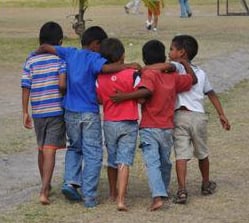
The second we pulled up to the home, we were engulfed in a swarm of children who ran alongside the bus. They hugged us and held our hands and even tried to carry our heavy bags inside for us. It was only a matter of seconds before one little boy, Hector, had taken my left hand and another, Jorge, had taken my right. The children definitely demonstrated the longing for human touch that is in every one of us.
Throughout the first few days of the week, we led and participated in worship (in Spanish), worked with translators to lead Bible studies and counseling, and enjoyed hours of pure play-time with the children. It was during these days that I realized how wrong I’d been about Children’s homes. They weren’t doing the “auxiliary” work of God; rather, they were on the front lines of duty in that they rescued children and raised them to learn the Gospel. Children’s homes don’t merely pick up the scraps of a fallen world; they enact a successful and efficient evangelistic strategy. Christ said, “Make disciples of all nations” (Matthew 28:19), not merely “evangelize all nations.” Granted, every discipleship process does start with a single moment of evangelism, but discipleship requires a constant, continuous process of teaching and accountability, and Children’s homes offer this.
The children put us all to shame with their selfless lifestyle and pure joy, despite their circumstances. They had no TV’s, video games, or fancy toys, yet they were always entertained. They would kick a soccer ball for hours and when it popped, they had just as much fun kicking the deflated piece of plastic. They never grew tired of piggyback rides, and would yell, “Benjamín, Benjamín” and point to their shoulders to let me know they wanted to climb on mine. Other children would hold my both of my hands to ensure their places in line for the next shoulder ride.
Worshipping in Spanish were some of the most gratifying moments of each day. Because I didn’t know Spanish, I was freed, in a way, from my tendency to intellectualize and analyze the lyrics I heard. I was able to meditate on God himself, rather than meditate on man’s attempts, however poetic, to describe God through words. 2 Corinthians 9:15 says, “thanks be to God for His indescribable gift.”
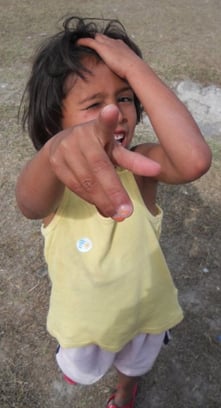 It wasn’t until the second to last day, however, that I met Lluvia, and eight year old girl with an incredible smile, playful nature, and an unending supply of unconditional love. (As a side note, if you’re my Facebook friend, read my Facebook note called “Lluvia” for a poem about her and information on sponsorship). One thing Mike Edwards and his wife Marty had told us from day one was that people “couldn’t smell, touch, hear, or taste” photos. I won’t attempt to describe Lluvia in great detail, because any attempt to do so would do injustice to her (or God’s) character.
One incident that impressed me occurred that afternoon. Lluvia had been begging for a cup of water (“agua”) for twenty minutes and I had been reluctant to give it to her. Any time I gave on child anything, the others would notice and swarm around me. Finally, I gave in and got her a glass of water. The first thing she did, however, when the children who noticed swarmed around her, was give water to every child who asked, including the older boy who had been bullying her for the past hour. She emptied almost the whole cup before she took a sip. It really is amazing how children often understand God’s view on material possessions so much better than adults. Matthew 10:42 says, “whoever gives just a cup of cold water to one of these little ones because he is a disciple, I assure you: he will never lose his reward.” It certainly always seems that whenever I search for a verse to describe an experience I’ve had, God provides me with one more literal than I had expected.
After an afternoon of pure play and after dinner, the children had organized, unbeknownst to us, an “appreciation night” for our efforts, complete with singing, skits, and a slide show. As we waited for the night to start, Lluvia fell asleep in my arms. I can honestly say that I now understand what “the peace of God” feels like. Before that night, the “peace of God” was nothing more than an overused catch phrase in Christian lyrics, and likely a few Psalms.
I had expected my first encounter with “the peace of God” to be an almost out-of-body experience. I had expected to feel some abnormal sensation and to perhaps even receive a vision. I couldn’t help but to chuckle to myself when I realized “the peace of God” had tangled hair and wore crocs. I thought, however, how incredibly similar my experience was to that of the Israelites. They were expecting the Glory of God to be a dominant warrior king on a mighty horse, but instead the Glory of God was homely and rode on a donkey.
Throughout the week, we heard a number of awesome Spanish songs, almost all of which I downloaded on iTunes when I got home. I would piece together the lyrics, with some help from my friends, to find almost every song. The five or six songs I heard with Lluvia, however, I had absolutely no recollection of. I definitely don’t think that was a coincidence.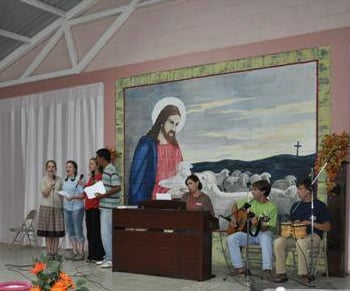
It was incredibly tough to leave, but the week was a complete success in that it both opened my eyes to those who were doing God’s work around the globe and it rid me of my false notions of the effectiveness of mission trips and Children’s homes. Caring after God’s children is not the auxiliary work of God; it is an essential and effective part of the Great Commission. We cannot be called lovers of God if we do not serve his friends, namely the children around the globe. James 1:27 says, “Religion that God our Father accepts as pure and faultless is this: to look after widows and orphans in their distress, and to keep oneself from being polluted by the world.” Or, much less Biblically-sound, “If you wanna be my lover, you’ve gotta get with my friends.”
Though I would love to write, right now, about Kevin McKenzie, the director of Good Shepherd’s Children’s Home, to do so at the end of an already-long blog would be a severe injustice to his story. Expect a blog soon about Kevin, obedience to God, and the subtle defense mechanisms we erect to excuse ourselves from serving God and the poor around us.
In closing, Bueno es Dios! God is Good!
And, a Poem I wrote about Lluvia…
A haven in Honduras, montanás verdés crown a majestic manger
so authentically Central American that even the cows cry “Bueno es Dios”.
Through cielos azulés you poured down Agape,
How appropriate, Lluvia: your name means Rain.
You’re a brown-skinned vessel of Jesucristo, a wellspring of peace,
you climb my shoulders unaware of your divine appointment.
The language barrier blocks nothing important: you giggle Spanish affection between the spaces in your teeth, “Mono Loco Benjamin”. Pure joy.
My first preview of God’s true affection from an eight-year-old Honduran prophet,
Lluvia dulcé, child of God, Santo Santo Santo.
You fell asleep with your jet-black head on my sinner’s shoulder,
Salsa music drown out by your rhythmic breathing,
An electric ebb and flow of Grace inside that vacuum,
A mighty fortress is our God; a sacred refuge is His name.
Lluvia dulcé, child of God, Santo Santo Santo.







