November 28, 2012:
This morning my team and I were able to sit down with a man named Phoul. Phoul is the father of our contact, Vuthy. I have seen him every day since being in Cambodia but only have said simple things to him because he does not speak any English. On the last day of ministry, we sat down with Phoul to listen to his story while Vutahy translated (Sorry that it is choppy writing, I literally was just writing down what he was saying while saying it):
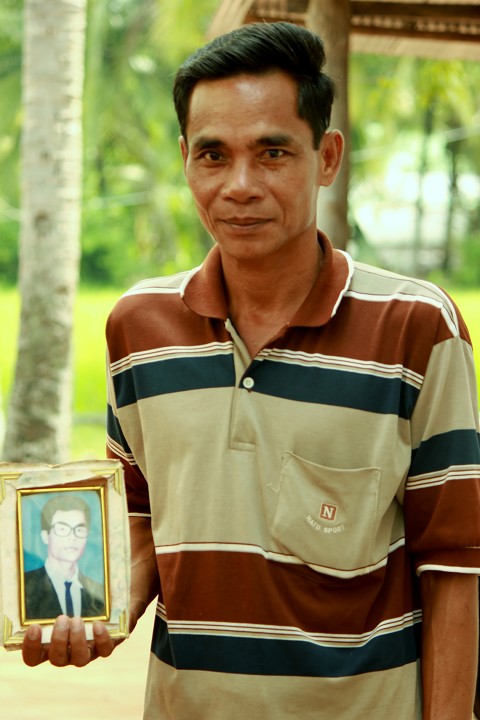
In 1975 through 1979, 3 out of 5 people were killed ruthlessly in Cambodia during the genocide by the Khmer Rouge.This is Phoul's story of what happened: (Photograph: Pei)
 In 1975, Phoul was 14 years old and lived in the Kampot Province. During that time, his older brother, Pei, was living in Phnom Penh. The Khmer Rouge wanted power and authority so they decided to kill anyone who was “knowledgeable” because those who were educated were much harder to lead than those who were not and the Army did not want to deal with anyone rebelling against them. Pei, who worked as a teacher and was also known in his home province for being extremely well educated, was killed when the Khmer Rouge entered into the city of Phnom Penh. His hands were tied around his back and he was stabbed to death while a loud speaker was playing because the Army did not want to hear the screams. Any time a loud speaker would play, the people of Cambodia knew the Army was torturing and killing people which became a mental torturing tactic the Army used towards those they kept alive. Pei not only left behind his family but also a fiancée.
Back in the more rural areas, Phoul and his family were separated and divided into groups. These groups would consist of 100 to 200 people and also separated specifically on age ranges and sex. For 3 years, 8 months and 20 days, Phoul lived with 100 to 200 boys his age. The Army would make them work on the land and would mostly feed them a spoonful of water and salt for every meal. He was almost killed due to starvation but he said “if we did not work, we were killed and if we worked, the work would be so hard but we would have so little food that they were killing us by starving us”. Phoul and the rest of the boys would move around after they finished their work in one area.
He saw many people die during that time including many “teenagers”. The Army would take the teenagers, make them stand in a line and dig a big hole. After the hole was finished, they would slaughter them and push them in the hole that they just dug; they would make the young people dig their own graves. He doesn’t know exactly why the Army killed so many young people and still isn't sure to this day.
In `1979 the Vietnam sent an Army to stop the Khmer Rouge. He said, up until that year, he had no hope: no hope for his life, no hope for a future. When the Vietnamese army came in 1979, that is when he finally felt some hope.
Fast forward to 1993, Phoul met some foreigners. They came from an organization that spread the gospel. In 1995, he decided to become a Christian and through his salvation, he is now helping in a ministry that cares and takes care of a whole village. He gave up his land for a ministry that gives children hope, purpose, and a home if they need it.
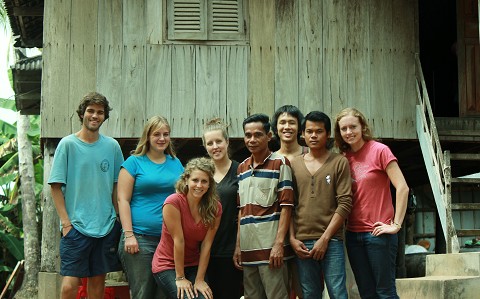
(The Team with Phoul)
“I became Christian because I saw how Christians are so faithful and take care of others”.