
It’s time to be real with you. I’m gonna go ahead and be Frank. Well, I’m actually gonna be Arden, but I’ll be frank as well, however that works. So, let me back up several months:
Before I was accepted to go on the World Race, I was pursuing a relationship that I knew God had asked me not to pursue. He made it pretty clear to me one night during a worship service that the relationship wasn’t what He wanted for me. But I didn’t know how to give it up. So in my stubbornness, fear, and uncertainty, I continued seeking out the relationship.
Only a few days later, a metaphorical storm came: I was accepted onto the Race. Committing to the race would mean that I wouldn’t have much choice in giving up the relationship. It simply didn’t make sense to choose into something that was only a few weeks old when I was about to leave the country for 11 months. So, in the hours and days to follow my being accepted, I went through a time of processing that twisted my heart in knots. I was emotionally destroyed (for a time. See 1 Peter 5:5-11, Romans 5:3-5, and this blog).
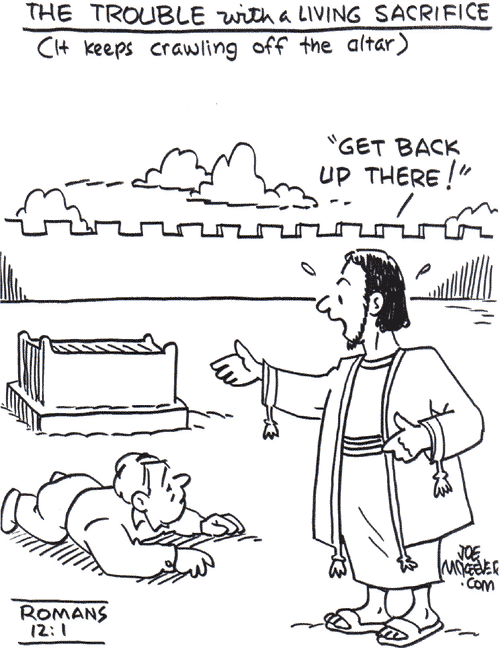
Now certainly the entirety of my emotional distress wasn’t solely due to giving up the relationship. But from those moments, it was clearer to me than before that I was investing too much of my energy and identity into finding a wife; the esteemed “bone of my bones and flesh of my flesh” (Gen 2:23). I didn’t know what it would look like, and I was a little afraid (or a lot afraid) of what it might require, but I knew something needed to change in me. I knew I must find a place where relationship with the Lord and obedience to Him was what I most sought after, not a wife. I knew I needed to be willing to give up anything for Him. Fresh perspective was telling me anything less was idolatry. I fearfully hoped this “race” I signed up for would somehow help me find that. So in a “clambering onto the altar” moment of surrender, I committed myself to the 11 months of missionary work.

Since then, it has become clear to me that this felt need wasn’t one that would simply work itself out through the process of the race. I still find myself, to a degree, idealizing romantic relationships (something that is a taboo for racers) and continue to need God’s (and the leadership’s) patience, guidance, and grace.
The challenging reality is it’s easy for us to behave this way. We hear God ask us to obey Him, but we don’t always comply. We stay where it’s comfortable, easy, and where our hearts leads us. Why does this happen? How do we become overcome by what’s easy? Lately, it looks as though this is a problem with our foundation.
In Luke 6, Jesus says:
46“Why do you call me, ‘Lord, Lord,’ and do not do what I say? 47I will show you what he is like who comes to me and hears my words and puts them into practice. 48He is like a man building a house, who dug down deep and laid the foundation on rock. When a flood came, the torrent struck that house but could not shake it, because it was well built.
49But the one who hears my words and does not put them to practice is like a man who built a house on the ground without a foundation. The moment the torrent struck that house, it collapsed and its destruction was complete.”
Jesus makes it clear – when we call him Lord, we must obey Him if we want to survive the storm. We must be his disciples, not false servants. We must “dig deep” in an effort to follow his teachings. If we ignore his voice, if we push away what He calls us to, and flee from his “good, prefect, pleasing will” (Romans 12:2), then we will collapse when trial comes.
You see, God doesn’t just ask us to do things because He is God, and “what he says, goes.” He’s interested in our best interests as well, and plans to make us complete in our character (see Matthew 7:11, Romans 8:28, James 1:2-4, Philippians 1:6, the account of Jonah, et al).
Yet there’s still more in what Jesus is saying in Luke 6. As I’m sure you noticed, Jesus likens himself to “rock”. This isn’t the only time this happens in the Bible. Jesus is also referred to as “the cornerstone” and a “living stone” throughout scripture (e.g. Acts 4:11, Matthew 21:42, 1 Peter 2:4). In Ephesians 2:19-20, Paul writes:
So then you are no longer foreigners and noncitizens, but you are fellow citizens with the saints and members of God’s household, because you have been built on the foundation of the apostles and prophets, with Christ Jesus himself as the cornerstone.
As far as I’m aware, cornerstones aren’t used much anymore. But in the days of the Bible, the cornerstone was the first and most significant stone that was laid when building a foundation. Every other stone’s location, direction, and significance was based off of the cornerstone. If the cornerstone wasn’t right, the whole building would be off. Similarly, Christ is the basis for every one of us. Our lives, like living stones, simply can’t be based off of anything else, or we’ll be part of a different building: A building that isn’t chosen and precious, a building where the spirit of God doesn’t dwell, a building that is destroyed when the torrent strikes.
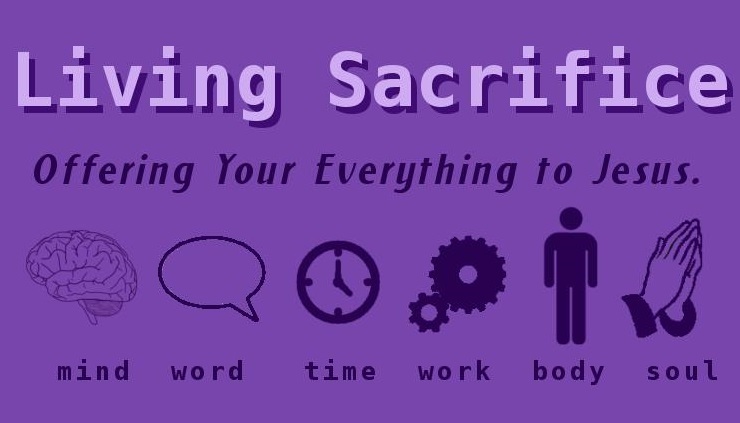
But, if we do build on the living Stone, not only by living in obedience to Christ, but by basing the entire foundation of our lives (our job, our marriage, our joy, our comfort, our schedule, our money, our conversation, our family and friends) around Him, we will never be put to shame. We will endure the storm without being shaken. We will be a chosen people, a royal priesthood, a holy nation, a people belonging to God. (1 Peter 2:4-9 et al)
So let me ask you:
Is God asking you to obey Him? Are you complying?
Are you finding your satisfaction in Him? Is He your foundation?
I invite you to join me today in the lifelong goal of laying your foundation on Christ, the foundation that doesn’t shake, the foundation that won’t be destroyed, and the foundation that is the Lord himself. It may take some “altar scrambling,” but it’s always worth it.







