
The Ukrainians in Crimea speak Russian. Russian is the most difficult language I’ve encountered on the Race thus far. I cannot, no matter how often I try, make the sounds used to pronounce their words. All the sounds are in the throat, and for some reason, my mouth refuses to make these sounds.
When I first arrived in Ukraine and realized I couldn’t pronounce their words, I wondered how in the world I was going to communicate with the people God had placed in my life for this month.
My team has been more than blessed this month with our location – a resort that overlooks the Black Sea. One of our first days here, a woman from one of the families here for vacation approached us and began making the hand-motions for singing and playing guitar. She wanted us to sing with her and her son on the balcony after we finished our dinner.
Once we joined them on the balcony, my teammate Silas began playing some simple English worship songs, such as “Awesome God” and “Blessed Be Your Name.” The woman and her son instantly joined us in singing. Even though we couldn’t speak to one another, we sang the same worship songs to the same God, but in two different languages.
Several days later, I was playing the piano (first time since Malaysia!) by myself when one of the couples staying at the resort walked into the room and said, “Music!” This was one of the ten English words they knew. They motioned for me to start singing and playing a worship song, so I began playing “I Could Sing Of Your Love Forever.” They both began singing in harmony with me in Russian. After we sang a couple songs, they attempted to ask me some questions, which was nearly impossible to figure out with mere hand gestures. So, we went back to singin’ to the Lord! It was awesome to raise our hands together in praise to our God, while singing in different languages. 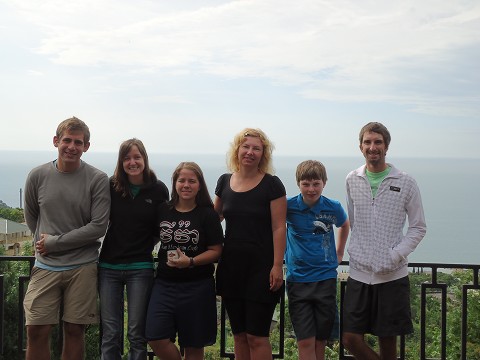
A few days ago my team started working at a children’s camp. In the hour that we teach English to them everyday, I’ve discovered that teaching them through songs is one of the most effective approaches. In efforts to teach them the body parts, we sing, “Head, Shoulders, Knees, and Toes,” and to teach them the time and months we make up songs and chants. I love hearing the kids sing these songs to themselves the following days as they play various games and activities.
For the past two Sunday morning church services, my team has sang a song for the church, while I played piano or guitar. After each service, the sweet little old lady who is the church pianist always comes up to me and shakes my hand, gives me a hug, and gives me the biggest smile ever. Then she always spouts off something in Russian. The second Sunday I asked our translator what she was saying and he said, “You are a musician and I am a musician!” Simple, yet somehow something that small instantly bonded us.
So even though I can’t speak Russian and most likely will never speak Russian, music has become my Russian language. When the only way I can really communicate with people is through worshipping God together, we instantly gain a much deeper connection than if we would have sat and talked for several hours.
My Russian language has reminded me that giving praise and glory to God is the most crucial part of this life and the next. And worshipping God with others in multiple languages will always be a beautiful thing.







